
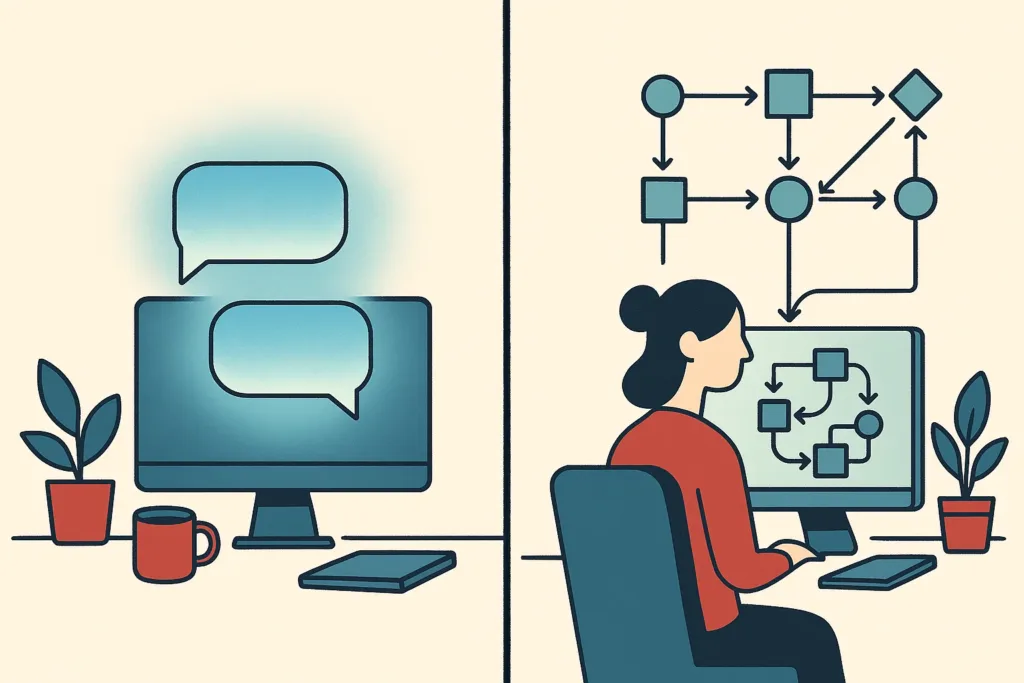
A support team drowning in "where's my order?" tickets doesn't have the same problem as a sales team losing deals because nobody followed up within an hour. Yet both get sold the same thing: "AI." That's where the ai agent vs chatbot decision actually matters. Buy the wrong one and you either overpay for autonomy you don't need, or underbuild for a problem that needs real action across your systems. This article breaks down what each one actually does, where each wins, and how to match the tool to the bottleneck instead of the hype.
Quick-answer definition: AI agent vs chatbot at a glance
- Acts autonomously to achieve goals
- Breaks tasks into multi-step processes
- Uses connected tools without human prompts
- Projects significant operational time savings
- Answers questions one turn at a time
- Follows fixed paths or scripts
- Limited flexibility in responses
- Relies on user prompts for interaction
Here's the short version. A chatbot answers. An AI agent acts. A chatbot takes a message, finds a response, and sends it back, one turn at a time. An AI agent takes a goal, breaks it into multi-step tasks, and uses connected tools to complete it, often without a human prompting each step. The difference between an ai agent and a chatbot isn't the model underneath, since both can run on large language models. What separates them is autonomy and reach. This shift toward autonomous execution isn't hypothetical, either: Gartner's forecast on agentic AI adoption projects agentic systems will reclaim a meaningful share of operational time currently spent on manual, repetitive work. For a deeper look at how modern agents plan and use tools, IBM's explainer on AI agents is a solid starting point. Everything else in this comparison builds on that single split.
What a chatbot actually is (scripted vs LLM-based)
- Follows fixed paths for responses
- Predictable but inflexible
- Breaks with unexpected phrasing
- Cost-effective for simple tasks
- Generates natural replies based on intent
- More flexible than scripted chatbots
- Can use retrieval-augmented generation
- Still limited to conversational tasks only
A chatbot handles conversation. There are two broad types. A scripted chatbot, sometimes called a rule-based chatbot, follows fixed paths: if a user says X, reply with Y. It's predictable and cheap, but it breaks the moment someone phrases a question it wasn't programmed for.
An ai chatbot built on large language models is more flexible. It understands intent and generates natural replies instead of matching keywords. Many pair the model with retrieval-augmented generation so answers draw from your real documents, not guesses. For a neutral definition, Google Cloud's overview of chatbots is useful. Here's the key, though: even an advanced ai chatbot is still a chatbot if the model only sharpens the answer, not the action. If you want to see this tier done well rather than in the abstract, ChikooChat for lead qualification and booking is a working example of a chatbot product built specifically to handle that first layer of conversation and intake.
What an AI agent actually is (tool use, autonomy, multi-step tasks)
An AI agent is a system that pursues a goal, not just a reply. Give it an objective, and it plans, decides which connected tools to call, and executes multi-step tasks until the job is done. This is what people mean by agentic AI: the system calls tools to query a database, update a CRM, send an email, or check a calendar, then adapts based on what each step returns.
What actually happens is a loop: observe, decide, act, repeat, rather than a single request and response. That loop is what lets an ai agent for customer support resolve a ticket end to end instead of just suggesting an answer, closing out customer service issues without a human relaying each step. The trade-off is that autonomous tasks carry execution risk, which we'll come back to. If you want the mechanics spelled out in more depth, how a custom AI agent actually works covers the planning and tool-use layer beyond what this comparison can.
Head-to-head comparison table: capabilities, autonomy, integration, cost
The table below sums up the chatbot vs ai agent comparison across the factors that actually change your build decision. It also doubles as a quick reference for the difference between an ai agent and a chatbot when you're scoping a project. Read it as a spectrum, not a rivalry: many businesses run both, a chatbot for front-door questions and an agent for the heavier workflow automation behind them.
| Factor | Chatbot | AI Agent |
|---|---|---|
| Primary job | Answer questions, hold conversation | Complete goals via multi-step tasks |
| Autonomy | Reactive, one turn at a time | Plans and acts across steps |
| Integration | Minimal; often a knowledge base | Deep; APIs, CRMs, internal software |
| Best for | FAQs, order status, lead intake | Lead qualification, ticket resolution |
| Build cost & effort | Lower, faster to deploy | Higher, more to maintain |
These key differences drive everything from cost to risk, which the next sections unpack.
Key differences: how they work, what they can do, learning, integration
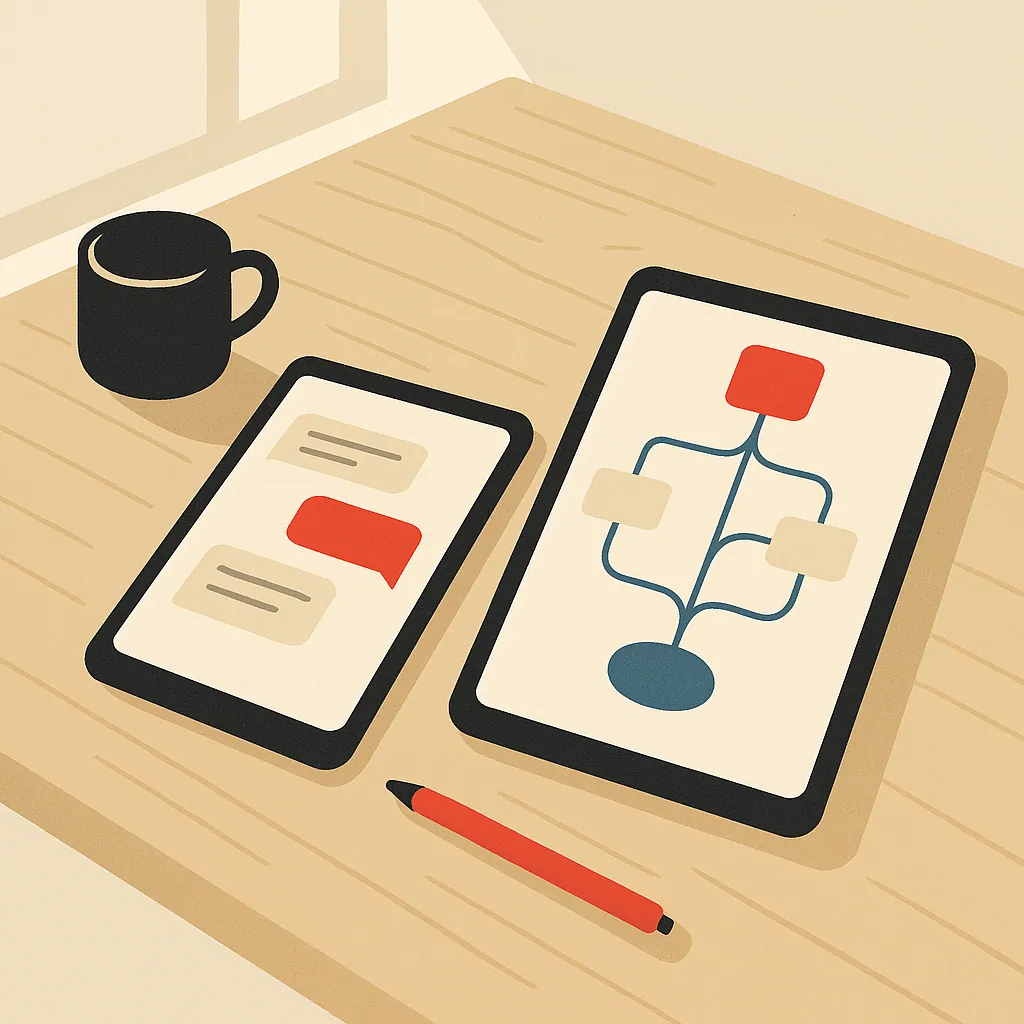
Four practical key differences separate the two. First, how they work: a chatbot responds, an agent reasons and executes. Second, what they can do: a chatbot informs, an agent changes the state of your systems. Third, learning: neither "learns" on its own in production unless designed to. Both improve through better data, prompts, and feedback loops, not magic.
Fourth, integration: a chatbot often needs none beyond content, while an agent lives or dies by its connected tools. Many assume adding an LLM automatically turns a chatbot into an agent. In reality, you've only made a smarter talker until you give it tool access and the authority to act.
Why connected tools/integrations determine what an agent can resolve
An agent is only as capable as the systems it can touch. Here's why this matters: an agent with no integration is just a chatbot with extra steps. If it can't reach your CRM, it can't update a record. If it can't reach your scheduling tool, it can't book the slot.
To actually resolve a ticket, check inventory, or move a deal forward, the agent needs authenticated access to those platforms through APIs. This is exactly why agents cost more and take longer. The work isn't the conversation, it's the connections between tools. Bespoke Mind Ai focuses on AI integration with existing business software, which is usually the hardest part of making an agent genuinely useful rather than demo-ready.
What sits between a scripted chatbot and a full AI agent (the spectrum)
Most real deployments live in the middle. On one end sits the scripted chatbot with fixed flows. A step up, an LLM-based ai chatbot that answers freely but takes no action. Further along, a chatbot with limited tool access: say, it can look up an order but not refund it.
Then a constrained agent that handles specific multi-step tasks with human approval on anything risky. At the far end, a more autonomous agent running business workflows with minimal oversight. These are ai assistants of increasing capability and cost, the kind now marketed broadly as ai assistants for both sales and support. Picking a point on this spectrum, rather than jumping to full autonomy, is usually the smarter call for a small business. A custom AI chatbot built for SMBs typically sits in that middle zone, scoped with just enough tool access to be useful without the overhead of a full agent build.
Use cases by business function and industry
These use cases map cleanly to that spectrum. In customer support, a chatbot deflects FAQs while an ai agent for customer support resolves issues that span systems. In sales, chatbots do first-touch lead intake, while agents handle lead qualification by scoring, enriching, and routing.
In operations, agents can help with workflow automation that removes manual work across tools. By industry: retail uses agents for order and inventory actions, real estate for scheduling and follow-up, finance for document-heavy business operations, each with its own use cases shaped by what the underlying systems allow. Consider a service firm where every inbound lead waits a day for manual qualification. An agent that qualifies and books leads promptly can help turn a leaking funnel into closed revenue. The function decides the tool, not the other way around.

When a chatbot is still the better choice
Don't over-engineer. The answer to when is a chatbot the better choice is simple: when the bottleneck is volume, not complexity. If customers mostly ask the same handful of questions, hours, pricing, shipping, order status, a chatbot can handle customer support at a fraction of the cost, with almost no integration to maintain.
A chatbot also wins when you need fast deployment, predictable behavior, or a simple virtual assistant on your site tomorrow rather than next quarter. The question when is a chatbot the better choice usually gets answered by looking at your tickets: if most of them are informational customer service issues, a chatbot can clear them without the risk or expense of an agent acting on your systems.
Who each option is best for (selection criteria by business type)
Match the option to the business. A chatbot is best for a small business with high repetitive question volume, a limited budget, or a team that needs a quick win before investing further.
An ai agent fits businesses where manual work spanning several systems is the actual drag: operations-heavy teams, lead-driven service firms, multi-location companies juggling several platforms. Founder-led businesses where one person holds too much process knowledge often benefit most from an agent, because it can help carry out business workflows that currently depend on that person, easing the operational bottlenecks that build up around a single point of failure. The honest selection criterion: pick the chatbot if your pain is answering, pick the agent if your pain is doing.
How to tell if a vendor is selling an agent or a chatbot
Ask one question: "What can it do without a human in the loop?" If the answer is "it replies based on your documents," that's a chatbot, regardless of how much agentic AI language is in the pitch. If it genuinely performs autonomous tasks, ask which connected tools it integrates with and request a live demo of it completing a multi-step task, not just conversing.
Watch for vendors who rebrand an ai chatbot as an "agent" because the term sells. The tell is integration depth: real agents name specific systems, authentication, and error handling. Chatbots dressed as agents stay vague about what happens after the conversation ends.
Diagnosing the bottleneck first: matching the tool to the manual-work problem
Start with the problem, not the product. Before choosing between ai agent vs chatbot, map where time actually leaks. Is your team re-answering the same questions, or re-doing the same multi-step process across tools?
The first is a content problem a chatbot solves. The second is a workflow problem that needs an agent built for automation, not just conversation. The root cause of wasted spend is buying capability that doesn't match the bottleneck. A readiness audit, the kind Bespoke Mind Ai runs before scoping any build, helps surface whether your operational bottlenecks come from answering or from doing, so you commit budget to the right layer instead of guessing. Evaluating that capability gap against actual risk tolerance is also where a framework like NIST's AI Risk Management Framework is useful, since it gives businesses a neutral standard for weighing what level of autonomy is appropriate before committing to a build.
Cost, build effort, and timeline: what each actually takes to deploy
A chatbot is the lighter lift. With a clean knowledge base and a few conversational flows, a scripted or LLM-based chatbot can go live quickly and cheaply, and maintenance mostly means keeping content current. An agent is a different project.
It needs API integration, authentication, error handling across every connected tool, and ongoing monitoring because it's taking real actions in your business operations. That means more upfront effort, a longer timeline, and continued oversight. Results vary based on existing processes, business complexity, and team adoption, but the pattern generally holds: chatbots are measured in days to weeks, custom agents in weeks to months depending on how many systems they touch.
Custom build vs off-the-shelf for agents and chatbots
- Tailored to specific business operations
- Integrates with internal tools effectively
- Handles complex manual workflows
- Requires careful planning and scoping
- Quick setup for basic chatbots
- Sufficient for simple FAQ deflection
- Struggles with specific integrations
- Less adaptable to unique business needs
Off-the-shelf software gets a basic chatbot running fast, and for pure FAQ deflection that's often enough. The limits show up with agents. Generic platforms struggle to connect to your specific CRM, your internal tools, or your odd legacy system, which is exactly where the value sits.
This is the case for custom ai systems: an agent built around how your business actually operates, not a template bent to fit, slotted into your business workflows instead of forcing you to adapt to someone else's. The practical rule: chatbots tolerate off-the-shelf, agents usually need custom work to handle real integration and manual work that templates can't absorb. Planning an ai agent that's safely scoped matters more than the model you pick, and that scoping work is rarely the hard part compared to the integration work itself.
If repetitive questions or manual, multi-step work is slowing your team down, one way to tell whether you need a chatbot, an agent, or neither is to look at where the time actually goes. Bespoke Mind Ai runs fixed-price readiness audits and builds custom AI systems scoped to how your business operates, so you can get a plain-English assessment of your bottleneck before committing to any build. If you're still weighing the ai agent vs chatbot question after reading this, it's often faster to just book a free automation discovery call and talk through your specific bottleneck than to keep guessing from general advice.
Frequently Asked Questions
Are AI agents and chatbots the same technology?
No, a chatbot replies to messages one turn at a time, while an AI agent plans multi-step tasks and acts on external systems without waiting for a new prompt each time. A chatbot built on an LLM is still a chatbot if it only improves the conversation, not the action it takes.
What is the actual difference between an AI model and an AI agent?
An AI model (like an LLM) is the underlying engine that generates text or predictions when given input. An AI agent wraps that model with memory, tool access, and decision logic so it can complete a goal, such as updating a CRM record or scheduling a follow-up, rather than just producing a response.
How do I know if my business needs an agent instead of a chatbot?
If your bottleneck is answering repetitive questions, hours, pricing, order status, a chatbot handles that at lower cost and with minimal integration work. If the bottleneck is a multi-step process, like qualifying a lead, checking inventory, and booking a slot across three systems, that's agent territory.
Is it actually worth upgrading from a chatbot to an AI agent?
Only if the chatbot is hitting a ceiling it can't script its way past, for example, needing to pull live data or complete an action instead of just answering. For a lot of SMBs, a well-scoped chatbot handles 80% of the volume at a fraction of the build cost, so upgrading before you've outgrown that is wasted spend.
What are the risks of letting an AI agent act autonomously in my business?
Because agents call APIs and modify records without a human approving each step, a bad plan or bad data can propagate errors faster than a chatbot ever could, a chatbot's worst case is a wrong answer, an agent's worst case is a wrong action. Most teams mitigate this by scoping the agent to specific tools and adding approval checkpoints on anything irreversible, like payments or customer communications.
Can a chatbot be upgraded into an agent later, or do I need to start over?
In most custom builds, the conversational layer (intent handling, FAQ logic) can stay and be extended with tool access and planning logic rather than rebuilt from scratch. The bigger lift is usually the system integrations, connecting the agent to your CRM, scheduling tool, or inventory system, not the conversation design itself.
What should I avoid telling a chatbot or AI agent in a business setting?
Avoid pasting customer PII, payment details, or proprietary business data into third-party chatbots that aren't covered by a data processing agreement, since that input can be logged or used for model training depending on the vendor's terms. Custom-built agents and chatbots should run on infrastructure where you control data retention, which is a standard requirement to spec before development starts.
Which costs more to build and maintain, a chatbot or an AI agent?
A chatbot is cheaper and faster to deploy because it needs minimal system integration, often just a knowledge base and a few conversational flows. An AI agent costs more upfront and to maintain because it requires API connections, error handling across tools, and ongoing monitoring since it's taking real actions, not just generating text.