
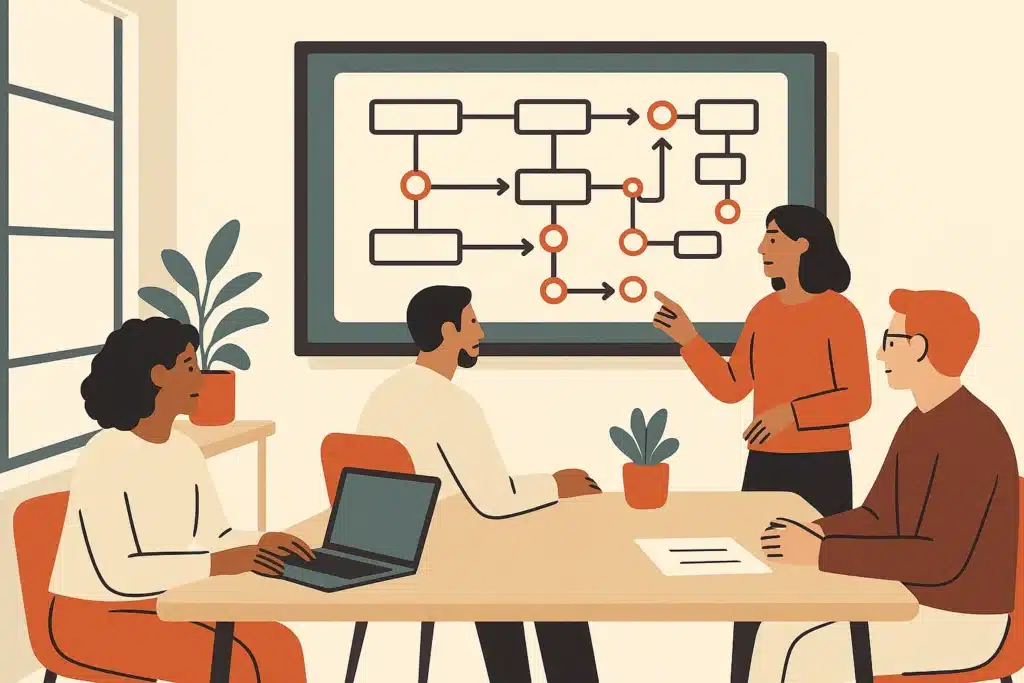
Picture a distribution company where three people spend roughly 15 hours a week copying order details between their invoicing tool and their inventory sheet. That's 45 hours a week of typing nobody chose to hire for. This is what ai in businesses looks like at ground level. It's not a sweeping reinvention. It's specific manual work that quietly eats payroll. This article walks through what the technology is, where it removes repetitive tasks, and how to tell which processes are worth automating first.
What AI in business actually means (plain-English definition)
Strip away the marketing and ai in business means using software that learns from data. It handles messy, unstructured inputs to take on work people used to do by hand. That covers reading an email and routing it, spotting an odd pattern in sales figures, or drafting a first version of a report. It is not one product you install. It is a set of capabilities you apply to specific business processes.
The distinction that matters: AI is about handling variation. A traditional rules-based tool breaks the moment input changes. An AI system adapts. The McKinsey Global Institute's research on AI adoption tracks how firms actually put this to use. For a grounded view of what enterprises should realistically expect, Gartner's AI insights hub is a useful counterweight to the hype. The pattern is consistent. Value shows up where AI attacks a named, repetitive process, not where it's bought as a vague initiative.
How AI works: core technologies (machine learning, NLP, generative AI, predictive analytics)
Four capabilities do most of the work in real deployments. Machine learning finds patterns in historical data and applies them to new cases, which is what powers demand forecasting or fraud flagging. Natural language processing lets systems read and respond to human text, so customer inquiries and support tickets can be sorted or answered. Generative AI produces new content: draft emails, summaries, product descriptions. Predictive analytics turns past data into forward-looking estimates for staffing, stock, or churn.
You rarely need all four. Most SMB use cases lean on one or two. A helpdesk problem is mostly natural language processing. An inventory problem is mostly machine learning and predictive analytics. The UK government's guidance on understanding artificial intelligence breaks these categories down in plain terms if you want a neutral reference. The point of data analytics here is direction, not certainty. It narrows guesswork, it does not remove human judgment.
Common misconceptions and the anti-hype reality of AI
Many assume AI means a system that thinks and runs the business on its own. In reality, it handles narrow tasks well and falls apart outside its training. It has no understanding of your goals, only patterns in the data you feed it.
The second myth: that generative ai is always right. It produces fluent output, which reads as confident even when it's wrong. That's a reason to keep verification on anything customer-facing or financial.
Third, the belief that ai adoption requires a massive budget and a dedicated data science team. Plenty of small business ai tools deliver time savings on a single workflow without either. Good small business ai tools can improve operational efficiency without new hires. What actually happens is that companies overspend on broad platforms when a targeted fix would have paid off faster. The honest framing: AI reduces manual work on defined tasks. It does not eliminate operational problems wholesale.

Why AI matters for business operations and strategy
The reason this matters comes down to where growth stalls. As a founder-led company scales, more knowledge and more manual steps pile onto the same few people. Business operations that ran fine at ten clients start dropping balls at fifty. AI matters because it targets that failure point: the repetitive work that grows with volume. Applying ai in businesses here helps keep those business operations from breaking.
Handled well, AI improves operational efficiency by taking predictable tasks off people. They spend time on judgment and relationships instead. The gains here echo broader trends in U.S. Bureau of Labor Statistics productivity data, where reducing time spent on manual work is a consistent driver of output per hour. That shapes strategy, because leaders finally get visibility into what's happening across operations instead of relying on memory. The business value isn't the technology. It's fewer hours lost to manual work and clearer decisions. Used deliberately, a leaner operation can respond faster than a rival buried in overhead.
Where AI removes manual work: automation and workflow optimization
Manual work clusters in predictable places: data moving between disconnected systems, inbox triage, report assembly, scheduling, and status-chasing. Workflow automation removes the copy-paste steps between tools that don't talk to each other. This is where automation and workflow optimization earns its keep. Most operational bottlenecks aren't a single hard task. They're dozens of small handoffs that add up.
The mechanism is straightforward. AI agents can read an incoming request, pull the relevant data, take an action, and log it, without a person babysitting each step. These ai agents cut friction and lift operational efficiency across the process. Bespoke Mind Ai builds this workflow automation around a client's existing process rather than forcing the team onto new software, and its business process automation solutions focus on the mechanics of automating those repetitive steps. That distinction matters. The goal is to improve operations you already have, not add a tool that creates fresh manual work. Done right, it can deliver measurable time savings on the exact steps slowing the team down.
Real-world use cases of AI across business functions
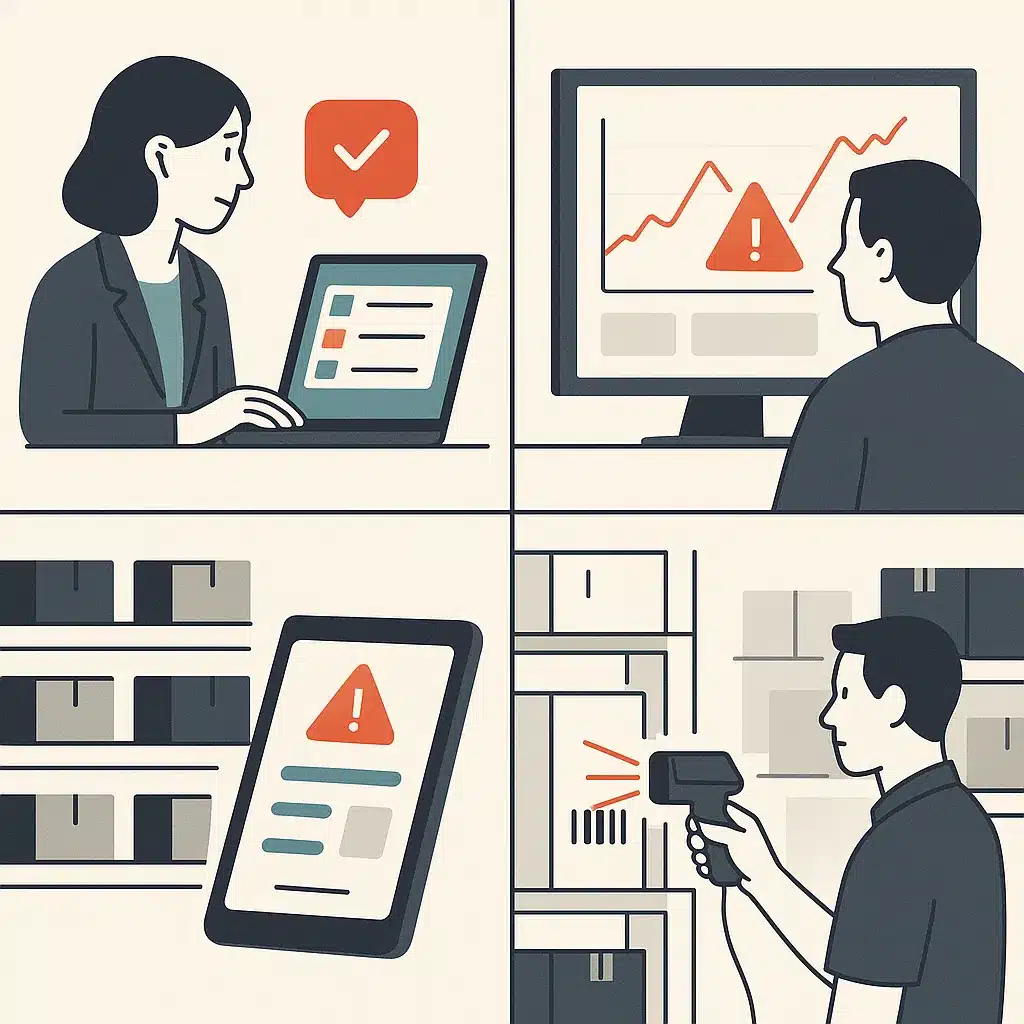
Concrete ai use cases beat abstract promises. In customer support, natural language processing sorts and drafts replies to routine tickets, so agents handle only the tricky ones. In finance, machine learning flags duplicate invoices and unusual expenses before they're paid. In sales, predictive analytics scores leads so reps call the ones most likely to close first.
Operations sees the biggest wins. Inventory systems predict reorder points. Scheduling tools fill gaps automatically. Computer vision handles quality checks on a production line or reads shipping labels for supply chain management. Marketing teams use generative ai to produce first drafts of copy, then edit.
Every one of these ai use cases shares a trait: it targets a repetitive, high-volume task with a clear right answer. That's the filter. AI systems earn their place on business processes where the work is frequent and the output is verifiable, not on one-off strategic calls.
AI for market research, forecasting, and decision-making
Forecasting is where data analytics pays back fastest, because most SMBs still plan by gut. Predictive analytics reads seasonality, past demand, and recent trends to estimate what next month looks like. That tightens staffing and stock decisions. It won't be perfect, but a directional forecast beats a blind guess every time.
For market research, AI can process large volumes of reviews, survey responses, and support transcripts. It surfaces what customers actually complain about and want. Natural language processing clusters thousands of open-ended comments into themes in minutes, work that used to take an analyst days.
The value for decision-making is speed and range. Leaders see patterns across more data than a person could hold in their head. What it doesn't do is decide for you. It narrows the options and shows the evidence. The call stays human, especially where the stakes are high.
AI for customer and employee relationship enhancement
On the customer side, faster and more consistent responses drive a better customer experience. AI handles the first reply instantly at any hour, routes complex issues to the right person, and gives staff a full history so nobody asks the customer to repeat themselves. The repetitive tasks disappear. The human conversation gets more attention.
Internally, the same logic applies to your team. When ai tools absorb the tedious lookups, approvals, and status updates, employees spend less of the day on administrative churn. Consider a founder-led agency where the ops lead spends the first hour of every day chasing project statuses across Slack, email, and a spreadsheet; that hour is lost before any real work starts, and it repeats daily. That's not a small thing for retention. People leave roles where most hours go to repetitive tasks a system should handle. This is exactly where AI assistants that take repetitive tasks off your team earn their place.
Here's what actually happens when relationship work improves. The human interactions that need empathy and judgment get the time they deserve, because the machine took the busywork. Bespoke Mind Ai sets up internal tools and AI assistants that put the right information in front of staff at the moment they need it.
Challenges and risks of adopting AI (privacy, workforce, accountability)
- Ensure compliance with data protection rules in your jurisdiction.
- Communicate openly about workforce changes to reduce fear.
- Accountability remains with humans for AI’s decisions.
- AI can be confidently wrong without context awareness.
- Always include human review for judgment-heavy tasks.
Privacy concerns come first. If you feed customer data into an AI system, you're responsible for where it goes and how it's stored. Data protection rules vary by jurisdiction, so check the requirements that apply to your business. Where personal data is involved, confirm your approach with a qualified professional or your relevant data protection authority.
Workforce disruption is the fear people say out loud least. Handled badly, ai adoption feels like a threat. Handled openly, it reads as removing the parts of the job people already hate. Say which tasks change and why.
Accountability is the risk that bites hardest. When ai systems make a wrong call, a person still owns the outcome. The reason is that an AI system reproduces patterns from its training data without knowing your context, so it can be confidently wrong in ways nobody catches until the damage is done. That's why judgment-heavy work needs a human review step. Treat AI as support for decision-making, not a replacement for the person accountable for it.
How to identify which manual tasks are worth automating first
Start by listing tasks, not tools. For each one, ask three questions: how often does it happen, how many hours does it consume, and does it have a clear right answer? The tasks that score high on all three are your first candidates. High-frequency, high-hour, verifiable work is where automation tends to return the most, the fastest.
Here's why this ordering matters. The roi on ai is only calculable once you can name the process, count the hours, and price those hours. If you're unsure where to begin, this walkthrough of how to calculate ROI on AI automation shows how to quantify time and cost savings before you commit. If you can't, you're not ready to buy. You're ready to measure.
An AI readiness audit does exactly this mapping. It's the practical entry point Bespoke Mind Ai uses before building anything, so spend follows real operational bottlenecks. Running an AI readiness audit of your operations is the logical first step to see what AI can remove before you buy anything. Skip the tasks that are rare, ambiguous, or need heavy judgment. Those stay human for now. Prove value on one bottleneck, then expand.
Off-the-shelf AI tools vs. systems built around how you operate
- Best for standard processes like email marketing.
- Examples include HubSpot and Salesforce Einstein.
- Avoid rebuilding existing solutions unnecessarily.
- Can lead to workarounds if workflows don’t match.
- Ideal for unique workflows and specific bottlenecks.
- Removes handoffs that generic software can’t address.
- Tightens operations end to end.
- Requires mapping of manual work to identify fixes.
Off-the-shelf software is the right call when your process is standard. If you need email marketing or basic CRM automation, HubSpot or Salesforce Einstein already solve it. You shouldn't rebuild what exists.
The trouble starts when the tool assumes a workflow you don't run. Then your team bends its process to fit the software, and the manual work you wanted gone reappears as workarounds. Many assume more subscriptions mean more efficiency. Often they mean more disconnected systems to reconcile.
Custom ai solutions make sense when your bottleneck sits in the gaps between tools, or in a process specific to how you operate. Custom AI solutions built around how you operate remove handoffs generic software can't see and tighten operations end to end. For teams ready to act, AI consulting focused on removing manual work turns that mapping into working systems. The honest rule: use off-the-shelf where you're standard, build custom where you're not. That balance keeps ai in businesses practical instead of an expensive tool sprawl.
If repetitive work is slowing your team down, the fastest way to know what's worth automating is to look at your actual workflows first. You can book a discovery call with Bespoke Mind Ai to map where manual work is costing you hours and see which fixes are worth building. It's a conversation about your operations, not a sales pitch for software.
Frequently Asked Questions
What does AI in businesses actually mean beyond the buzzwords?
It's the applied use of technologies like machine learning, natural language processing, and computer vision to automate tasks, surface patterns in data, and support decisions. In practice that means chatbots handling customer inquiries, systems flagging inventory gaps, or tools drafting reports:not abstract 'transformation.'
How is AI different from the traditional automation my business already uses?
Traditional automation follows fixed rules for predictable, structured tasks, like an assembly-line robot repeating the same weld. AI learns from data, handles unstructured inputs like open-ended customer messages, and adjusts over time instead of breaking when a task falls outside its script.
Which AI tools are most used by businesses right now?
Widely adopted platforms include HubSpot for marketing, sales, and service automation, Salesforce Einstein for CRM-based predictions, and Microsoft Copilot for document and workflow tasks. The right choice depends on where your manual work actually lives, not on which tool has the most features.
How does a small business start with AI without wasting money?
Start by identifying repetitive, time-consuming tasks:customer inquiries, data entry, inventory tracking:then set one measurable goal like faster response times. Prove value on a single bottleneck before expanding, so spend is tied to a specific outcome rather than a general 'AI initiative.'
Is AI actually worth it for a smaller company, or just for enterprises?
The value comes from removing manual hours on tasks you already pay staff to do, which scales down to SMB size. If you can name the process, the time it consumes, and the cost of that time, you can judge ROI before committing:if you can't, it's too early to buy.
What if AI gives wrong answers or makes bad decisions?
AI outputs are only as reliable as the data and the boundaries you give it, so it should support decisions in high-stakes areas rather than run them unsupervised. Keeping a human review step on judgment-heavy tasks:and using AI mainly on repetitive, verifiable work:limits the cost of any single error.
What is the '30% rule' people mention with AI?
It's an informal guideline suggesting AI can realistically automate or accelerate roughly 30% of tasks within many roles:typically the repetitive, rules-based portion:rather than entire jobs. The practical takeaway is to target that automatable slice of a workflow, not to replace whole positions.
Will AI replace the jobs in my operations team?
AI more often absorbs repetitive tasks like data entry and scheduling than full roles, freeing people for judgment, relationship, and strategy work it can't do well. The realistic outcome is fewer manual hours per person, not a headcount replaced by a chatbot.