
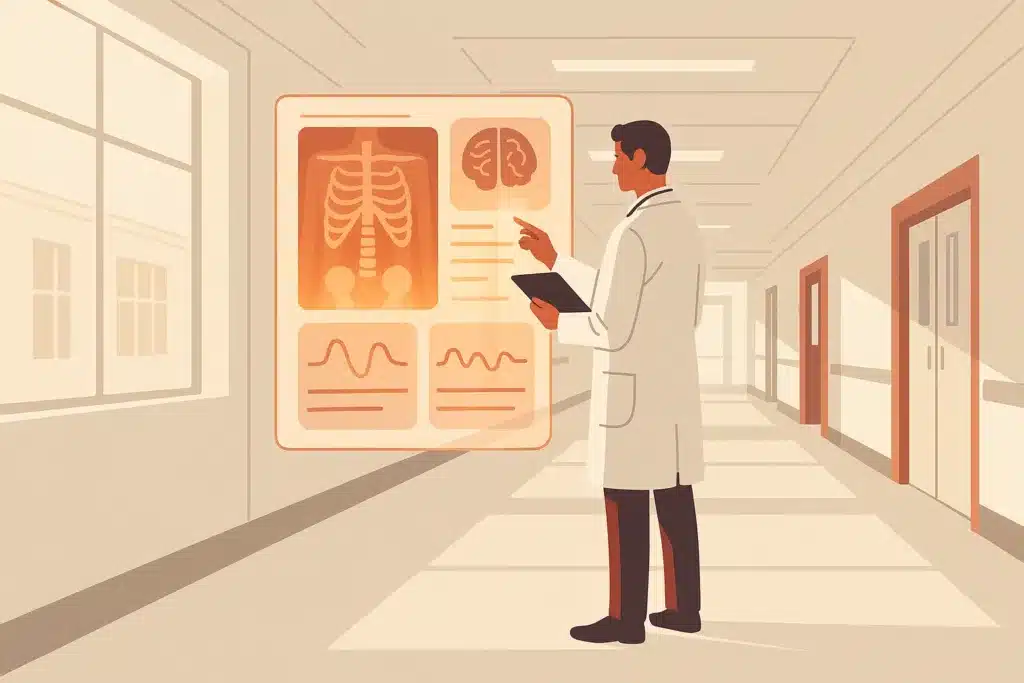
A primary care physician in a busy clinic spends nearly two hours on paperwork for every hour of patient contact. That ratio, documented across many time-motion studies, is the quiet reason burnout keeps climbing and appointment slots keep shrinking. The promise of ai for healthcare isn't a robot doctor replacing your physician. It's the far less glamorous work of clearing the documentation, coding, scheduling, and records reconciliation that eats clinical hours. This article walks through what artificial intelligence in healthcare actually does today. It covers where AI removes manual work, where it stays a support tool, and how to tell a useful deployment from an expensive one that sits unused.
What AI in healthcare actually means (plain-English definition)
Start with the term that gets thrown around loosely. What is artificial intelligence, in this context? It's software that learns patterns from data instead of following rules a programmer typed out by hand. Point that capability at clinical data, medical images, patient histories, and scheduling logs, and you get artificial intelligence in healthcare. These are systems that predict, classify, summarize, or flag things faster than a human working alone.
That definition matters because "AI" in a hospital brochure can mean four very different things. One system reads a chest X-ray and highlights a suspected fracture. A second predicts which admitted patients are trending toward sepsis. A third drafts a visit note from a recorded conversation. A fourth simply reshuffles the appointment calendar to cut no-shows. Each carries its own accuracy bar and its own compliance weight. Confusing them is how organizations end up disappointed. A practice that expected the scheduling tool to also flag clinical risk, or assumed the note-drafting tool came with the same regulatory clearance as an imaging model, has already set itself up for a mismatch between what was bought and what was needed.
Here is why the distinction matters: the imaging tool and the scheduling tool fail in completely different ways. A wrong scheduling suggestion wastes a slot. A wrong imaging read can miss a tumor. So the oversight, testing, and regulatory scrutiny scale with the stakes. That is exactly how the U.S. Food and Drug Administration treats these products. The FDA's list of AI-enabled medical devices now includes hundreds of cleared tools, most of them in radiology. Each went through review tied to its clinical risk.
Many assume ai for healthcare means autonomous disease diagnosis. In reality, the vast majority of approved and deployed systems are assistive. They narrow, prioritize, or draft, and a clinician signs off. That framing is not a marketing softener. It's how the technology is built, regulated, and paid for. Machine learning for healthcare works best when it handles the volume and pattern-matching, and human judgment handles the exceptions, the context, and the final call. Keep that split in mind and the field stops sounding like science fiction. It starts looking like ordinary operational improvement, much like how businesses use AI to remove manual work in other industries.
One more distinction worth drawing early: buying an AI product and deploying one that actually gets used are not the same thing. A tool can clear every technical benchmark and still fail because it doesn't fit the way a specific practice books appointments, routes referrals, or closes out a claim. The systems that stick are the ones scoped to a named bottleneck, not the ones chosen for their feature list. That gap between capability and fit is the single biggest reason healthcare AI budgets get wasted, and it runs through every section that follows.
Why manual work dominates healthcare operations and where it comes from
Healthcare didn't accumulate its paperwork by accident. Every safety rule, billing code, and consent form was added for a defensible reason, and almost none were ever removed. The result is a system where clinical documentation exists to satisfy at least four audiences at once: the clinician's memory, the next provider, the billing department, and a potential audit. One note serves four masters, so it gets long, structured, and slow to produce. A single office visit for something as ordinary as a diabetes check-up can generate a note that runs several screens, most of it written not for the person treating the patient but for the systems that pay for and review the care.
Then there's the fragmentation. A single patient encounter can touch a scheduling system, an electronic health records platform, a lab interface, an imaging archive, a pharmacy system, and a billing tool. Those tools frequently don't talk to each other cleanly. Staff become the human glue, retyping the same patient data across disconnected systems. That re-entry is pure manual work, and it's where errors and hours quietly pile up. The ONC guidance on healthcare interoperability exists precisely because siloed patient data creates this kind of rework across the industry.
The root cause is structural. The American Medical Association's research on physician burnout has repeatedly tied administrative burden and electronic health records friction to clinician exhaustion. When a physician spends the evening finishing notes at home, the profession has a name for it: work outside of work. It's not a personality flaw. It's a workflow that produces more documentation than any human can finish inside a shift. A doctor who saw twenty patients between nine and five can easily face another ninety minutes of charting after dinner, and that unpaid, unseen labor is exactly the kind of manual work that pushes experienced clinicians toward reduced hours or an earlier exit from the field.
Picture a mid-sized specialty clinic where three staff spend most of their day on prior authorizations, phone tag with insurers, and re-keying referral data. None of that touches patient care directly. Yet it can consume tens of thousands of dollars in monthly salary just to move information between systems that should have shared it automatically. That is the pattern repeated across the healthcare industry: skilled people doing repetitive tasks that a well-scoped system could handle.
Now trace what that fragmentation actually costs downstream. When referral data lives in one system and the scheduling calendar in another, a missed hand-off doesn't just create rework, it delays a patient's appointment and sometimes their diagnosis. The manual re-entry isn't only expensive; it's a failure point where information gets dropped, transposed, or entered late. A single mistyped date of birth or a policy number entered one digit off can bounce a claim back weeks later, or worse, route a specialist referral to the wrong department entirely. That is the mechanism connecting back-office friction to clinical consequences: every extra manual step is another chance for the record to fall out of sync.
This is the ground where automation earns its place. Not by replacing the clinician's judgment, but by attacking the administrative tasks that were never a good use of trained staff. Understanding where the manual work comes from is the first step to removing it. You can't automate a process you haven't actually mapped, which is why it helps to find out what your practice can automate before committing to any tool.
How AI works in a healthcare context (data, machine learning, models)
Under the hood, most ai applications in healthcare run on the same basic loop. Feed a model many labeled examples, let it learn the patterns, then apply those patterns to new cases. Show an imaging model a few hundred thousand chest X-rays labeled "pneumonia" or "clear," and it learns the visual signatures. That's machine learning for healthcare in one sentence: pattern recognition trained on prior data.
The quality of that prior data decides everything. AI algorithms don't understand medicine. They pick up on correlations in whatever they were fed. If the training set came from one hospital serving one demographic, the model may stumble on patients who look different from that set. So clinical data curation, not the algorithm itself, is usually the hard part. A mediocre model on excellent, representative data beats a clever model on narrow data almost every time. A model trained mostly on scans from one imaging machine, for instance, can quietly lose accuracy the moment it meets images from a different manufacturer's scanner in another building.
Different tasks use different model types. Imaging and pathology lean on computer vision. Risk prediction from electronic health records uses models that ingest structured fields like labs, vitals, and diagnoses. Clinical documentation and patient messaging increasingly use large language models, the same family that powers chatbots, tuned and constrained for medical settings. Drug discovery uses models that predict how molecules behave. One label, "AI," covers all of them.
Here is what actually happens when a model runs: it outputs a probability, not a verdict. A sepsis model doesn't declare "this patient has sepsis." It returns a risk score, and the deployment team decides what threshold triggers an alert to a nurse. Set the threshold too low and staff drown in false alarms. Set it too high and you miss cases. That tuning is a clinical and operational decision, not a technical afterthought. It's also why two clinics running the same model can get very different results: the threshold and the workflow around the alert matter as much as the model itself. One ward might set the bar so that nurses get three alerts a shift they can act on, while another sets it so aggressively that staff start ignoring the alarms altogether, which defeats the entire purpose of having the tool.
The mechanism worth remembering is feedback. Trusted ai systems in medicine are monitored after deployment, because patient populations shift, documentation practices change, and a model that performed well last year can drift. Machine learning for healthcare is not a one-time install. It's a system that needs measurement, retraining, and human review built in from day one. That is precisely why integration matters more than the underlying algorithm.
Administrative and back-office tasks AI removes (documentation, records, scheduling)
This is where ai for healthcare removes the most manual work with the least clinical risk, and it's the natural place to start. Ambient clinical documentation tools now listen to a visit, then draft the note in the electronic health records system for the clinician to edit and sign. Instead of typing during or after the appointment, the physician talks to the patient and reviews a draft. Early adopters report meaningful cuts in after-hours charting, the exact "work outside of work" that drives burnout.
Scheduling is another dense target. Predictive models estimate no-show risk from historical patterns and prompt reminders or overbooking where appropriate. Intake forms, insurance eligibility checks, and referral routing all involve moving structured patient data between systems, which is textbook workflow automation. None of it requires the AI to make a medical judgment. It just needs to move information reliably and flag exceptions. A front desk that once phoned every insurer to confirm coverage before a visit can instead have eligibility checked automatically overnight, so staff arrive to a clean list and only chase the handful of cases the system couldn't resolve.
Then there's the billing and coding layer. Medical coding maps a visit to standardized codes for reimbursement, and it's slow, repetitive, and error-prone when done by hand. AI can suggest codes from the clinical documentation and flag mismatches before a claim goes out, which can help reduce denials. Prior authorization, one of the most hated administrative tasks in the healthcare industry, is being chipped away by process automation that assembles the required documentation and submits it.
Take a common case: a claim gets denied because the diagnosis code and the procedure code don't align under a payer's rules, and nobody catches it until the rejection lands weeks later. A coding assistant that flags the mismatch before submission turns a multi-week rework loop into a two-minute check at the point of entry. That is the concrete payoff of back-office automation: not a vague efficiency gain, but a specific failure caught before it costs revenue and staff time.
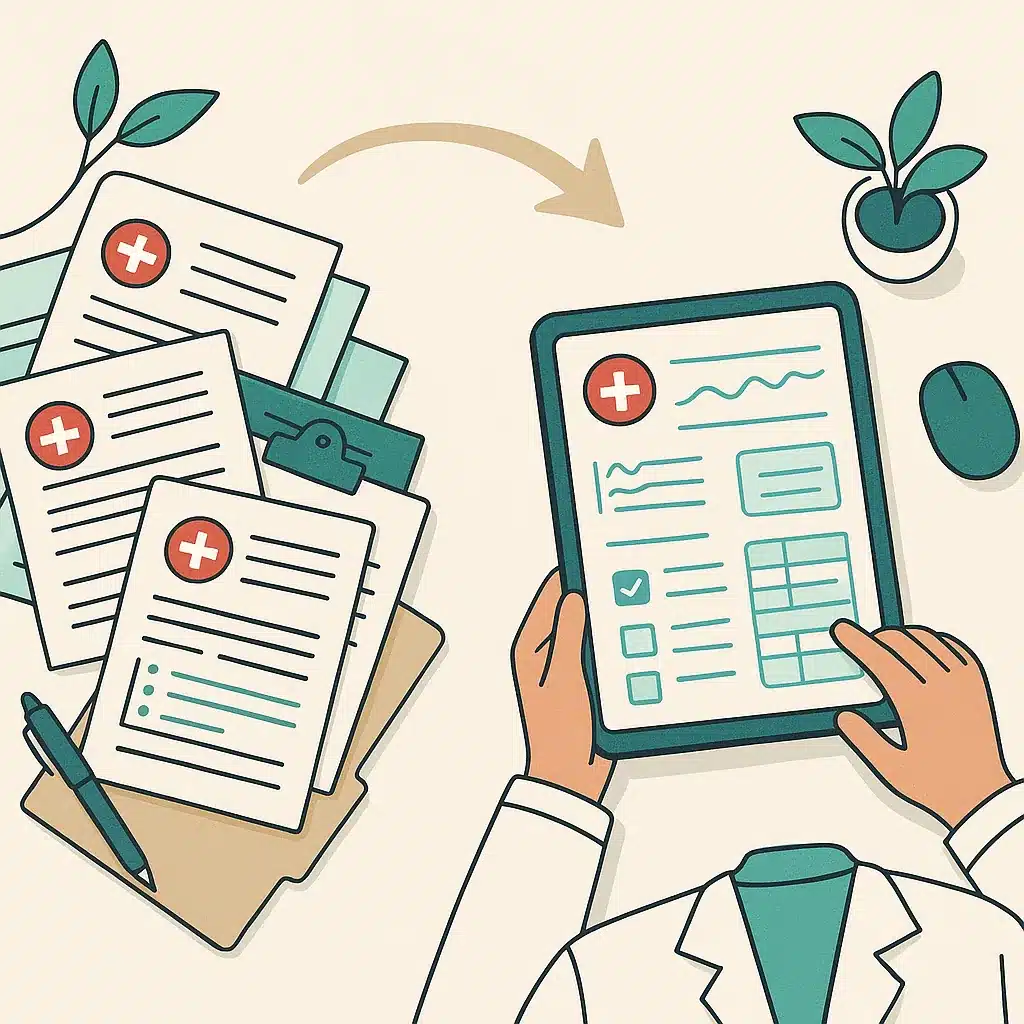
The rule here: back-office automation tends to pay off fastest because the tasks are high-volume, rule-heavy, and low-stakes next to diagnosis. This is where custom ai systems and internal tools can deliver measurable value relatively quickly. A firm like Bespoke Mind Ai builds this kind of workflow automation around how a practice actually operates. It connects the scheduling, records, and billing systems that were never designed to share data, so staff stop retyping the same information. The goal isn't more software layered on top. It's less manual work for people already stretched thin.
Clinical uses: diagnosis, imaging, and decision support
Move up the risk ladder and you reach disease diagnosis, where the accuracy bar is high and the oversight is heavy. Medical imaging is the flagship. AI reads X-rays, CT scans, MRIs, and pathology slides, and on narrow tasks it performs strongly. In one large review of imaging cases, sensitivity reached roughly 97 percent, meaning the model rarely missed the target finding. That's the level of diagnostic accuracy that makes radiologists pay attention.
What these tools actually do in practice is triage and flag. Advocate Health deployed FDA-cleared models across many sites to detect pulmonary embolisms, brain hemorrhages, and fractures, pushing the most urgent scans to the top of the radiologist's queue. The AI doesn't sign the report. It reorders the work so a critical bleed gets read in minutes instead of hours. That reordering is where patient outcomes can improve, because time matters enormously in those conditions. A brain hemorrhage sitting untouched in a queue of routine scans for two hours is a very different outcome from the same bleed flagged and read within ten minutes, and that difference is measured in a patient's recovery.
Clinical decision support extends the same idea into the ward. Models watching streams of clinical data from monitors and labs estimate the risk of deterioration, sepsis, or readmission, and alert staff before a crisis becomes obvious. Here is why this works: early physiological signals often precede visible symptoms, and a model tracking dozens of variables at once catches patterns a busy clinician scanning a chart might miss.
Consider a widely cited example. A model trained on health records detected signals linked to pancreatic cancer up to three years earlier than typical specialist detection in testing. Early detection in that disease is close to everything, since late-stage prognosis is grim. That result did not come from a standalone gadget. It came from ai algorithms applied to large clinical datasets inside a research pipeline.
The honest caveat: accuracy in disease diagnosis varies sharply by task. A cross-specialty meta-analysis pooled AI diagnostic accuracy around 81 percent versus roughly 71 percent for general physicians, but those numbers collapse or soar depending on the specific question. AI for healthcare is not uniformly superhuman. It's excellent at narrow, well-defined pattern tasks and unreliable outside them. That is exactly why the clinician stays in the loop.
AI in treatment, personalized care, and drug discovery
Diagnosis is only half the clinical story. Once you know what's wrong, treatment decisions weigh options against a specific patient's genetics, history, and current medications. This is where personalized care gets real. AI can cross-reference a proposed regimen against a patient's full medication list to flag drug interactions that a rushed prescriber might overlook, especially in older patients taking a dozen drugs at once. An 80-year-old on medications for blood pressure, cholesterol, diabetes, and arthritis presents dozens of possible interaction pairs, and an automated cross-check can catch the risky combination that a busy clinician juggling a full waiting room might not pause to trace.
Personalized care also means matching therapy to biology. In oncology, models analyze tumor genetics and medical images to help predict which patients are likely to respond to a given drug. That can spare others the toxicity of a treatment unlikely to work. The mechanism is the same pattern-matching seen elsewhere: learn from thousands of prior cases which features correlate with response, then estimate the odds for a new patient. It supports the oncologist's decision. It doesn't replace it.
Drug discovery is where AI can compress timelines that used to run a decade. Traditional discovery screens enormous chemical libraries against a target, mostly by expensive trial and error. Machine learning for healthcare narrows the field by predicting which molecular structures are likely to bind, be safe, or be manufacturable, so labs test a shorter, smarter list. The National Institutes of Health has documented the growing role of these methods across the drug development pipeline.
The result isn't a finished drug from a machine. It's a faster, cheaper front end. AI proposes candidates. Wet-lab scientists and clinical trials still do the confirming. Anyone promising an AI that invents cures on its own is selling hype, and the healthcare industry has learned to be skeptical of exactly that.
There's a workload angle here too. Every automated interaction check or candidate screen is repetitive analytical work lifted off a specialist, freeing clinical and research staff for the judgment calls only they can make. That's the consistent theme across ai applications in healthcare: the technology absorbs the high-volume pattern work, and human expertise concentrates where it's genuinely needed. Treatment and discovery are just higher-stakes versions of the same trade.
Telehealth, patient communication, and workload management
The pandemic normalized telehealth, and AI is quietly making it more sustainable. Video visits generate the same documentation burden as in-person ones, so ambient note-taking and automated summaries apply directly. On top of that, triage tools help route patients to the right level of care before a clinician's time is spent. A minor concern doesn't consume a specialist slot, and a serious one doesn't wait.
Patient communication is a huge, invisible workload. Practices field endless calls and messages about medication refills, appointment logistics, results, and instructions. AI agents can handle the routine, high-volume questions, drafting responses for staff review or answering directly within tight, approved boundaries. The point is not to replace the care team's voice. It's to stop skilled staff from spending afternoons on the same twenty questions. A nurse who fields the same "when should I take this on an empty stomach?" question fifteen times a day is a nurse not available for the patient whose question actually needs clinical thought, and that is the trade automation quietly corrects.
Here's a place to correct a common misconception. Many assume a healthcare chatbot is trying to diagnose patients over text. In reality, the responsible deployments stay firmly in the administrative and informational lane: scheduling, reminders, refill logistics, and pointing people to the right resource. The moment a conversation edges toward a clinical judgment, a trusted ai system hands off to a human. That boundary is a design choice, not a limitation to apologize for.
Workload management is the operational payoff. When routine messages, documentation, and triage are absorbed by automation, the remaining human effort concentrates on patients who actually need a clinician. Picture a clinic drowning in a shared inbox of three hundred daily messages. Automating even the clearly routine third of them returns hours to the staff every single day. That's real workload management, measured in reclaimed time rather than abstract capability.
The connective tissue underneath all of this is workflow automation that spans systems. Telehealth, messaging, and scheduling live in separate tools by default. Stitching them together so a patient interaction flows cleanly from booking to visit to follow-up is where custom ai systems earn their keep. This is why custom AI systems built around how your practice operates reduce the repetitive tasks that never needed a human in the first place. That is where operational efficiency comes from.
Benefits: efficiency, cost optimization, and patient outcomes
Group the payoffs into three buckets, because conflating them is how expectations go wrong. The first is efficiency and productivity: automating clinical documentation, coding, and scheduling can return clinician and staff hours directly. When a physician stops charting for two hours every night, that time flows back to patients or to sanity. Both matter for retention in a field bleeding staff.
The second bucket is cost optimization. Fewer claim denials from cleaner coding, fewer no-shows from predictive scheduling, and fewer hours spent re-keying patient data across disconnected systems all show up on the ledger. Cost optimization in healthcare rarely comes from one dramatic saving. It accumulates from dozens of repetitive tasks getting cheaper. That's less exciting than a headline number, and far more reliable. A single denied claim reworked by hand might cost a practice twenty-five dollars in staff time; multiply that across hundreds of avoidable denials a month and the accumulated saving becomes the kind of number that can meaningfully move a small practice's margin.
The third bucket is patient outcomes, and this is where the stakes are highest. Earlier detection of deterioration, faster reads on critical scans, and interaction checks that help prevent a dangerous prescription all translate into better care. Patient outcomes can improve not because the AI is smarter than the doctor, but because it never gets tired, never skips a monitoring window, and never forgets to cross-check the twelfth medication.
A necessary honesty note: these benefits are conditional. Results vary based on existing processes, data quality, implementation, and how well the care team adopts the tool. The wider promise of artificial intelligence in healthcare depends on it. An imaging model that hits a median AUC around 0.91 in a study can underperform in a clinic whose scans differ from the training data. Nobody serious should promise a guaranteed percentage improvement. The value of ai for healthcare is real precisely because it's specific: measurable returns come from building AI into an existing workflow, not from buying a tool that sits unused. The providers who see returns scoped a concrete problem first and matched the technology to it second.
Building trusted, safe, and compliant AI systems in healthcare
Compliance is not a footnote in healthcare AI. It's the gate. The Health Insurance Portability and Accountability Act, HIPAA, governs how protected health information is handled, and any system touching patient data must comply. Here is where a lot of enthusiasm crashes into reality: the consumer version of ChatGPT is not HIPAA compliant, and pasting patient data into it is a violation, full stop. Safe use requires a Business Associate Agreement and a deployment that isolates that data.
That single fact reshapes deployment choices. Healthcare providers need enterprise or custom-built systems with a signed BAA, controlled data flows, and audit trails, not a browser tab. Any system handling protected health information has to meet the HIPAA Security Rule requirements, which distinguishes healthcare automation from generic tools. Trusted ai systems in this setting are defined less by their model and more by their governance: who can access the data, where it's stored, how it's logged, and how errors get caught.
Three risks deserve direct attention. First, biased training data. If a model learned from a narrow population, it can produce unequal outcomes, and in medicine that means worse care for underrepresented groups. Second, over-reliance. When a tool is usually right, staff can start trusting it reflexively and stop checking, which is dangerous exactly when the model is wrong. Third, privacy exposure, the risk that patient data leaks through a poorly secured integration.
The mechanism that manages all three is human oversight. Keep a clinician in the loop, treat AI output as a flag or a draft rather than a decision, and the failure modes stay contained. This is not a temporary scaffolding to remove once the tech matures. It's the operating model. AI in healthcare is designed to support medical decision-making, so the treating clinician keeps responsibility for the final call. That is also why regulators keep the human in the loop by design.
There's a practical reason over-reliance is the sneakiest of the three risks. A model that is right 95 percent of the time trains staff to stop scrutinizing it, which means the 5 percent of wrong outputs land exactly when nobody is checking. The fix isn't better accuracy; it's a workflow that forces a human review step at the point where a wrong answer would do the most damage. Governance, in other words, has to be designed against the model's strengths, not just its weaknesses.
Compliance rules also vary by jurisdiction. HIPAA is the U.S. baseline, but state privacy laws, and different frameworks abroad like the EU's regulations, add requirements on top. Any organization building or buying ai applications in healthcare should verify obligations with a qualified compliance professional and the relevant regulatory authority rather than assuming a vendor has handled it. Trust in these systems is earned through governance, testing, and transparency, not asserted in a sales deck.
Skills, roles, and evaluating AI applications in healthcare
Adopting AI changes what certain roles do, without erasing them. Radiologists don't disappear. They shift toward reviewing flagged cases and handling the ambiguous ones the model can't resolve. Coders move from typing every code to reviewing AI suggestions and catching the exceptions. The pattern across the healthcare industry is augmentation of skilled work, not wholesale replacement, and framing it otherwise breeds resistance that sinks projects. Tell a coding team the tool is coming to replace them and adoption dies on day one; tell the same team the tool handles the tedious first pass so they can focus on the tricky edge cases, and you get cooperation instead of quiet sabotage.
New roles appear alongside the old ones. Someone has to curate clinical data, monitor models for drift, set alert thresholds, and manage the integration between AI tools and existing systems. These are hybrid roles blending clinical understanding with data literacy, and they're in short supply. Organizations that invest in this internal capability get far more from their tools than those that install and walk away.
For non-technical leaders, the more urgent skill is evaluation: how to tell a useful AI product from an expensive one. Ask what specific task it performs, what data it was trained on, how its accuracy was measured, and whether that measurement reflects your patient population. A vendor who answers those questions concretely is worth talking to. One who retreats to vague claims about transformation is not.
Here is why evaluation matters so much: the same word, "AI," covers a validated FDA-cleared imaging tool and an unproven chatbot with equal marketing confidence. Diagnostic accuracy figures quoted in glossy materials often come from ideal test conditions that don't survive contact with a real clinic. Insist on knowing how the tool was validated and by whom.
Consider a practice that buys a well-reviewed scheduling AI on the strength of its published accuracy numbers, then finds those numbers were measured on a patient population nothing like its own. The no-show predictions come back noisy, staff stop trusting the reminders, and the tool quietly falls out of use within a quarter. The lesson isn't that the product was bad; it's that the validation context never matched the deployment context, and nobody checked before buying.
A practical evaluation habit: map the manual work first, then shop for a tool that fits it, rather than buying a tool and hunting for a problem it might solve. Most disappointing deployments run backward, starting with the technology. The teams that succeed start with a bottleneck, count the repetitive tasks it creates, and only then ask whether AI applications in healthcare can remove that specific manual work. That discipline separates operational efficiency from expensive shelfware.
The future of AI in healthcare
Predicting the future of AI in healthcare invites hype, so anchor it in trajectory rather than fantasy. First, it helps to recall what is artificial intelligence really doing here. The clearest near-term direction is deeper integration: AI moving from standalone tools bolted onto workflows toward capabilities woven into the electronic health records systems clinicians already use. The friction of switching between apps is a real barrier, and the winning products will be the ones that disappear into existing screens. A clinician who has to leave the chart, open a separate application, copy in a patient identifier, and switch back is a clinician who will quietly stop using the tool within weeks, no matter how capable it is.
Ambient documentation is likely to become standard rather than novel. The value proposition, returning clinician hours by drafting notes automatically, is strong enough that adoption is climbing quickly. As that spreads, clinical documentation shifts from a chore the clinician performs to a draft the clinician approves. That is a meaningful change in the daily texture of the job.
Multi-agent systems, where several AI agents handle different steps of a workflow and hand off to each other, are moving from experiment toward practical use in administrative operations. Picture prior authorization handled end to end: one agent assembles the documentation, another checks it against payer rules, a third submits and tracks it, with a human reviewing exceptions. That's process automation applied to one of the most painful administrative tasks in the field.
The honest limit on this future is regulation and trust, and that's appropriate. AI assisted surgeries, where robotic systems guided by AI support a surgeon's precision, are advancing, but the human surgeon stays in command. Clearance for higher-autonomy systems will be slow and cautious for good reason. The stakes forbid moving fast and breaking things.
What won't change is the core division of labor. AI for healthcare will keep absorbing volume, pattern recognition, and repetitive tasks, and human clinicians will keep owning judgment, context, and responsibility. The organizations that thrive won't be the ones that adopt the flashiest technology. They'll be the ones that scope their manual work carefully and remove it deliberately, treating custom ai systems as a means to operational efficiency rather than an end in themselves.
Off-the-shelf tools vs custom-built AI systems for healthcare operations
- FDA-cleared models are ready to use immediately.
- Standardized products fit clinical, high-stakes tasks well.
- Generic tools often require manual workarounds.
- Designed for average buyers, not specific practices.
- Tailored to specific practice workflows and needs.
- Connects multiple systems for seamless information flow.
- Reduces repetitive tasks through bespoke automation.
- Built around actual processes, not one-size-fits-all.
Off-the-shelf AI products have a real place. An FDA-cleared imaging model is exactly the kind of thing you should buy rather than build, because validating a diagnostic model takes resources and regulatory work no single practice can replicate. For the clinical, high-stakes, heavily regulated tasks, standardized certified products are the right answer.
The picture flips for operational workflows. Every practice's scheduling quirks, referral patterns, billing rules, and communication habits differ, and a generic tool forces the practice to bend around the software instead of the reverse. This is where disconnected systems become the core problem: the off-the-shelf tool solves one slice but doesn't connect to the other five tools staff use, so someone still retypes patient data between them.
What actually happens with generic deployments is telling. The tool arrives, it doesn't quite match the workflow, staff invent manual workarounds to bridge the gap, and the promised time savings evaporate. A common pattern: teams that buy a platform to fix a bottleneck end up spending as much time feeding the platform as they saved. The technology isn't defective. It just wasn't built around how that specific operation runs.
The reason this happens so predictably is that off-the-shelf tools are designed for the average buyer, and no real practice is average. A product that assumes one referral workflow will fight a clinic that runs three, and every place the assumption breaks becomes a manual patch. Multiply those patches across scheduling, billing, and records, and the tool that promised to save time has quietly recreated the manual work it was supposed to remove. That is the structural reason custom automation fits where generic software strains.
Custom ai systems earn their cost when the workflow automation has to span several systems that were never designed to cooperate. Building AI agents and internal tools around a practice's actual process, connecting the EHR, scheduling, and billing so information flows without re-entry, is where the repetitive tasks genuinely disappear. Bespoke Mind Ai focuses on exactly this: designing custom automation around how a business already operates rather than reselling a one-size tool, so the system fits the team instead of the team fitting the system.
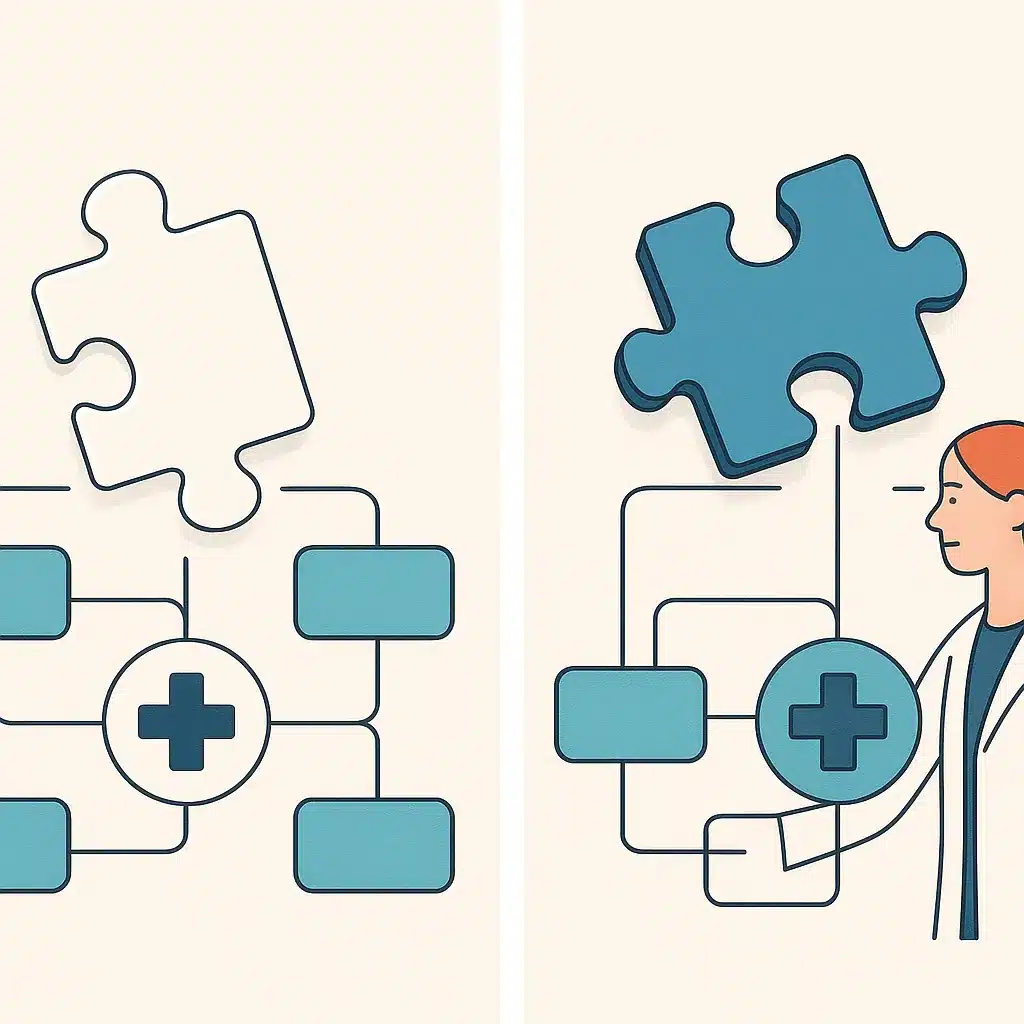
The decision rule is straightforward. Buy the certified clinical models. Build, or commission, the operational automation that has to fit your specific manual work. Confusing those two categories is how budgets get wasted, and getting them right is how measurable returns actually show up.
How to scope which healthcare workflows to automate first (readiness and ROI)
Start with the boring stuff, deliberately. The first workflows to automate are the high-volume, rule-heavy, low-clinical-risk tasks, because they tend to deliver the fastest measurable returns with the least regulatory weight. Documentation, coding support, eligibility checks, appointment reminders, and routine patient messaging all qualify. Save the high-stakes clinical automation for later, once the organization has built confidence and capability.
Quantify before you commit. For each candidate workflow, count how many hours a week staff spend on it, how often it produces errors, and what those errors cost, whether that's claim denials, no-show revenue, or rework. A task consuming fifteen staff hours a week is a stronger candidate than one consuming two, regardless of how impressive the AI sounds. This is where an automation scoping exercise or an ROI calculation turns a vague ambition into a ranked list. Writing down that eligibility checks eat twelve hours a week while manual appointment reminders eat three tells you exactly where to point the first project, and it protects you from chasing whichever workflow happens to be the loudest complaint that week.
Readiness is the other half. Ask whether the data the automation needs is clean and accessible, whether the systems involved can integrate, and whether the team will actually adopt the change. Running an AI readiness audit for your operations surfaces these gaps before money is spent. It frequently reveals that the real blocker isn't the AI at all, but disconnected systems and messy patient data that need fixing first.
There's a reason readiness so often outweighs the technology choice. An automation is only as reliable as the data feeding it, so a model pointed at inconsistent, half-populated records will produce inconsistent, half-trustworthy output no matter how capable it is. Fixing the data plumbing first isn't a delay before the real project; it is the project, because clean inputs are what let every downstream automation actually work. Skip that step and the shiniest tool still inherits the mess underneath it.
Sequence the rollout so early wins build momentum. Automate one clearly painful, well-understood workflow, measure the time saved honestly, and use that result to justify the next. Trying to transform everything at once overwhelms staff and buries the signal about what actually worked. Operational efficiency compounds when it's earned in steps.
If repetitive administrative work is quietly draining your team's hours and pulling skilled staff away from patient care, a focused conversation can map exactly where automation would pay off first. Bespoke Mind Ai runs a discovery-led process that starts by understanding the underlying operational problem, then scopes custom automation around it, so you can book a discovery call to identify your highest-ROI workflows before committing to any build. The goal isn't more software; it's less manual work in the corners of ai for healthcare where your team is stretched thinnest.
Frequently Asked Questions
How is AI actually used in healthcare day to day?
AI reads medical images (X-rays, MRIs, CT scans, pathology slides), flags high-risk patients for conditions like sepsis or heart failure, and automates administrative tasks like documentation. Advocate Health, for example, deployed FDA-approved AI models across 22 sites to detect pulmonary embolisms, brain hemorrhages, and fractures.
Is there a medical AI similar to ChatGPT?
Yes:clinical copilots built on large language models exist, such as the AI system OpenAI and Penda Health deployed to support frontline clinicians. These differ from consumer ChatGPT because they run inside clinical workflows with medical guardrails, rather than answering open-ended health questions.
Is ChatGPT HIPAA compliant for handling patient data?
The standard consumer version of ChatGPT is not HIPAA compliant and should not be used to process protected health information. HIPAA-safe use requires a Business Associate Agreement (BAA) and a deployment that isolates patient data, which is why healthcare organizations use enterprise or custom-built systems instead.
How does AI diagnostic accuracy compare to human doctors?
In specific tasks, AI is competitive with or exceeds clinicians:a review of ~1.1 million imaging cases found sensitivity up to ~97% and specificity ~93%. A cross-specialty meta-analysis put AI's pooled diagnostic accuracy at ~81% versus ~71% for general physicians, though results vary sharply by task.
Is AI in healthcare actually worth the investment, or is it overhyped?
The value is real in narrow, well-defined tasks: imaging AI has hit a median AUC of ~0.91, and one model detected early pancreatic cancer up to three years earlier than specialists in testing. The ROI depends on integrating AI into existing workflows rather than buying tools that sit unused:generic deployments rarely pay off.
What are the biggest risks of using AI in healthcare?
Key risks include biased training data producing unequal outcomes, over-reliance on AI outputs without clinician review, and privacy exposure when patient data is handled improperly. These risks are why AI is positioned to support:not replace:medical decision-making.
What if the AI gives a wrong diagnosis:who is responsible?
AI systems in healthcare are designed as decision-support tools, so the treating clinician retains responsibility for the final diagnosis and treatment. This is why regulated deployments keep a human in the loop and use AI to flag or prioritize cases rather than make autonomous calls.
Why is AI becoming more important in healthcare now?
Healthcare generates enormous data volumes:EHRs, imaging, lab results, genomics, and monitoring:that outpace human review capacity. AI processes this data faster to detect patterns, estimate patient risk, and enable earlier intervention, which is the core reason adoption is accelerating.