

Your support team answers the same billing question forty times a day. Your reps spend the first ten minutes of every call confirming whether a lead is even qualified. That repetitive back-and-forth is exactly where conversational AI earns its keep. Not by replacing your people, but by taking the predictable, high-volume exchanges off their plates. This article breaks down what the technology is, how it works, and where it removes real operational bottlenecks instead of adding another tool nobody uses.
What conversational AI actually is (plain-English definition)
So, what is conversational AI, in plain terms? It's software that can understand what a person types or says, figure out what they want, and respond in a way that keeps the exchange going. It combines natural language processing with machine learning, so the system interprets meaning instead of matching exact keywords. That's the difference between a tool that answers "Where's my order?" however it's phrased, and one that only works if you click the right menu button. IBM's overview of what conversational AI is describes it as technology that enables realistic, human-like exchanges between people and machines, a fair plain-English starting point.
Conversational AI vs. traditional rule-based chatbots
- Reads intent and holds conversational context
- Handles unexpected phrasing effectively
- Interprets language rather than matching patterns
- Follows a fixed script with pre-mapped questions
- Dead-ends on unplanned customer phrases
- Loops back to menus when confused
Rule-based chatbots follow a fixed script. You map out every question and branch in advance, and the moment a customer phrases something you didn't plan for, the bot dead-ends or loops back to a menu. An ai chatbot built on conversational AI doesn't rely on those rigid trees. It reads intent, holds conversational context, and handles phrasing it was never explicitly shown.
Many assume traditional chatbots and conversational AI are the same product with different labels. In reality, one matches patterns and the other interprets language. Google Cloud's explanation of chatbots and conversational AI lays out the same distinction clearly. If you're trying to decide whether the investment makes sense for your business, it's worth looking at whether an AI chatbot actually pays off before committing to a build.
How conversational AI works (NLP, NLU, ML, intent, context)
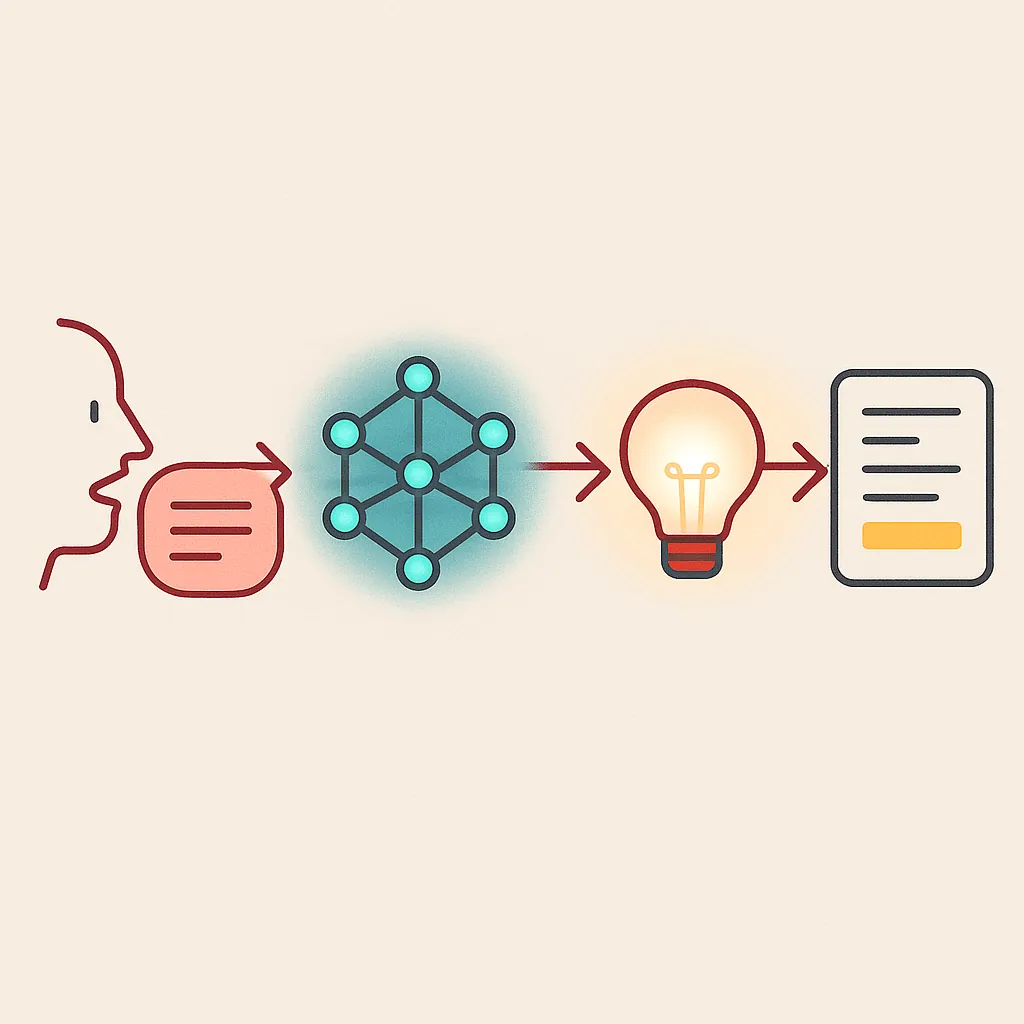
Here's how conversational AI works, in sequence. First, natural language processing breaks the raw input into something structured. Then natural language understanding, or NLU, figures out the intent behind it: is this a refund request, a scheduling question, or a complaint?
Machine learning improves those predictions over time by learning from real conversations. The piece most people underestimate is context. Without it, the system treats "and the second one too" as unclear, because it lost track of what you asked thirty seconds ago. Natural language understanding paired with context retention is what makes the exchange feel like a conversation instead of a series of disconnected queries.
Core components of a conversational AI system (ASR, NLU, fulfillment, NLG)
Four parts make up the components of conversational AI. When voice is involved, automatic speech recognition converts spoken words into text the system can read. NLU then pulls out intent and key details from that text.
Fulfillment is where the work happens: pulling an order status, booking a slot, or checking an account balance by connecting to your systems. Finally, natural language generation turns the result into a clear, human-sounding reply, and for voice, converts it back to speech. Skip fulfillment and you have a bot that talks well but does nothing useful, because the conversation only creates value when it can reach into real data and complete an action. The components only deliver value when wired to real data and real actions.
Chat vs. voice conversational AI
- Lives on websites and messaging apps
- Faster to deploy and easier to contain
- Allows customers to scroll back through conversations
- Powers phone systems and voice assistants
- Handles accents and background noise
- Best for replacing frustrating menu-based phone trees
Chat-based conversational AI lives on your website, in messaging apps, and inside support widgets. It's faster to deploy, easier to contain, and customers can screenshot or scroll back through it. Voice-based conversational AI powers phone systems and voice assistants, and it carries extra weight because it relies on speech recognition that has to handle accents, background noise, and people talking over each other.
Voice tends to work best for replacing frustrating menu-based phone trees. Chat suits detailed, multi-step requests. Neither is objectively better. The right choice depends on where your customers already try to reach you and what they're asking for.
Where conversational AI fixes real operational bottlenecks
The operational bottlenecks worth targeting are the repetitive ones. Picture a service business where two staff members spend most mornings answering "What's the status of my request?" by hand, hours of manual work every week on a question a system can answer instantly. This is also where the cost case gets concrete: Gartner has pointed to a projected $80 billion in contact center labor cost reductions tied to conversational AI adoption by 2026.
Conversational AI can absorb that volume, freeing your team for calls that genuinely need judgment and supporting business efficiency across the board. Custom ai chatbots built for lead qualification can also screen inquiries before a rep ever picks up, so sales time goes to prospects who are actually ready. This is where Bespoke Mind Ai builds conversational systems around how your workflows already run, rather than forcing you onto a generic script, including a custom chatbot built for lead qualification and booking that handles screening before a human ever joins the conversation.

Common business use cases and examples
The strongest ai use cases cluster around repetitive, structured exchanges. Customer service automation handles order status, returns, billing questions, and password resets without a ticket ever reaching a person. Voice agents replace clunky phone menus so callers skip the "press 4 for billing" maze.
Lead qualification bots ask the screening questions a rep would ask anyway, then route hot leads straight to sales. Internally, ai agents and copilots can surface answers from scattered documents, so staff stop hunting through folders. These overlap closely with AI agents handling real-world business tasks, which extend beyond conversation into taking action across your systems. Each example targets the same pattern: a predictable conversation happening often enough that automating it can meaningfully support business efficiency and customer experience at once.
What makes a conversational AI response trustworthy and accurate
Accuracy comes from what the system is allowed to pull from. A response grounded in your live data, order records, policy documents, current pricing, tends to be more trustworthy than one a general-purpose model improvises. Ungrounded generative ai tends to fill gaps with plausible-sounding but wrong answers, because a language model predicts likely text rather than verifying facts against your records.
That's why serious conversational AI connects large language models to your verified sources and includes confidence thresholds. When the system isn't sure, it should say so or hand off, not guess. Trust also depends on consistency: the same question should get the same correct answer whether asked at 9am or midnight. For businesses formalizing how they evaluate and manage this kind of risk, NIST's AI risk management guidance offers a useful framework for thinking through governance before deployment.
How to start adding conversational AI to your operations
Start by counting. For one week, log the questions your team answers over and over. The highest-frequency, lowest-judgment ones are your first automation candidates.
Don't try to automate everything at once. A narrow, well-scoped build that handles order status reliably beats a sprawling one that half-works everywhere. Map where the bot needs to pull data from, and decide upfront where it hands off to a human. Then pick a channel, chat or voice, based on where those questions already land. The benefits of conversational AI tend to show up fastest when you target a specific, measurable bottleneck instead of a vague "we should have AI" goal.

Custom-built conversational AI vs. generic off-the-shelf bots for SMB ops
- Built around specific business workflows
- Can access unique business data
- Often cost-effective for smaller teams
- Suitable for generic tasks like FAQs
- Break down with complex, specific inquiries
- Cannot access unique customer information
Off-the-shelf bots are fine when the job is generic: answer a static FAQ, collect an email, point someone to a help page. They break down the moment the conversation needs to know something only your business knows. A generic ai chatbot can't check whether a specific customer's invoice is overdue or book against your actual calendar.
Custom ai systems exist for that gap. They're built around your workflows, your data, and your handoff rules, exactly what matters for SMB operations. The misconception is that custom means enterprise-only and expensive. In reality, a tightly scoped conversational AI platform tuned to one or two high-volume workflows is often where smaller teams see reduced costs first.
Connecting conversational AI to your existing stack and data
A conversational AI system is only as useful as the systems it can reach. If it can't read your CRM, your booking tool, or your order database, it can only talk, not act. Real value comes from integration: the bot checks a live record, updates a field, triggers the next step in your business workflows.
This is where conversational flow management meets your actual stack, and where most generic tools hit a wall because they weren't built to plug into your particular tools. Integration rules and data handling also vary by industry and region, so for anything involving customer data, confirm requirements with a qualified advisor or the relevant data-protection authority before you deploy.
If repetitive questions and manual lead screening are eating your team's hours, a short conversation can map where virtual agents and workflow automation would actually help. See how custom conversational AI fits your operations with a no-pressure discovery call from Bespoke Mind Ai, built around how your business already runs, not a generic template. Results vary based on your existing processes, complexity, and team adoption. If you'd rather talk it through directly, you can book a free automation discovery call and get a clearer picture of where to start.
Frequently Asked Questions
What exactly is conversational AI?
Conversational AI is the combination of natural language processing, dialogue management, and machine learning that lets software hold a back-and-forth exchange instead of just matching keywords to scripts. It's what powers chatbots, voice agents, and virtual assistants that need to track context across a conversation rather than reset after every message.
How is conversational AI different from a regular chatbot?
A basic chatbot runs on fixed decision trees, if the input doesn't match a pre-built path, it fails or loops back to a menu. Conversational AI uses NLP and NLU to interpret intent and retain context, so it can handle questions it wasn't explicitly scripted for.
Is conversational AI actually worth it for a small business, or is it overkill?
It depends on volume and complexity: if your team is manually answering the same 10-15 questions daily or qualifying leads by hand, the automation pays for itself quickly. If your query volume is low or every interaction needs a judgment call, a simpler rule-based tool or no automation at all may be the better fit.
What happens if conversational AI gets a customer's question wrong?
A properly scoped system includes fallback logic and handoff points that route the conversation to a human when confidence is low or the request falls outside its training. The risk isn't the AI failing occasionally, it's deploying one without a clear escalation path, which is a build and QA issue, not a reason to avoid the technology.
Which AI conversation model is considered the best?
There isn't one universal winner, the right model depends on the use case, with some platforms prioritizing fast multi-channel deployment (like Fin) and others offering more flexibility to plug in your own LLM (like Voiceflow). For most SMBs, the better question is which platform fits existing systems and support volume, not which model ranks highest in benchmarks.
Why are businesses investing in conversational AI now instead of sticking with chatbots?
Salesforce research found 89% of service professionals say conversational AI improves self-service resolution rates, and 88% say it speeds up issue resolution. Gartner also found customers are now three times more likely to turn to third-party generative AI tools than a company's own chatbot, which signals that static bots are losing ground to systems that can actually hold a conversation.
What are the main business use cases for conversational AI?
The most common applications are customer support automation (order status, billing, returns), replacing menu-based phone systems with voice agents, and qualifying sales leads before handing them to a rep. Each use case targets a specific point where manual, repetitive back-and-forth is consuming staff time.
Do I need a custom-built conversational AI system, or can I use an off-the-shelf tool?
Off-the-shelf platforms work fine for generic, high-volume tasks like FAQ answering. Once the conversation needs to pull live data from your CRM, booking system, or internal tools, a custom build becomes necessary because pre-built platforms usually can't integrate deeply enough with how your business actually operates.