

A company can spend $80,000 on an AI scheduling tool and quietly shelve it eleven months later. The software works fine. But the data sits in four disconnected systems that can’t talk to each other, so the AI never has clean inputs to learn from. That kind of failure is predictable. The AI Readiness Audit exists to catch exactly this kind of mismatch before the money leaves the account. This article walks through what readiness means across your data, infrastructure, people, business operations, and governance.
What an AI readiness audit/assessment is
An ai readiness assessment is a structured review of whether your business operations can actually support AI. It scores your data quality, technical infrastructure, process maturity, skills, and governance against the demands of real ai systems. Think of it as a pre-flight check before ai adoption. According to McKinsey, the gap between ambition and value usually comes down to organizational foundations, not the models. The goal is to find that gap before you spend on tools.
Why readiness must come before AI adoption
Buying AI before checking readiness is like fitting a turbocharger to an engine with no oil. AI amplifies whatever foundation it sits on: a model trained on disconnected, low-quality inputs produces faster bad decisions, not better operational efficiency. The Harvard Business Review has repeatedly tied AI failures to weak ai readiness rather than technical limits. Run the audit first.
Data quality, structure, and governance readiness
Your data foundation decides whether AI works. If information lives in spreadsheets, email threads, and three SaaS tools that never sync, your data maturity is low. A proper ai readiness assessment checks accessibility, ownership, structure, and accuracy. Clean, well-governed data beats large volumes of messy data, because AI learns the patterns in your data, so inconsistent records teach it inconsistent rules. Low data maturity also distorts every later ai use case. Following the NIST AI Risk Management Framework can help formalize governance, clear ownership, and consistent structure: the prerequisites that make AI useful rather than dangerous.
Technical infrastructure and systems readiness
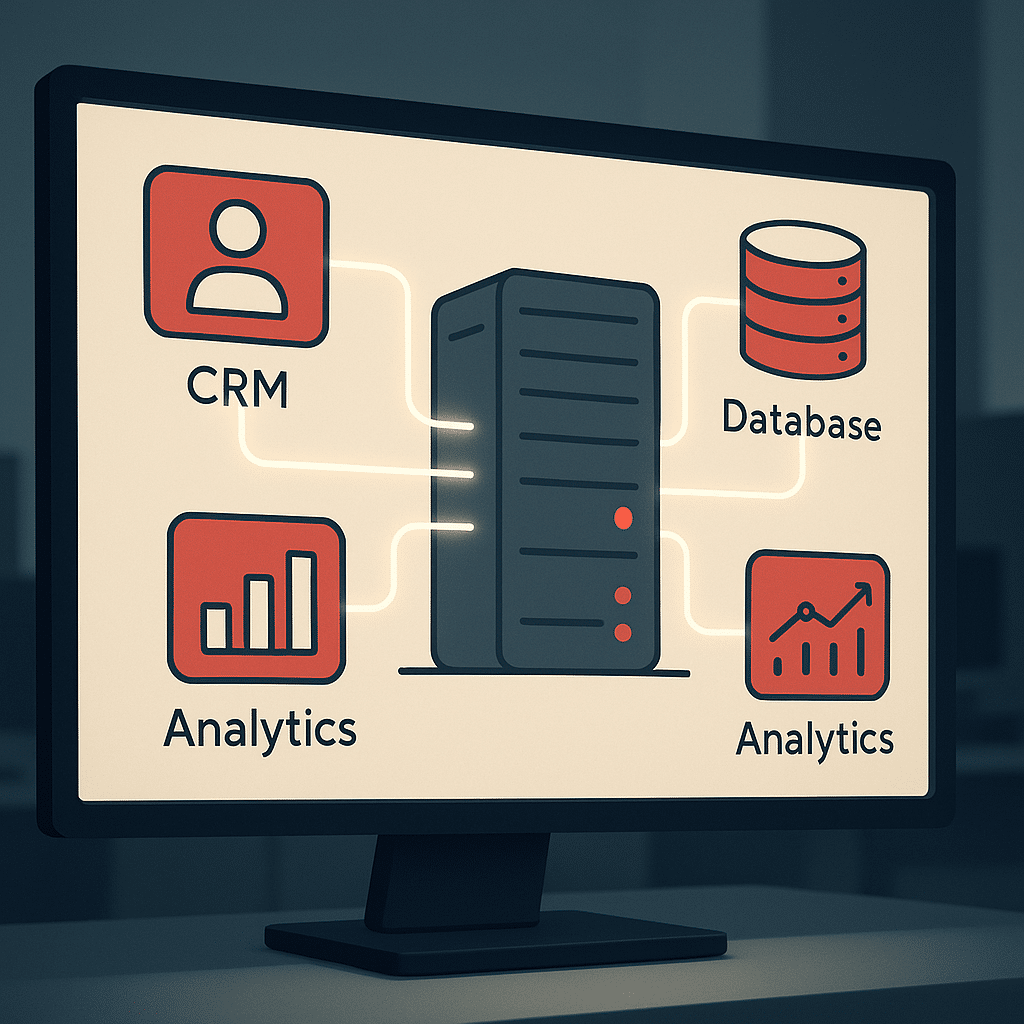
AI workloads have requirements your current setup may not meet. This part of the audit examines whether your technical infrastructure can handle integration, data flow, and the processing AI demands. Disconnected systems are the usual culprit. When each tool holds a fragment, AI can’t see the whole operation. Check API availability, storage, and how cleanly your existing tools exchange information. Scalable systems matter, because ai pilots that work for ten records often collapse at ten thousand.
Process maturity and workflow alignment
AI struggles to automate a process nobody has defined. Process maturity measures how consistent, documented, and repeatable your business workflows are before workflow automation enters. The root cause of many failed rollouts is automating a broken process. You just make the mess run faster. Gartner’s analysis of AI implementation challenges points to process and operational gaps as the reason initiatives stall, so a good assessment documents workflows, flags gaps, and shows where business process integration and process improvement deliver real value. For a practical start, our guide to AI workflows for small business breaks down how to map and improve these flows. Fix the workflow first. Then automate it.
Organizational, staff, and skills readiness
Tools don’t adopt themselves. Organizational readiness covers whether your team has the skills, capacity, and willingness to work alongside AI. That makes change management central. A 50-person service firm with no one comfortable reading AI outputs will see adoption stall, no matter how good the software is. Many assume readiness here means hiring data scientists; in reality, it’s about whether the people doing the work will actually use what gets built.
Leadership, sponsorship, and accountability
AI initiatives without an owner drift until they die. Executive sponsorship gives an AI project budget, priority, and someone accountable when trade-offs arise. The audit checks whether leadership has a clear ai strategy or just a vague desire to “use AI.” A real ai strategy ties accountability to specific outcomes, like reduced manual work or operational efficiency. That keeps progress measurable rather than aspirational.
Step-by-step process for conducting an audit
Start with your data: map every source, check accessibility, and assign ownership. Next, review technical infrastructure to confirm your systems can integrate and scale. Then assess process maturity by documenting business workflows and spotting operational bottlenecks. Evaluate skills and organizational readiness honestly. Review governance and compliance rules. Finally, score each area to produce an ai maturity baseline. Self-service tools shorten the first pass to minutes. A thorough internal assessment usually spans a few weeks, depending on data complexity.
Gap analysis and prioritized recommendations
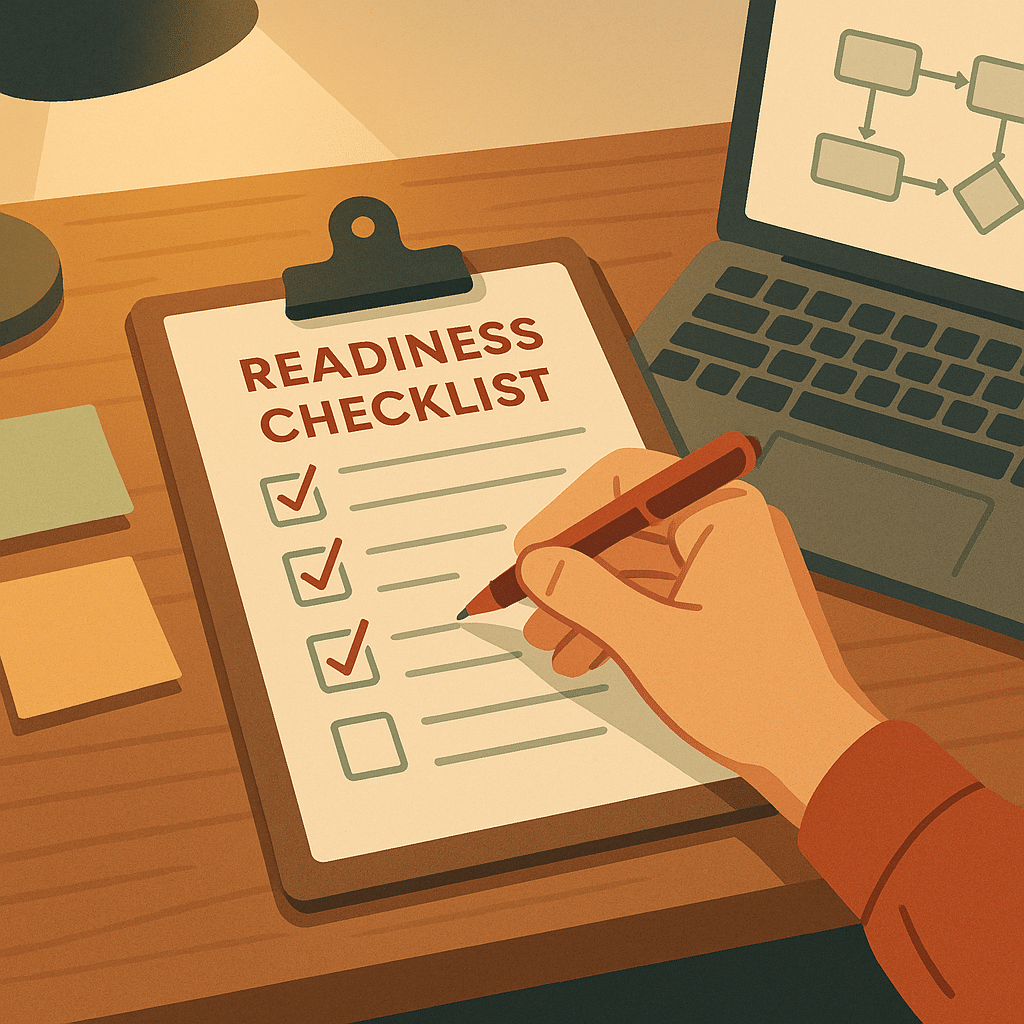
The audit’s value is in the gap analysis, not the score. Once you know where readiness is weak, you sort findings by impact and effort. A data quality gap that blocks every future ai use case ranks higher than a nice-to-have reporting upgrade. Good gap analysis turns a list of problems into an ai readiness checklist: fix the data foundation, connect systems, then pilot.
Building an actionable AI roadmap
A score without a plan is just anxiety. The ai roadmap sequences your readiness fixes into phases tied to real outcomes. Phase one usually addresses data quality and disconnected systems. Later phases introduce pilots in areas with the clearest workflow automation potential. The ai roadmap should name owners, rough timelines, and success measures for each step.
Governance, compliance, and ethical requirements
Governance is where many ai implementation efforts get blindsided. Before deploying, you need rules covering data privacy, access controls, decision transparency, and accountability for AI outputs. For regulated industries, compliance gaps can halt an otherwise solid project. Clear governance also protects against the quieter risks: biased outputs, unexplained decisions, and unclear ownership when something goes wrong. Strong governance isn’t bureaucracy. It’s what lets you scale AI with confidence.
Why AI initiatives fail without readiness
The pattern is consistent. Companies buy AI tools, skip the ai readiness checklist, then discover the foundation can’t support what they bought. The failure rarely looks like a technical breakdown, so teams blame the software when the real problem was readiness. Consider a regional accounting firm that rolled out an AI document classifier across three offices: it misfiled half its inputs because each office named files differently, and within a quarter the staff returned to manual sorting. McKinsey’s research on AI adoption across business operations shows operational value is realized where foundations are solid, not where the hype is loudest. An audit catches these gaps before the spend.

Readiness signals organizations commonly miss
Some readiness gaps hide in plain sight. Teams celebrate having “lots of data” while ignoring that it’s inconsistent and ungoverned. A common miss is mistaking software ownership for process clarity. You have the tools, but no documented workflows behind them. Low operational visibility is the quietest signal of all. If you can’t see how work flows today, you can’t tell AI where to help.
Identifying operational bottlenecks and manual work before automating
Find the manual work first. Map where your team repeats tasks, re-enters data, or copies information between manual processes. Watch for the work that quietly eats hours: status updates, reporting, reconciling data across tools. Targeting these operational bottlenecks is the fastest route to process improvement. As Harvard Business Review’s coverage of operational readiness and automation emphasizes, repetitive tasks are prime candidates because removing them delivers measurable time savings.
Custom-built systems vs off-the-shelf AI tools for readiness
- Designed around specific business operations
- Targets painful bottlenecks effectively
- Can be more cost-effective long-term
- Offers tailored solutions for unique needs
- Assumes standard business operations
- Works for generic, standardized tasks
- May not fit manual processes well
- Often leads to subscription costs over time
Off-the-shelf AI assumes your business operates like everyone else’s. It rarely does. Generic tools work for standardized tasks. But founder-led and service businesses usually have manual processes that don’t fit a template. Custom-built systems are designed around how your business actually operates. A focused custom system targeting one painful bottleneck often costs less than years of subscriptions that never quite fit. Readiness should guide which path delivers business value.
Reducing founder dependency through operational visibility
In many small businesses, the founder is the integration layer. Too much knowledge sits in one head, so operations stall whenever that person is unavailable. This burdens both small business owners and the operations managers who depend on them. Operational visibility breaks the dependency by surfacing how work flows, who owns what, and where things stick. Workflow automation can capture routine decisions and reporting, freeing the founder for higher-value work. To see how this works in practice, our overview of how Bespoke Mind builds these systems walks through the approach.
Frequently Asked Questions
What is an AI readiness audit and what does it cover?
An AI readiness audit is a structured evaluation of how prepared your business is to adopt and scale AI before you invest in tools. It typically reviews six dimensions: data quality and governance, technology infrastructure, people and skills, processes and workflows, governance frameworks, and organizational culture.
How do you actually run an AI readiness audit?
Start by assessing your data sources for accessibility, integration, and clear ownership, then review whether your IT systems can handle AI workloads. From there, evaluate your governance and compliance rules, your team’s skills, and how well current workflows map to automation opportunities.
Why bother with an audit before adopting AI tools?
Most AI projects fail because of organizational unpreparedness, not weak technology. An audit surfaces problems like fragmented data or disconnected systems early, so you avoid buying software that can’t deliver results on top of a broken foundation.
What's the difference between an AI readiness audit and a digital maturity assessment?
An AI readiness audit specifically measures your ability to implement and scale AI, focusing on data, infrastructure, talent, and governance gaps. A digital maturity assessment is broader, evaluating your overall digital capabilities and operations regardless of whether AI is the goal.
Is an AI readiness audit actually worth it for a small business?
For founder-led and service businesses with manual processes, an audit is often cheaper than the cost of a failed AI rollout. Free tools like ReadyPillar take under 10 minutes and give a composite score with gap analysis, so the entry cost can be close to zero.
What if our data is a mess across multiple tools, will the audit just tell us we're not ready?
Fragmented data is one of the most common findings, and the audit’s job is to show you exactly where the gaps are rather than simply disqualify you. The output is a roadmap that sequences the fixes, so you can consolidate data and connect systems before layering AI on top.
Which frameworks or tools can I use to assess AI readiness?
Options include ReadyPillar, which scores SMEs across six pillars in under 10 minutes, and E-ARI, which assesses eight dimensions for governance-heavy teams. The right choice depends on your size and how much compliance complexity you carry.
How long does an AI readiness audit take and who should be involved?
A self-service questionnaire can take under 10 minutes, while a thorough internal review spans a few weeks depending on data complexity. Include leadership for strategy, operations managers for workflows, and whoever owns your data and IT systems.