
I'll make a targeted keyword pass, weaving in each required keyword while trimming equivalent words to keep the count stable.
A founder of a 40-person property management firm spent eight months and roughly $400,000 trying to build an internal AI tool. The goal was to sort tenant maintenance requests. Two engineers quit before launch, and the half-finished system never shipped. That kind of outcome is exactly why The Real Cost of Building AI Tools In-House vs. Hiring a Development Partner deserves a hard, numbers-first look before you commit a budget. This article breaks down the actual spend, the timelines, the hidden drains, and the decision points. The goal is to help you choose the path that fits how your business actually operates.
In-house vs partner/outsourcing build models overview
- You own the code and infrastructure.
- Long-term roadmap is under your control.
- Requires significant operational work.
- Higher compliance burden in regulated industries.
- Custom-built systems delivered by external team.
- Less operational work on your end.
- Potentially faster deployment.
- May involve hidden costs over time.
There are two real ways to get a working AI tool: hire and build it yourself, or bring in an outside team to build it for you. In-house AI development means standing up an in-house AI team of AI engineers and a data scientist. You own the code, the infrastructure, and the long-term roadmap. Outsourced AI development means a scoped engagement with an AI development company that ships custom-built systems, then hands them over or supports them. The build vs buy question rarely has one universal answer. According to McKinsey, most organizations underestimate the operational work required to put AI into production, not the modeling itself. That gap is where budgets quietly blow up.
The mechanism is straightforward: a working model is maybe 10% of the job, while the data pipelines, integration with internal tools, monitoring, and retraining that keep it running are the other 90%, and that 90% is recurring labor. Picture a customer-service classifier that sorts incoming tickets. The model that tags a message as "billing" or "technical" is the easy part. The hard part is wiring it into your help desk, cleaning years of inconsistent ticket history, building the dashboard your operations manager checks, and keeping it accurate as your product and customers change. Both models can produce custom AI solutions built around how you operate that remove manual processes instead of off-the-shelf software. But the cost of building AI tools, the speed, and the risk profile look very different depending on which road you take. One practical note before the numbers: rules around data handling, model deployment, and security and compliance vary by jurisdiction and industry, so a property firm in one state and a healthcare provider in another will not face the same obligations. A clinic handling patient records carries a far heavier compliance load than a logistics firm routing trucks, and that difference can add months and real money to an in-house build. Check with your regulator or legal counsel before you settle on a build model, since that choice affects who carries the compliance burden.
Cost factors and budget breakdown of building AI in-house
The headline number for in-house AI development is the team. A minimal in-house AI team of two to three AI engineers runs $600,000 to $1.2 million in year one. That figure stacks salaries, benefits, recruiting fees, and onboarding. Individual specialists, machine learning engineers, MLOps people, and a data scientist sit at $140,000 to $250,000 each before benefits, and good talent is genuinely scarce. The U.S. Bureau of Labor Statistics tracks software and data roles among the fastest-growing technical occupations, and its U.S. software developer salary and employment data is a useful set of industry benchmarks when budgeting an in-house build team.
On top of payroll comes infrastructure and tooling: GPUs, cloud compute that scales with model training, monitoring, and licenses. This matters because AI development cost is not a one-time line item. It's a recurring obligation. Here's a concrete version of how this goes wrong: a logistics company we've seen budget $300,000 for a routing tool, then watch the number climb past $500,000 once cloud compute spiked during training, a senior engineer left mid-build, and the replacement search ran four months while the project sat idle. During those four idle months, the remaining engineer kept drawing a full salary while shipping nothing, the cloud bills kept arriving for half-trained models, and the operations team it was meant to help kept routing trucks by hand on spreadsheets. Many assume the model is the expensive part. In reality, the people and the infrastructure around it dominate the budget every year. The root cause is structural: an in-house AI team is a fixed cost that runs whether or not there is active work, so any gap between projects is money spent for no output. A team built to ship four tools a year still costs the same in a quarter when nothing ships.
Cost factors of partnering with an AI development company
An AI development partner prices by project, not by headcount. A scoped engagement typically lands between $50,000 and $500,000. The figure is driven by project scope and complexity rather than how many people you've hired. The cost of building AI tools through an outsourcing partner bundles strategy, design, engineering, and deployment into a fixed or milestone-based fee. You're not carrying talent acquisition, benefits, or idle capacity between projects. A retail operator who needs one inventory-forecasting tool pays for that one tool, not for a standing team to maintain through every slow season.
Harvard Business Review's research on the hidden costs of in-house software development underscores how build-it-yourself decisions often carry operational expenses that never appear in the original budget. Infrastructure usually lives inside the partner's quote or gets set up cleanly in your own cloud account. Maintenance and support are negotiated separately, often as a monthly retainer, so you only pay for what you use. The practical upside: an AI development partner converts an unpredictable, open-ended payroll commitment into a defined spend with a clear scope. That makes the cost-benefit analysis far easier for small business owners and finance teams to approve, because a single line item with a known number is something a CFO can sign off on, while an open-ended hiring plan with uncertain delivery dates stalls in budget meetings for a quarter. The reason this works is simple: when the team is shared across multiple clients, you pay for the slice of capacity your project needs instead of funding full salaries through every quiet stretch.
Pros and cons of in-house AI development
The case for an in-house AI team is control. You own the IP, the roadmap, and the institutional knowledge. For products where AI is the core differentiator, that ownership compounds into real competitive advantage, and tight integration with internal tools becomes easier over time. If your entire business is an AI product, keeping that capability under your own roof is the only sensible call.
The downside is weight. You're funding AI development cost whether or not there's active work. The technical capabilities you need shift fast, so today's hires can be outdated in 18 months. Hiring is slow, retention is harder, and a single departure can stall a project. There's also knowledge dependency: when one engineer holds the architecture in their head, you've traded founder dependency for engineer dependency. Imagine that engineer takes a two-week vacation in the middle of a production incident, or worse, accepts an offer elsewhere; suddenly nobody can explain why the model behaves the way it does, and you're reverse-engineering your own tool. In-house AI development rewards companies that build AI continuously and punishes those that need one tool and move on. The underlying rule: ownership only pays off when you use it constantly, because the cost of keeping that capability alive is the same whether you ship one tool a year or twenty.
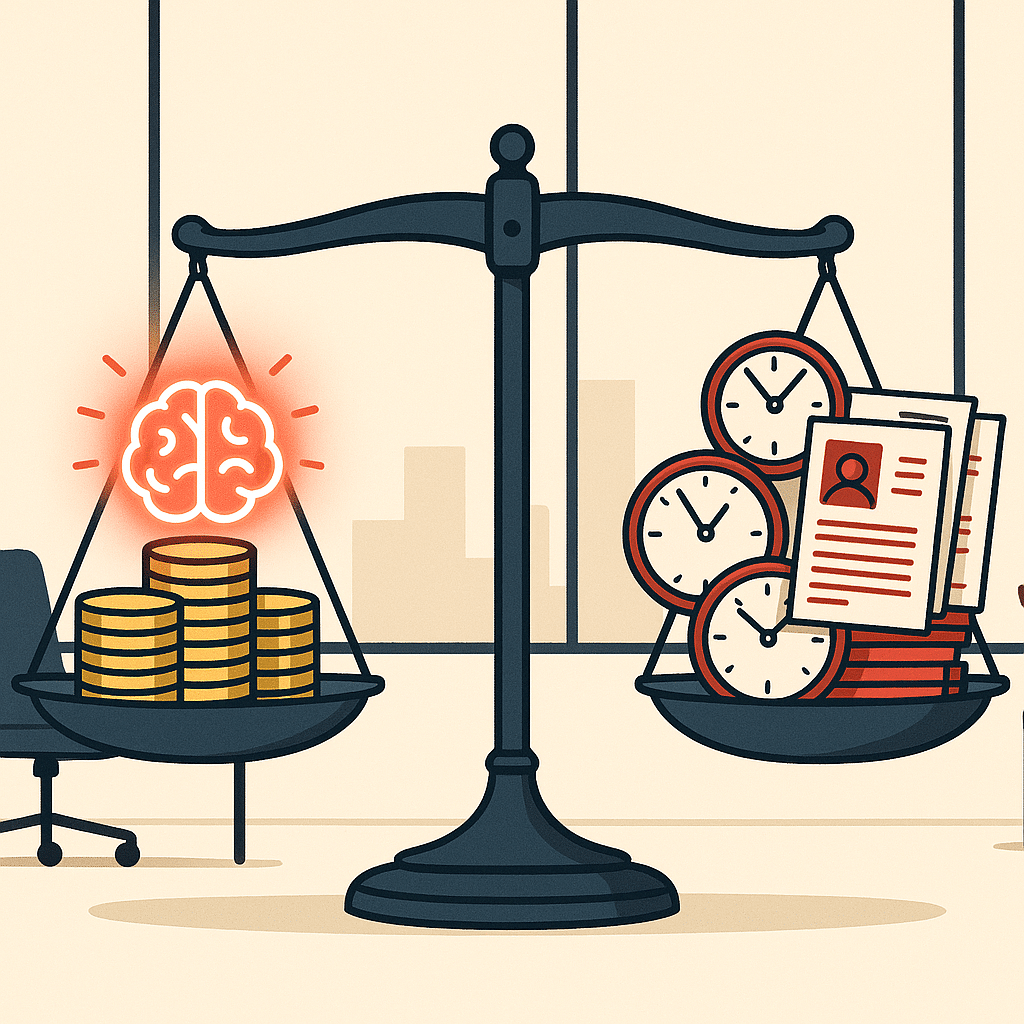
Pros and cons of partnered/outsourced AI development
Outsourced AI development gets you to a result without a hiring cycle. You buy experience that's already been sharpened on similar problems, which usually means faster time-to-market and fewer expensive false starts. An AI development company brings ready infrastructure and tooling, a tested process, and accountability tied to delivery. A partner who has built five document-processing systems or deployed AI agents already knows the edge cases that would cost a first-time in-house team three months to discover.
The trade-offs are real. You depend on an external team's availability, and weak documentation can leave you stranded after handover. There's also the risk of a generic build if the outsourcing partner doesn't take time to understand your business workflows; you end up with a tool that technically works but ignores the way your team actually processes an order or approves an invoice. The fix is choosing an AI development partner that works discovery-first and builds custom AI business solutions around your operations, then hands over clean code and clear documentation. Done right, the model gives you operational efficiency and scalability without the permanent cost or the knowledge dependency of an in-house AI team. This is the trade-off in plain terms: you give up some direct control in exchange for speed and predictable cost, which is the right call for most businesses that need a working tool rather than a permanent AI department.
Hidden, opportunity, and maintenance costs
The sticker price misleads people on both sides, but in-house carries more hidden costs. Recruitment fees, the months a role sits empty, retention bonuses, and the infrastructure that grows with usage all stack up after the budget's already approved. Then there's opportunity cost, the most overlooked number in the entire build vs buy debate. Every month your team spends building plumbing instead of shipping product is revenue you didn't earn. For a founder-led services business, that might mean a quarter where your best technical people built internal data pipelines instead of the client-facing feature that would have closed three deals.
Gartner's research on enterprise AI adoption and project risk shows a significant share of AI initiatives stall or fail outright, which reframes the in-house path as a risk-laden bet rather than a sure thing. What actually happens is that internal builds drag on, and the opportunity cost of a delayed launch often dwarfs the engineering spend itself. Maintenance never stops either: models drift, dependencies break, and someone has to be on call. A model that flagged fraud accurately last year quietly starts missing new patterns this year, and nobody notices until losses show up. With a partner, maintenance and support are a defined retainer you can scale up or down. With an in-house team, it's a permanent salaried line whether the tool needs attention this month or not. The mechanism behind drift is worth naming: real-world data changes over time, so a model trained on last year's patterns slowly loses accuracy until someone retrains it, which means maintenance is not optional upkeep but the cost of staying correct.
Talent acquisition, hiring time, and retention challenges
Talent acquisition is where in-house plans stall first. Hiring qualified AI engineers takes three to six months from job posting to a productive start, and that's before anyone writes shippable code. Senior machine learning talent fields multiple offers, so you compete on compensation, equity, and interesting work all at once. A founder competing against a well-funded tech company for the same engineer usually loses on at least two of those three fronts.
Retention is the second trap. AI specialists move frequently, and losing one mid-project resets timelines and reopens knowledge dependency gaps. The root cause is supply: there are far more open AI roles than experienced people to fill them, which inflates both salary and turnover. For most companies outside of tech hubs, sustained talent acquisition simply isn't realistic. A development partner sidesteps the whole problem, because the team is already assembled, retained, and matched to your project scope from day one. Consider what this looks like in practice: a regional accounting firm posts a senior ML role, gets three unqualified applicants in two months, finally hires at a 20% premium over budget, and loses that person to a tech company nine months later, leaving the half-built tool undocumented. The firm then restarts the search from zero, except now it also has to untangle whatever the departed engineer left behind. That single cycle can cost more than an entire scoped partner engagement.
Time-to-market and speed comparison
Speed is often the deciding factor, and it's not close. A development partner can reach production in roughly 8 to 16 weeks because the team, the process, and the infrastructure already exist. Building the same thing with an in-house AI team usually takes 12 to 18 months once you count hiring. Remember, three to six of those months disappear into recruiting and onboarding before a line of production code gets written.
For a business trying to remove operational bottlenecks this quarter, that difference is the gap between solving the problem now and solving it next year. Think about what a year of waiting means: a workflow automation tool that matches invoices, shipped in ten weeks, removes that manual work for the rest of the year, while the in-house version is still in interviews. Time-to-market directly shapes return on investment, since a tool that ships in ten weeks starts saving manual work nearly a year ahead of the in-house path and posts a faster return on investment. McKinsey's industry analysis on automation and workforce productivity quantifies how much manual work can be removed once a tool is live, which makes earlier deployment even more valuable. When operational efficiency is the goal, faster time-to-market almost always wins the cost-benefit analysis. This is the part founders underestimate most: the cost of building AI tools in-house vs. hiring a development partner is rarely just dollars, it's the months of time savings and visibility you forfeit while the internal build is still finding its footing.

When each model makes sense (decision framework)
Use a simple decision framework. Build in-house when AI is core to your product, when you'll keep building AI tools continuously, and when permanent IP control drives long-term competitive advantage. In those cases the AI development cost is an investment in a durable capability that beats off-the-shelf software. Choose a partner when you need a specific tool, want predictable spend, and don't plan to staff a permanent in-house AI team. Most founder-led and service businesses fall squarely in the second group, because their core value is in their service or product, not in maintaining a standing AI department.
Run the cost-benefit analysis honestly: weigh first-year team cost against a scoped fee, factor in time-to-market, and account for opportunity cost. Many assume custom-built systems are enterprise-only. In reality, a focused partner project sized to your business workflows is well within reach for mid-sized and even small operations that need workflow automation and AI agents without the overhead. A useful test: if you can name the one process eating the most manual work right now, that is a scoped problem a partner can solve, not a reason to hire a permanent team. If you can name five such processes and expect five more next year, that's the signal to start thinking about building a capability of your own.
Hybrid model as a middle option
You don't always have to pick one lane. A hybrid model lets a partner build the first version, prove the value, and document everything, while your team learns the system and gradually takes ownership. This works well when you want eventual in-house control but can't absorb the hiring time or the early risk of a from-scratch build. The partner handles the hard initial engineering and sets up the infrastructure, then your team maintains and extends custom-built systems that already work. A junior internal hire can manage and tweak a documented, running tool far more easily than they could have built it from nothing.
The reason this lowers risk is sequencing: you prove the tool earns its keep before you commit to permanent salaries, so the expensive hiring decision comes after the value is demonstrated rather than before. If the tool delivers less than expected, you've spent a scoped fee, not a year of salaries. A hybrid path also keeps knowledge dependency low, because clean documentation and a working system transfer far better than an idea that lives in one engineer's head. For founder-led businesses weighing The Real Cost of Building AI Tools In-House vs. Hiring a
How to choose and evaluate an AI development partner
Start by ignoring the demos and asking how the partner thinks about your operations. A capable partner spends more time understanding your bottlenecks than pitching their stack. Look for evidence they have shipped systems into real workflows, not just prototypes. Ask how they handle handoffs, documentation, and what happens when a process changes after launch. The right partner explains technical decisions in terms of business outcomes and pushes back when automation is not the answer. Evaluate their ability to scope tightly, deliver in stages, and leave you with something your team can actually operate and maintain.
Cost-of-AI-agent estimates and benchmarks
Treat any single price quote with caution, because agent costs depend on the work the agent actually does. The real drivers are call volume, model choice, integration complexity, and how much human review you keep in the loop. A simple internal task agent might run a few hundred dollars monthly in usage, while a customer-facing agent handling high volume can climb quickly. Build your estimate from the workflow, not the technology. Map expected interactions, multiply by token and tooling costs, then compare against the hours and errors you are removing. The benchmark that matters is cost per outcome, not cost per request.
Operational readiness before automating a workflow
Automation amplifies whatever process you point it at, including the broken parts. Before automating, confirm the workflow is stable, documented, and produces consistent outputs when run manually. If your team handles the same task five different ways, fix that first or you will simply scale the inconsistency. Identify clear inputs, decision rules, and what a successful result looks like. Check who owns the process and whether edge cases are understood. A workflow that is messy on paper will be expensive and fragile in code. Readiness is less about technology and more about clarity on how the work actually gets done.
Founder dependency and internal visibility risks of in-house builds
- Single point of failure if key person leaves.
- Undocumented decisions can lead to confusion.
- Hidden dependencies may stall processes.
- Lack of visibility complicates system changes.
- Treat internal systems as products for better ownership.
In-house builds often work right up until the person who built them leaves or gets too busy. When critical logic lives in one founder's head or one engineer's side project, you have a single point of failure disguised as progress. The system runs, but nobody else fully understands it, and changes become risky. This shows up as undocumented decisions, hidden dependencies, and processes that stall the moment that one person is unavailable. The fix is treating internal systems like real products with documentation, ownership, and visibility. If your team cannot explain how a system works without one specific person, you do not own it yet.
Custom-built systems vs off-the-shelf software trade-offs
- Tailored to unique business workflows.
- Provides competitive differentiation.
- Best for complex, specific needs.
- Can be costly and time-consuming.
- Quick to implement for common problems.
- Lower initial costs.
- May require operational adjustments.
- Limited customization options.
Off-the-shelf software is the right call when your problem is common and the tool fits your process closely. The trade-off appears when you start bending your operations to match the software, paying for features you never use, or stitching together five tools to cover gaps. Custom-built systems make sense when your workflow is a genuine differentiator or when no product maps to how you actually work. The honest answer is usually a mix: buy the commodity parts and build only where custom logic creates real leverage. Each business has custom problems, so the goal is fit and outcomes, not building for its own sake.
Frequently Asked Questions
How much does it actually cost to build an AI tool in-house?
A minimal in-house team of two to three AI engineers typically costs $600,000 to $1.2 million in the first year once you factor in salaries, recruitment, and infrastructure. Individual specialists like machine learning engineers and MLOps experts run $140,000 to $250,000 annually before benefits.
Is hiring a development partner cheaper than building internally?
In most cases, yes. Project-based engagements with a development partner generally range from $50,000 to $500,000, compared to seven-figure first-year costs for an in-house team, and they avoid ongoing salary and infrastructure commitments.
How much faster is a development partner than building an in-house team?
A development partner can reach production in roughly 8 to 16 weeks, while building a production-ready system in-house often takes 12 to 18 months. Much of the in-house delay comes from 3 to 6 months of recruiting and onboarding before any work begins.
Is building AI in-house worth it if we want full control of our IP?
In-house development does give you full control over intellectual property and tighter integration with existing systems, which can matter for a long-term competitive advantage. The trade-off is higher upfront cost, slower time-to-market, and the ongoing challenge of retaining specialized talent.
What hidden costs come with building AI tools in-house?
Beyond salaries, you carry recruitment time, talent retention, and infrastructure spend on hardware and cloud services that scale with model training. These costs continue indefinitely, while a partner engagement is scoped and time-bound.
What if our partner-built AI tool doesn't fit how our business actually works?
That risk is real with off-the-shelf software, but it's reduced when a partner builds custom systems around your specific workflows and bottlenecks. The goal is solving the underlying operational problem, not handing you generic software you have to adapt to.
Which option gives the better ROI for AI tools?
For companies without existing AI expertise, a development partner usually delivers faster ROI by reaching production in weeks instead of months at a lower entry cost. In-house makes more sense when AI is core to your product and you need permanent, deeply integrated capability.
Can a small business realistically afford to build AI in-house?
Rarely, since a $600,000 to $1.2 million first-year cost is out of reach for most small and founder-led businesses. A scoped partner project in the $50,000 to $300,000 range is typically the more practical route to remove manual work without a full hiring commitment.