
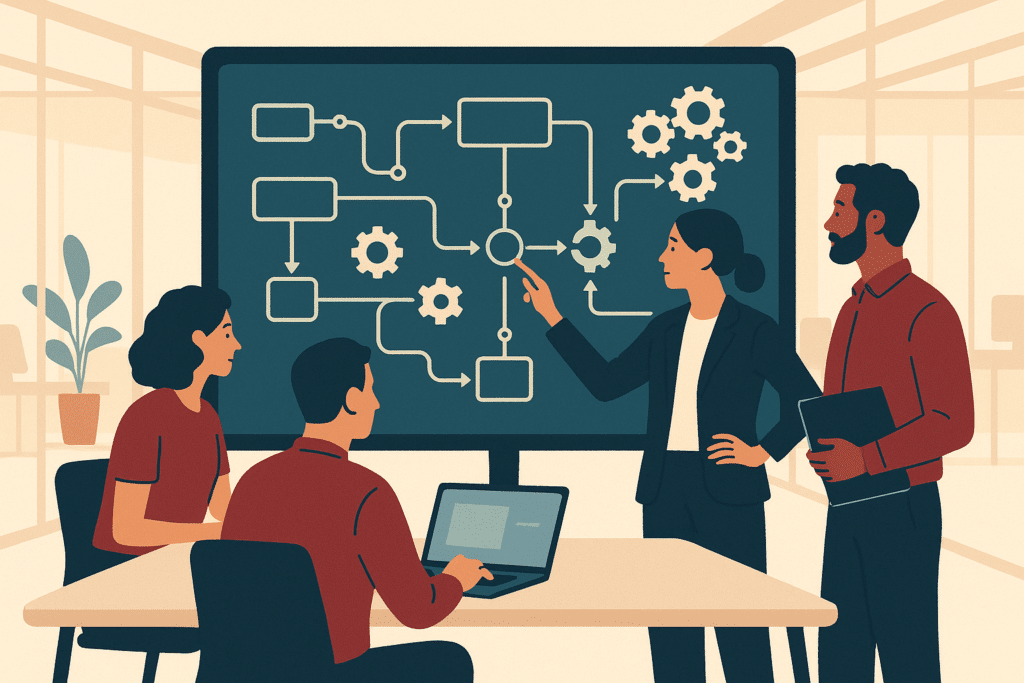
It is common for a distribution company to have eleven separate tools tracking inventory, orders, and supplier communication. Nobody can answer a simple question like “which SKUs are about to run out” without an operations manager pulling three reports by hand every Monday. That is the gap ai integration in custom business software is meant to close. It doesn’t add another dashboard. It builds intelligence into the systems your team already uses, so the manual work disappears. This article walks through what integration involves, what it costs, where it goes wrong, and how to tell whether your business needs it.
What AI integration in custom software means
AI integration in custom business software means embedding capabilities like machine learning models, large language models, or ai agents directly into custom software that reflects how your business actually runs. Instead of coding fixed if-then rules, the system learns from your data. It handles judgment-heavy tasks: flagging anomalies, drafting responses, routing work. This matters because most business processes don't fit rigid logic. They involve exceptions a rules engine can't anticipate. According to the McKinsey State of AI report, adoption is climbing. But value comes from applying AI systems to specific business workflows rather than bolting it on generally. That distinction shapes everything that follows.
Custom AI vs off-the-shelf AI solutions
- Takes longer to build
- Tailored to business operations
- Enhances competitive advantage
- Utilizes proprietary data effectively
- Deploys in days
- Lower upfront costs
- Includes basic tools like chatbots
- Limited control over data
Off-the-shelf ai deploys in days and costs less upfront. You get a chatbot, a transcription tool, a generic analytics add-on. The tradeoff is limited control over your proprietary data and little room to shape behavior around your workflows. Custom ai solutions take longer to build but are shaped to your business operations. That matters when your business processes are the thing that gives you a competitive advantage. A Deloitte report on generative AI adoption found that organizations scaling AI successfully tend to build around proprietary data. Many assume off-the-shelf ai is always cheaper. In reality, generic tools that force manual work often cost more over time.
Benefits of integrating AI into business software
The clearest benefit is less manual work. When ai integration handles repetitive tasks like data entry, categorization, and follow-ups, your team spends time on higher-value work instead of overload. Beyond time savings, integration improves operational efficiency by connecting information that used to sit in separate tools. Leaders gain visibility they didn't have: real numbers, updated automatically, instead of week-old spreadsheets. Custom ai development also supports better data management, since the system is built around your actual data sources rather than someone else's format. The goal isn't more software. It's less manual work and clearer insight into business operations.
Improved efficiency and workflow automation
Workflow automation is where many businesses see fast results. AI removes the handoffs and waiting periods that slow work down. An invoice arrives, gets read, gets matched, gets routed, without a person touching it. Intelligent automation goes further than rule-based scripts because it handles messy inputs, a misspelled vendor name or a scanned receipt, that break traditional workflow automation. One logistics team cut order-processing time from hours to minutes after intelligent automation took over exception handling. That kind of process improvement can compound, an outcome echoed in Deloitte's research on AI and intelligent automation in business, which points to operational efficiency gains. Every repetitive task the system absorbs frees capacity you can redirect toward growth instead of hiring. If you're mapping where automation fits, this practical guide to AI workflows for small business is a useful start.
Enhanced decision making and data analytics
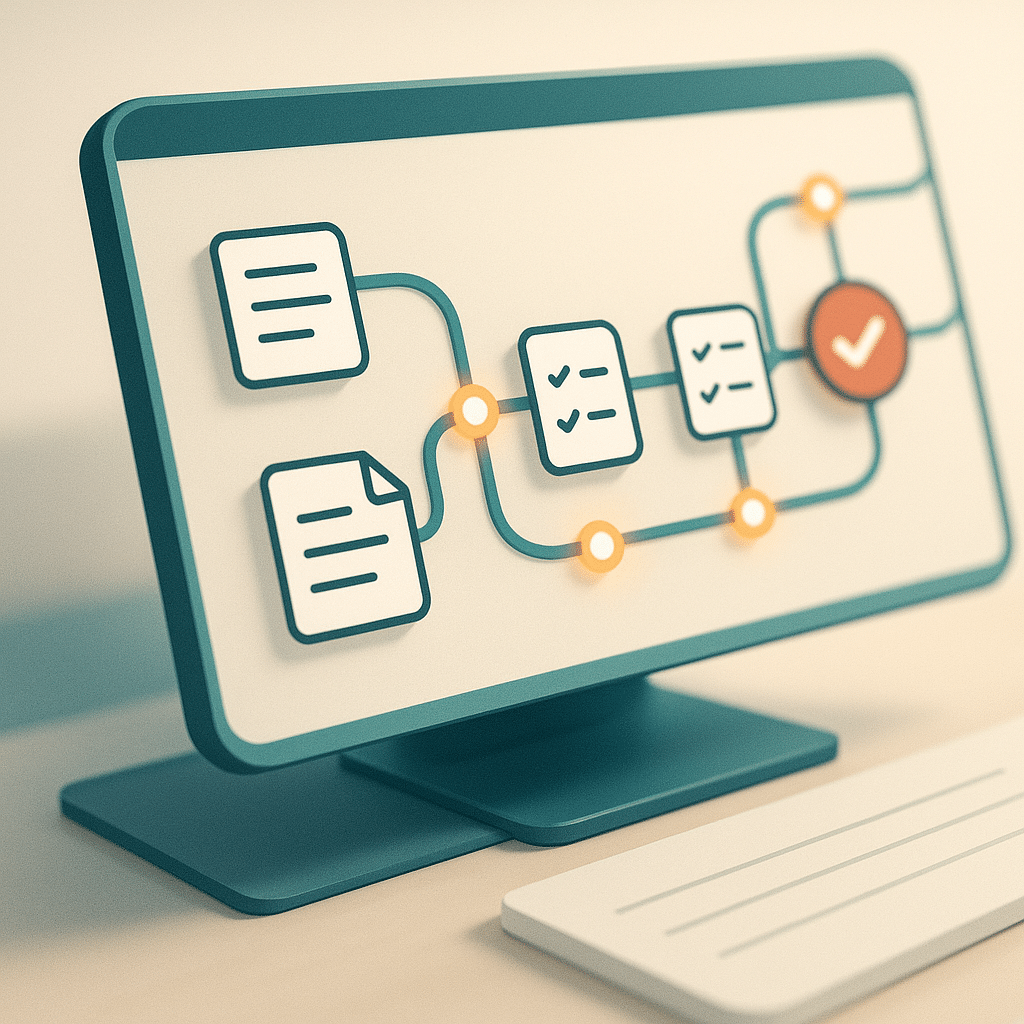
Data sitting in disconnected tools doesn't help anyone decide anything. AI integration turns scattered records into signal. Predictive analytics can flag which customers are likely to churn or which stock will run short before it happens. Decision making shifts from reactive to planned. The root cause of poor decisions in most growing companies isn't a lack of data. It's that the data isn't accessible in a usable form, often trapped in manual processes. Conversational ai layered onto your systems lets a manager ask "what were our slowest-moving products last quarter?" in plain language and get an answer, no report-pulling required. That accessibility is what makes predictive analytics practical rather than theoretical.
Common AI capabilities and technologies (agents, NLP, computer vision, predictive)
A few core capabilities cover most real-world applications. Ai agents handle multi-step tasks on their own: monitoring inventory, generating purchase orders, escalating issues. Natural language processing powers conversational ai and lets systems read and route unstructured text like emails and support tickets. Computer vision reads documents, inspects images, and checks quality on production lines. Predictive analytics forecasts demand, risk, and maintenance needs. Generative ai drafts content and summarizes long records. Agentic ai combines several of these into systems that plan and act toward a goal. You rarely need all of them, only the ones that map to your specific business processes and bottlenecks.
Key steps and strategies for AI implementation
Good ai implementation strategies start with a problem, not a tool. Define one operational bottleneck worth solving, then measure it. Next, get your data in order: clean, connected, and available. Integration built on messy data produces unreliable output. Choose an integration approach that fits, whether API-based access, embedded models, or a setup for querying your own documents. Build a small version, test it against real work, and expand only once it holds. The 10-20-70 rule is a useful frame: 10% algorithms, 20% technology and data, 70% people and processes. Most of these strategies succeed or fail on that last 70%, adoption, not the model. If you're unsure whether your operations are ready, an AI readiness audit can surface the gaps before you commit.
Scalability and flexibility of AI-integrated systems
Custom-built systems earn their cost partly through scalability and flexibility. An off-the-shelf tool ties you to its roadmap and pricing tiers. Scalable systems you own can grow with volume, add a new location, or absorb a new product line, without a forced upgrade or a workaround. This matters because operational complexity grows faster than headcount as a business scales. Rigid tools become the operational bottlenecks themselves. Scalable custom-built systems shaped as custom ai solutions let you adjust logic as your business workflows change. Technology that works the way your team works today should still fit when your team is twice the size.
Data security and compliance in AI integration
Security measures aren't an afterthought once you're feeding proprietary data into AI systems. Custom integration gives you more control here than most off-the-shelf ai, because you decide where data lives, who accesses it, and whether it ever leaves your environment. That control matters for regulated work. Compliance rules vary by industry and jurisdiction. For a structured way to address risk and trust concerns, the NIST AI Risk Management Framework offers government-backed guidance on responsible AI integration. Check the requirements set by your relevant data protection authority or a qualified advisor before deploying anything that touches sensitive records. Practical steps include access controls, encryption, audit logs, and clarity on how third-party models handle your inputs. Build these in from the start; retrofitting them later is harder and riskier.
When a business needs a custom AI solution
Not every business needs custom ai development. If a $50-a-month tool solves your problem cleanly, use it. The signal to go custom is friction: your team spends real hours on manual processes to make generic internal tools cooperate, or the tools can't touch your proprietary data at all. Founder-led businesses often hit this wall when growth outpaces existing systems. Many small business owners assume custom software is enterprise-only. In reality, a focused custom AI business solution solving one expensive bottleneck can pay for itself in time savings. The test is simple: does the tool fit how your business actually operates, or are you bending your operations to fit the tool?
Real-world applications and use cases
Real-world applications tend to be unglamorous and valuable. A property management firm used ai-powered automation to read incoming maintenance requests, categorize urgency, and dispatch the right vendor, cutting response delays sharply. A professional services team built an internal tool where staff query client data in plain language instead of waiting on a report. A distributor deployed ai agents to monitor stock and draft purchase orders through ai-powered automation. In each case the win wasn't the AI itself. It was the removal of a repetitive, error-prone manual step that had been quietly costing time.
Identifying operational bottlenecks before adding AI
Adding AI before you understand your bottlenecks just automates a bad process faster. Start by mapping where work stalls: which tasks pile up, which handoffs cause delays, where people re-enter the same data. The operational bottlenecks that matter are the ones costing measurable time or money, a two-day approval delay, or a weekly report that takes a full afternoon. In failed projects, teams pick an impressive AI feature first, then hunt for a problem to attach it to. Reverse that. Find the expensive manual processes across your business operations, quantify them, and only then decide where ai integration in custom business software earns its place. Fixing that sequence, problem first and technology second, is real process improvement, separating a system that removes manual work from one that just adds another layer.
Connecting disconnected systems and internal tools
Most businesses don't suffer from a lack of tools. They suffer from tools that don't talk to each other. Your CRM holds one version of the truth, your finance system another, and your operations team keeps a spreadsheet to bridge the gap. Every manual copy-paste is a point where errors and delays creep in. The fix isn't buying more software. It's building integrations that let data flow automatically between systems, so information stays consistent and your team stops acting as human middleware. When systems connect properly, the manual glue work disappears and people focus on actual decisions.
Reducing founder dependency through operational visibility
When a business relies on the founder to answer every operational question, growth stalls. The knowledge lives in one person's head, not in the systems. Operational visibility changes that. When key metrics, workflows, and status updates are captured in dashboards and automated reports, the answers become accessible to the whole team. Founders stop being the bottleneck for approvals and progress checks. The goal is simple: make the business legible without needing constant explanation. Once the numbers and processes are visible in real time, decisions get delegated with confidence and the founder can step back from daily firefighting.
Frequently Asked Questions
What does AI integration in custom business software actually mean?
It means embedding capabilities like machine learning models, large language models, or AI agents directly into software built around how your business operates. Instead of following fixed rules, the system learns from your data and handles complex tasks automatically.
How do I integrate AI into my custom-built application?
Start by identifying a specific operational problem worth solving, then choose an integration pattern such as API-based access, embedded models, or Retrieval-Augmented Generation (RAG). Before building anything, make sure your internal data is clean, connected, and available:and confirm usage rights for any external data.
What AI features are worth adding to custom business software?
The most practical additions include AI agents that manage tasks like monitoring inventory and generating purchase orders, and conversational data discovery that lets your team ask questions in plain language instead of pulling reports. The right features depend on which manual processes and bottlenecks are costing your team the most time.
How much does it cost to integrate AI into custom software?
A basic feature like a chatbot or simple automation typically runs $5,000 to $25,000, while AI-powered analytics or multi-system coordination falls between $25,000 and $80,000. Fine-tuned models or custom AI agents can range from $50,000 to over $200,000, and none of these figures include ongoing API usage, infrastructure, and monitoring costs.
Is custom AI integration actually worth it over off-the-shelf tools?
Off-the-shelf tools deploy in days and cost less upfront, but they offer limited customization and less control over your data. Custom integration makes sense when your workflows are specific enough that generic tools create more manual workarounds than they remove:the deciding factor is whether the tool fits how your business actually operates.
What if my data isn't clean or well-organized:can I still integrate AI?
You can, but the results will be unreliable, because AI outputs are only as good as the data feeding them. Fixing internal data quality and connecting disconnected systems should come before integration, not after.
Why does AI integration matter for a growing business?
Automating repetitive tasks can reduce operational costs by roughly 30-40% while improving accuracy, freeing your team from administrative overload. It also turns scattered data into actionable insight, which helps leaders regain visibility as growth adds operational complexity.
What's the 10-20-70 rule for AI, and why should I care?
It's a guideline for where to focus AI efforts: 10% on algorithms, 20% on technology and data, and 70% on people and processes. The point is that adoption fails when businesses treat AI as a technical project instead of an operational and human one.