
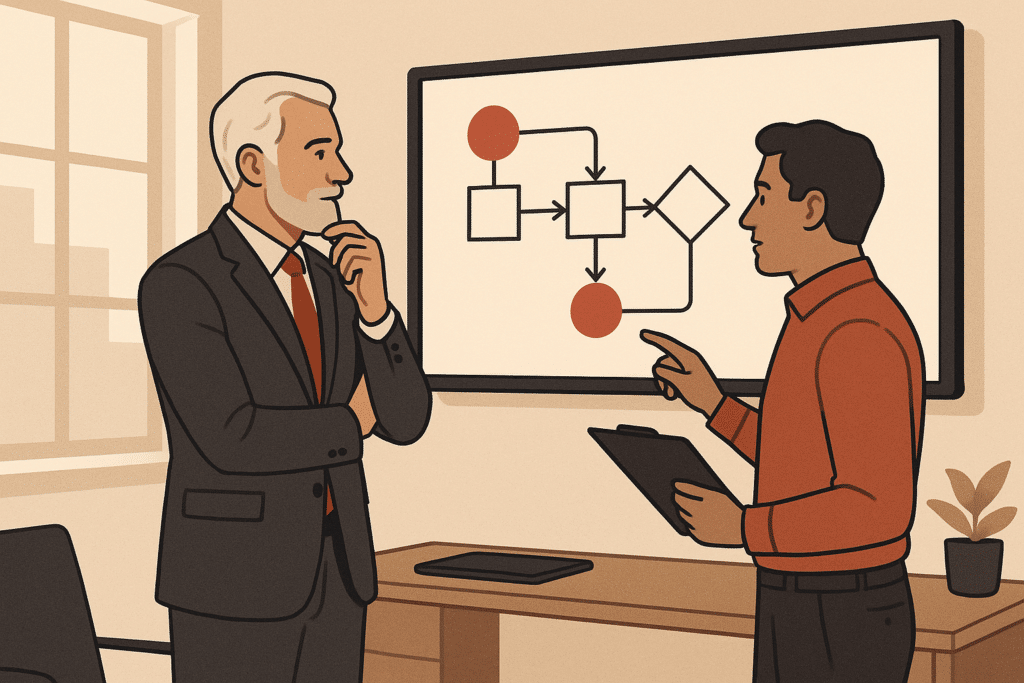
A five-person operations team spends eleven hours a week copying data between a CRM, a spreadsheet, and an invoicing tool. Nobody planned it that way. It grew one workaround at a time, and now it's the reason the founder can't take a week off. This is the real problem good ai consulting services solve. The point isn't adding another dashboard. It's removing the repetitive work that quietly eats your week. This article walks through what these services include, how to judge a partner, and where custom AI systems genuinely reduce manual effort versus where they just add cost.
What AI consulting services are (definition and scope)
AI consulting services help a business figure out where AI and automation actually fit, then build the systems to make it happen. That scope usually spans ai strategy development, ai implementation, data infrastructure work, team enablement, and ai governance. A good ai consulting company doesn't lead with technology. It starts with your business operations and works backward from the manual processes slowing you down. If you're unsure where to begin, our guide on where to actually start with AI breaks the decision down step by step. The point isn't a shiny model. It's less manual work and clearer operational visibility. According to McKinsey's State of AI research, companies seeing returns tend to redesign workflows rather than bolt AI onto existing ones. That's where scoping earns its keep. The scope flexes with company size: a founder-led firm of ten needs something different from a fifty-person operation, and discovery is where that difference gets defined instead of assumed.
Core AI consulting service offerings breakdown
Most engagements bundle a handful of distinct services. Strategy and an ai strategy and roadmap come first. Then ai implementation: building the workflow automation, ai agents, and internal tools that do the work. Underneath sits data engineering and data infrastructure, because messy data breaks even well-designed ai systems. Around all of it you need ai governance, ai security, and risk management so the whole thing stays safe and auditable. Finally, team enablement helps people actually use what gets built. The U.S. Small Business Administration offers useful planning guidance for smaller firms weighing where to start. The mix should match your problem, not a fixed package. A retail operation buried in inventory reconciliation needs heavy data engineering, while a services firm may need mostly ai agents and internal tools for client intake. Buying the full stack when you only need two pieces is a common way to overspend before proving they work.
AI strategy and roadmap development
Ai strategy development is where you decide what to build and, more usefully, what to ignore. Good ai strategy consultants start with an ai maturity assessment: how ready is your data, what do your business workflows look like, and where do the operational bottlenecks actually sit. Running an AI readiness audit of your operations is a practical way to surface those answers before committing budget. From there you get an ai strategy and roadmap that ranks ai use cases by expected business outcomes and feasibility, not by what's trendy. Here's why it matters. Most failed projects didn't fail at the model. They failed because nobody scoped the process first. A clear roadmap sequences the work so early wins fund later ones and the whole thing stays tied to measurable value. Consider an accounting firm that wanted to automate client reporting: the roadmap flagged that their data lived in four unconnected tools, so the first phase consolidated that data, and only the second built the reporting automation. Skipping that sequence would have produced fast reports built on unreliable numbers.
Why organizations need AI consulting / common challenges
The pattern is predictable. A company grows, tools pile up, and information ends up scattered across disconnected systems nobody fully controls. Teams drown in manual processes. Leaders lose visibility. Founder-led businesses hit a wall where too much knowledge sits in one person's head. Many assume the fix is more software. In reality, that usually adds another silo. As we've argued in a piece on why more software isn't the answer, the underlying data and process problems rarely get solved by another tool. What actually happens is that repetitive work quietly caps how much the business can grow without hiring. The Bureau of Labor Statistics analysis of automation and occupations offers a useful reference for which repetitive tasks are most exposed to automation. Ai consulting services help because an outside operator can see the operational bottlenecks the team stopped noticing. From there, they design process improvement around how the business already runs.

Data infrastructure and readiness foundation
Nothing works if the data underneath is broken. Before any ai integration, a consultant audits where your data lives, how clean it is, and whether it's accessible. This is the unglamorous data engineering that makes everything else possible. The root cause of most stalled ai adoption is poor data infrastructure: records duplicated across disconnected systems, formats that don't match, and gaps nobody documented. Getting this right isn't optional. Scalable systems depend on a reliable data foundation. Otherwise every automation you build inherits the same errors and multiplies them. Readiness work often surfaces quick wins too, like consolidating reporting that used to take half a day. Picture a services company whose customer records lived in both a CRM and a billing tool, with names spelled three different ways: any ai agent built on that mess would send invoices to the wrong contacts and erode trust fast. Cleaning and connecting that data first is what makes the later automation reliable instead of a new source of errors.
AI integration with existing systems and workflows
You already have tools your team knows. The goal of ai integration isn't to rip them out. It's to connect them so information stops getting re-entered by hand. This is where workflow automation earns its reputation: an ai system that reads a form, updates the CRM, triggers an invoice, and notifies the right person, without anyone touching a keyboard. Custom ai solutions get built around your actual business workflows rather than forcing your team to change how they work. This is the idea behind AI integration in custom business software, where the system fits your process instead of the other way around. Done well, ai implementation removes the copy-paste bridges between systems. It gives leaders real operational visibility instead of stitched-together reports. The reason integration matters more than raw capability is simple: a model that can't reach your data can't act on it, so the connective work is usually where the time savings actually come from.
Industries and use cases served
Ai consulting services fit any business running on repetitive tasks, but some see faster returns. Real estate firms automate lead intake, document handling, and follow-up. Professional service firms cut manual work in onboarding, scheduling, and reporting. Multi-location businesses use intelligent automation to standardize operations across sites. Common ai use cases include automated document processing, ai agents that handle first-line customer questions, internal tools that pull scattered data into one view, and workflow automation across finance and admin. The through-line is the same: identify the manual processes clogging business operations, then build custom ai solutions that remove them and improve operational efficiency. Businesses with high transaction volume and repeatable steps tend to see returns first, because automation pays back fastest where the same task repeats hundreds of times a week rather than in irregular one-off work.
Business outcomes, ROI, and measurable value
Judge this work by business outcomes, not model accuracy. Well-scoped projects commonly reach positive ROI within 6 to 12 months. Mid-sized companies have reported operational cost reductions in the 20 to 40 percent range through automation. Those numbers vary based on existing processes, complexity, implementation, and team adoption, so treat them as ranges, not promises. The measurable value shows up as time savings, fewer errors, and operational efficiency that lets the same team handle more volume. A good ai consulting partner defines the metrics upfront: hours removed per week, faster turnaround, cleaner data. If you want to run the numbers yourself, our walkthrough on calculating ROI on AI automation projects shows how. If you can't measure it, you can't tell whether the ROI is real.

AI governance, security, and risk management
- Don’t overlook AI governance as an afterthought
- Ensure strict access controls for sensitive data
- Monitor automated actions with an audit trail
- Confirm compliance with data protection regulations
- Regularly review systems to prevent drift and errors
Automation touches sensitive data, so ai governance can't be an afterthought. Ai security means controlling who and what can access records, keeping an audit trail of automated actions, and making sure ai agents operate within clear limits. Risk management here is practical: what happens when a system gets a bad input, and who catches it. Depending on your sector, you may fall under your country's data protection authority or industry-specific rules. It's worth confirming requirements with a qualified professional before deployment. Good governance also keeps intelligent automation trustworthy over time, because unmonitored systems drift, and drift quietly reintroduces the errors you automated away. The mechanism is straightforward: an automated process handling thousands of records amplifies a single overlooked error far faster than a human doing the same task by hand, which is why monitoring and clear limits matter as volume grows.
Team enablement, upskilling, and adoption readiness
Software that nobody uses is wasted money. Team enablement is the part where your people learn to work alongside the new ai systems, not around them. That means clear handover, plain-language documentation, and training focused on what changed in their day, not on the details beneath the surface. Ai adoption rarely stalls because of the tech. It stalls because people quietly revert to old manual work when the new way feels unfamiliar. As the Harvard Business Review on AI augmenting human work points out, the strongest results come when AI removes drudgery and elevates what people do rather than sidelining them. Adoption readiness fixes this by involving the team early, so the workflow automation matches how they actually operate. When the tool feels like less effort than before, adoption takes care of itself.
Generative AI and LLM solutions
Generative ai solutions have real uses, and plenty of hype to cut through. The practical applications are focused: drafting first versions of routine documents, summarizing long threads, answering internal questions from your own knowledge base, and powering ai agents that handle common requests. Built well, these generative AI solutions that remove manual work plug into your business workflows and reduce manual work on tasks that used to swallow hours. Built badly, they can produce inaccurate output and create rework. The difference is scoping and guardrails. A generative model works best on well-defined tasks with human review at the edges, not as a general-purpose replacement for judgment your team is paid to exercise.
How to choose an AI consulting partner
Look for evidence, not vocabulary. An ai consulting partner worth hiring can point to real deployments, not just decks. Ask how they scope work: a structured discovery process and an ai strategy and roadmap beat ad-hoc advice every time. Check whether they start with your operations rather than a product they're keen to sell, because a partner who leads with a fixed platform fits your problem to their tool instead of the reverse. Ask how they measure success, who owns the systems once built, and how they handle handover. A boutique ai consulting company often moves faster and costs less than a large enterprise consultancy, while a bigger firm may suit companies needing broad, multi-region rollouts. The right choice depends on your size, your timeline, and how much you value custom systems built around how your business actually operates. The best ai consulting services leave you with less manual work, clearer visibility, and scalable systems your team can actually run without the original consultant in the room.
Removing manual work through workflow automation
Manual work is rarely the real problem. The problem is the gap between systems that don't talk to each other, forcing your team to copy data, chase approvals, and re-enter the same information across five tools. Workflow automation closes that gap. Instead of adding more software, you connect what you already use so tasks move on their own. A lead becomes a record, an invoice triggers a follow-up, a signed contract kicks off onboarding. The outcome is simple: fewer errors, faster turnaround, and your people spending time on decisions instead of data entry.
Custom-built AI systems vs off-the-shelf software
- Designed around your business operations
- Higher adoption rates due to precise fit
- Eliminates unnecessary workarounds
- Results compound over time
- Solves average business problems
- Requires reshaping operations to fit
- May include unused features
- Limited customization options
Off-the-shelf software solves the average business's problem. The trouble is your business isn't average. Generic tools force you to reshape your operations around their assumptions, and you end up paying for features you never use while working around the ones you need. Custom-built AI systems flip that. They're designed around how your business actually runs, your data, your process, your edge cases. The comparison isn't about complexity or cost per seat. It's about fit. When a system matches your operations precisely, adoption is higher, workarounds disappear, and the results compound instead of plateauing at what the vendor decided was enough.
Reducing founder dependency and operational bottlenecks
When too many decisions route through one person, that person becomes the ceiling. Founder dependency feels like control, but it's really a bottleneck that slows growth and creates single points of failure. The fix is to move knowledge out of your head and into systems. Document the decisions, encode the rules, and let automation handle the repeatable calls so your judgment is reserved for the ones that genuinely need it. This frees you to work on the business rather than inside it, and it means operations keep running smoothly on the days you step away.
Frequently Asked Questions
What's actually included in AI consulting services, and what does it cost?
Most engagements cover strategy and roadmap development, AI and machine learning implementation, MLOps and infrastructure support, team training, and governance or compliance. Cost varies widely based on project scope, data readiness, and whether you need a one-off proof of concept or full deployment, so pricing is typically quoted per project rather than as a flat rate.
How do I pick the right AI consulting firm for my business?
Prioritize firms with a track record of real-world deployments over theoretical strategy, plus experience in your specific industry and its regulatory requirements. Look for a structured methodology and roadmap rather than ad-hoc advice, so the work is built around how your business actually operates.
Are AI consulting services worth it for a small or mid-sized company?
They can be, if the approach is scaled to your resources and focused on quick, measurable returns. Boutique firms serving smaller companies report roughly 40% faster time-to-value at 50-70% lower cost than large enterprise consultancies, which suits businesses that need focused fixes rather than sprawling transformation programs.
What kind of ROI can I realistically expect from an AI consultant?
Well-scoped projects often reach positive ROI within 6 to 12 months. Mid-sized companies have reported 20-40% reductions in operational costs through automation and 25-50% improvements in lead conversion, though results depend heavily on implementation quality and how ready your data and processes are.
Should I build an in-house AI team instead of hiring consultants?
An in-house team offers deep organizational knowledge, full IP ownership, and long-term capability building, but it's slower and more expensive to stand up. Consulting is usually the better fit when you need results quickly, lack internal AI expertise, or want to validate use cases before committing to permanent headcount.
What if the AI project doesn't work or wastes our money?
A structured engagement reduces that risk by starting with discovery and a prioritized roadmap, then testing a proof of concept before full deployment. This staged approach lets you validate feasibility and expected returns on a small scale before investing in the underlying problem, rather than paying for a full build upfront.
How does an AI consulting engagement actually work from start to finish?
It typically moves through discovery and assessment (stakeholder interviews, process audits, data inventories), opportunity mapping to prioritize use cases by ROI and feasibility, a proof of concept, and then full implementation and support. The early phases identify operational bottlenecks so the eventual build removes repetitive work rather than adding more software.
We're not a technical company:will we be able to understand and use what's built?
A good consultant explains technology through business outcomes and delivers systems that work the way your team already works. The goal is less manual effort and clearer visibility into operations, not technical complexity your team can't maintain.