

A 12-person property management firm we worked with had one operations lead spending 14 hours a week copying tenant data between a CRM, a spreadsheet, and an email client. Nobody called it a problem. It was just "how things got done." That kind of invisible drain is exactly where generative ai solutions earn their keep. They don't replace people. They remove the repetitive parts of a job that never should have been manual. This article walks through what generative AI actually does, where it fits in business operations, and how it lifts operational efficiency.
What generative AI is and how it works for business
Generative AI learns patterns from large datasets and then produces new outputs, text, code, images, in response to a prompt. Large language models predict the most likely next piece of content based on their training. For operations, that means drafting, summarizing, and generating drafts that a person reviews. According to IBM, generative models differ from earlier ai systems because they create rather than classify. The practical takeaway: the best ai solutions for business work on a specific operational task, not pointed vaguely at "productivity." If you're unsure where to begin, our guide on where to actually start with AI breaks the process down step by step.
Generative AI tools and solution categories
Most generative ai solutions fall into a few buckets. Text generation handles drafting emails, reports, and document summaries. Code generation speeds up internal tools and integrations. Image generation supports marketing and design work. Then there are ai agents that string multiple steps together. The Microsoft Work Trend Index tracks adoption, and the pattern is clear. General assistants handle everyday tasks, while custom-built systems get built when a workflow is specific to one business.
Business benefits and outcomes of generative AI
The business value shows up as time savings and cost savings from fewer repetitive tasks, which lifts operational efficiency across the team. Teams that spend hours drafting the same documents or answering the same questions get that time back. McKinsey's research on AI adoption across business functions shows organizations using generative AI to cut manual work and tighten operations. Most bottlenecks aren't caused by hard problems. They're caused by volume: the same small task done hundreds of times. The bigger gains come from quiet, unglamorous work: summaries, reports, data entry, and first drafts, a theme explored in depth across Harvard Business Review coverage of automation and the future of work. Before committing budget, it's worth learning how to calculate ROI on AI automation projects so the time saved translates into real numbers.

Automating processes and workflows
Workflow automation is where generative AI stops being a novelty and starts paying for itself. The point isn't automating processes for the sake of it. It's process improvement that removes the handoffs where information gets retyped, re-entered, or lost between disconnected systems. A typical case: an inquiry comes in by email, gets logged in a CRM, triggers a follow-up, and updates a report. Connect those business workflows with workflow automation and the team stops babysitting the process while gaining clearer visibility for everyday decision-making. Our practical guide to AI workflows for small business walks through what this looks like in day-to-day operations.
Building and scaling generative AI applications
Building ai applications that hold up under real use takes more than a clever prompt. You need ai infrastructure that connects to your existing internal tools, data that's clean enough to be useful, and a plan for the full ai lifecycle. The root cause of most failed projects is skipping the foundation: teams bolt a model onto disconnected systems and wonder why outputs are wrong. Scalable systems start with data quality and connected sources, a point echoed in Gartner analysis of generative AI in business operations. Get that right, and a small tool can grow with the business instead of breaking when volume doubles.
AI agents and agentic AI capabilities
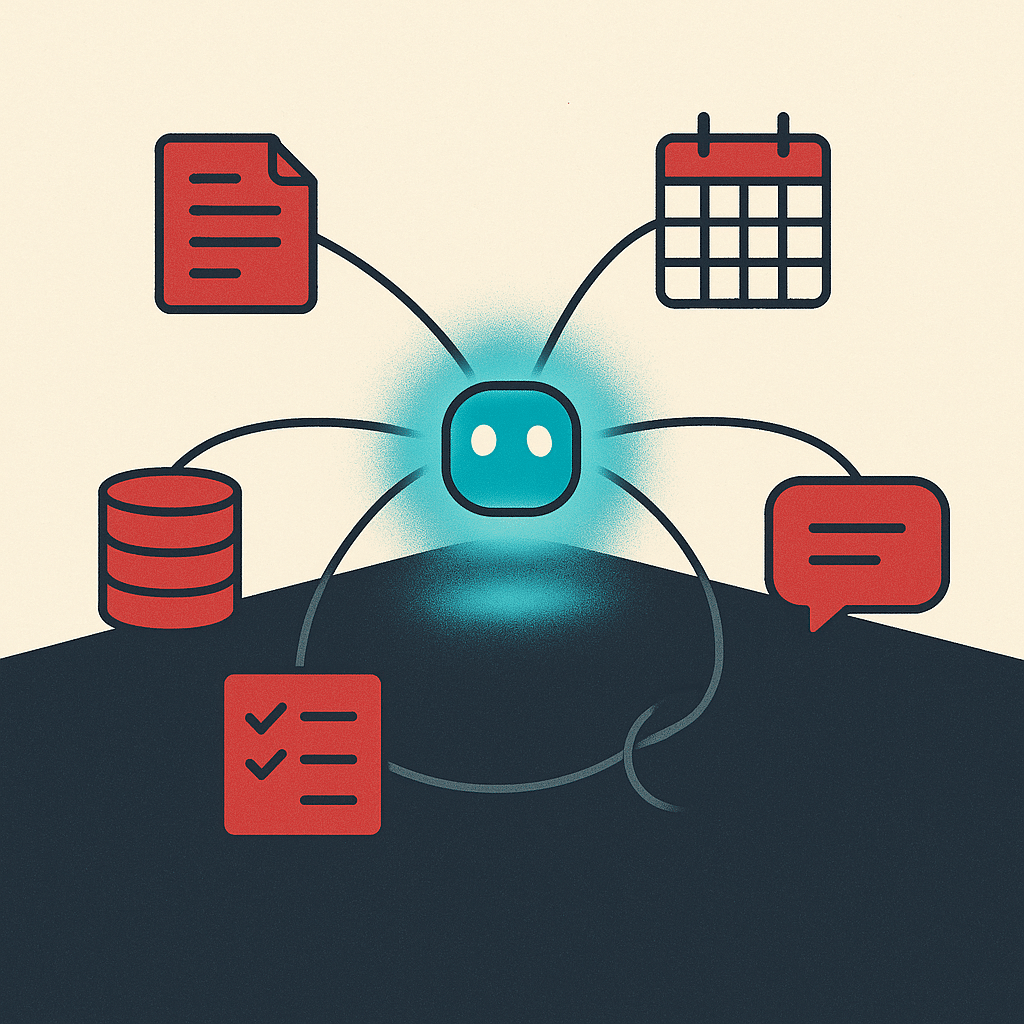
AI agents take generative AI a step further. Instead of producing a single output, agentic ai can plan, take actions across tools, and complete multi-step tasks with limited supervision. Think of an agent that reads an incoming request, pulls the relevant records, drafts a response, and updates the system, all without a person stitching it together. That said, agentic ai isn't magic. Agents work best on well-defined operations with clear rules and good data. Pointed at messy processes, they amplify the mess.
LLMs, RAG, and underlying AI technology
Large language models are the engine behind most generative ai tools, but on their own they only know what they were trained on. That's where retrieval-augmented generation, RAG, comes in. It lets the model pull from your own documents and data before answering, so outputs reflect your business rather than the open internet. This is why data quality matters so much, especially for enterprise ai used in real decision-making. The same models pointed at outdated or scattered data produce confident nonsense. We dig into why more software isn't the fix for data problems and what actually moves the needle.
Security, privacy, and responsible AI
Any ai systems touching customer or operational data raise real questions about security and privacy. Where does your data go, who can see it, and is it used to train someone else's model? Responsible ai means controlling that: keeping sensitive information inside systems you govern, limiting access, and reviewing outputs before they reach a customer. For regulated enterprise ai work, confirm compliance with the relevant data protection rules in your jurisdiction. Custom-built systems give you more control here than general tools do.
How customers and industries innovate with generative AI
Different industries apply generative AI to whatever manual work dominates their day. Service-based firms use it to draft proposals and summarize client calls. Real estate businesses automate listing content and tenant communication. Professional service firms generate first-draft reports from raw data. The pattern is the same: the best ai solutions for business succeed when they target a specific, high-volume task rather than a vague ambition. Multi-location businesses get the clearest wins, since the same process across sites multiplies the cost savings. U.S. Bureau of Labor Statistics data on time spent on administrative tasks helps quantify how much of the workday these repetitive duties consume.

Custom-built AI systems vs off-the-shelf software
- Tailored to specific workflows and processes
- Ideal for unique automation needs
- Requires more development time and resources
- Quick implementation for standard tasks
- Cost-effective for general use
- May not fit unique workflows perfectly
Off-the-shelf generative ai tools like ChatGPT Enterprise or Microsoft 365 Copilot are excellent for general, standard tasks. Custom-built systems make sense when your workflows are specific, when the process you're automating doesn't look like anyone else's. The decision is simpler than it sounds. If a tool off the shelf already fits how your team works, use it. If you're constantly bending your process to fit the software, that's the signal for a custom AI solution built around how you operate.
Removing manual work and operational bottlenecks for SMBs
Small and mid-size businesses feel manual work the hardest, because the same person often does five jobs. When too much knowledge sits with one founder, growth creates operational bottlenecks fast. Generative ai solutions help by absorbing repetitive tasks, drafting, summarizing, data movement, so the team handles higher-value work and gains sharper visibility for daily decision-making. Built around how your business operates, the right scalable system removes the bottleneck instead of adding another tool.
If repetitive work is slowing your team down, a short discovery call with Bespoke Mind AI can help identify where automation and custom AI systems would actually remove manual effort. No pressure, just a practical look at your operational bottlenecks and whether a tailored solution makes sense for how your business runs.
Frequently Asked Questions
What are generative AI solutions and how do they actually work?
Generative AI solutions are systems that create new content:text, images, audio, or code:by learning patterns from large datasets. They typically work in three phases: training a foundational model on unstructured data, tuning it for specific tasks, and then generating outputs in response to prompts.
How are generative AI solutions different from traditional AI tools?
Traditional AI follows predefined rules to perform narrow tasks like fraud detection or recommendations, usually trained on labeled data to recognize patterns. Generative AI instead focuses on producing new content rather than classifying or predicting within fixed parameters.
What kinds of operational problems can generative AI solve for a business?
It can handle repetitive work like drafting documents, summarizing information, generating reports, and supporting customer interactions. For most businesses, the real value is removing manual effort from existing workflows rather than producing creative content.
Is investing in generative AI actually worth it for a small business?
McKinsey and others point to measurable gains, with some reports citing 60-87% time savings on tasks like content creation and customer service. The return depends on targeting a real bottleneck:if a process is already efficient or low-volume, the gains will be limited.
What if my company's data isn't clean or organized:can we still use generative AI?
Data readiness is one of the biggest factors in whether a solution works, since models need relevant, accessible information to be useful. If your data is scattered across disconnected tools, it's often worth fixing that visibility problem before layering AI on top.
Should we build a custom generative AI system or just buy an off-the-shelf tool?
Off-the-shelf tools like ChatGPT Enterprise or Microsoft 365 Copilot work well for general tasks, while custom-built systems fit workflows that are specific to how your business operates. The decision usually comes down to whether your processes are standard or unique enough to justify a tailored build.
How do I choose the right generative AI solution for my company?
Start by defining the specific problem you want to solve, then assess whether you have the data to support it, and decide between building or buying. Match the solution to a measurable operational outcome rather than adopting AI for its own sake.
Is ChatGPT the same thing as generative AI?
ChatGPT is one example of generative AI, not the whole category. Many other models exist:including ones that generate images, audio, and video:from providers like OpenAI, Anthropic, and Mistral AI.