
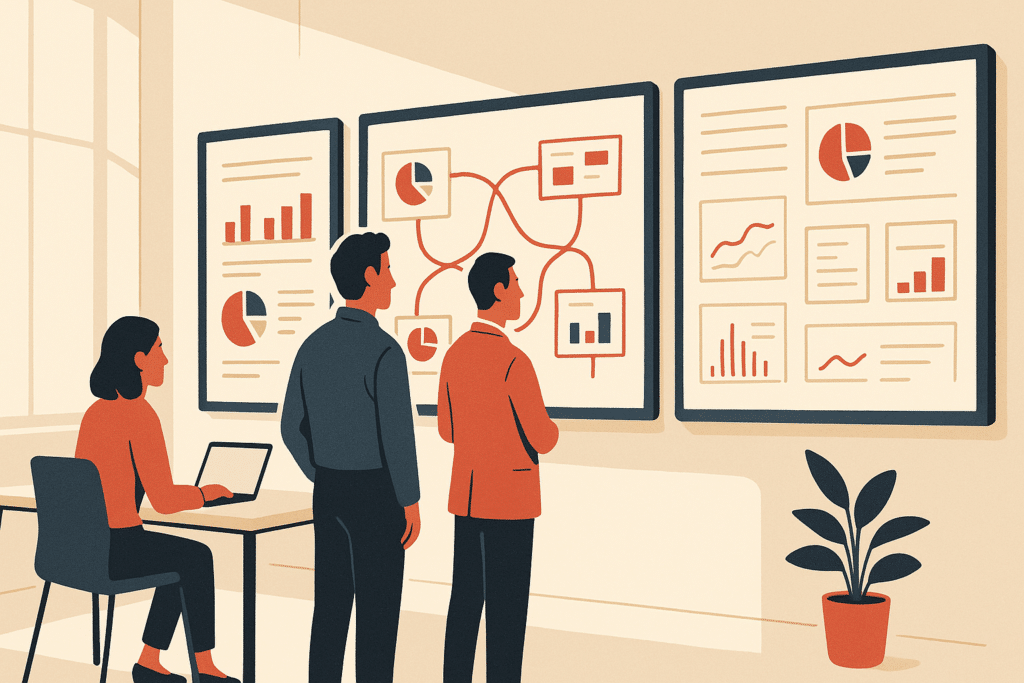
In plenty of logistics companies, several people manually copy order data between three systems every morning. Two hours a day, gone to a task a machine should handle. That’s the gap most ready-made tools never close. It’s exactly where custom ai business solutions earn their keep. This article walks through what these systems are, how they compare to packaged software, what they cost, and how to decide whether your operational problems fit a subscription or need a build.
What custom AI business solutions are
A custom ai solution is software built around how your business actually operates. It’s trained on your proprietary data and wired into the tools your team uses. Instead of forcing your processes to match a vendor’s template, the system reflects your decision logic, your documents, and your business workflows. According to McKinsey, most companies still struggle to capture value from AI because they bolt generic tools onto unique business operations. Their broader findings on automation potential across business processes show just how much manual work can realistically be removed once systems are designed around real workflows. Custom ai solutions close that gap by starting with the problem, not the product. The result is fewer manual processes and ai systems that behave the way your operations demand.
Custom AI vs off-the-shelf software
- Takes longer to build and costs more
- Integrates with disconnected systems
- Provides full control over behavior and data
- Delivers competitive advantage for specific needs
- Wins on speed and upfront cost
- Quick deployment within a week
- Serves broad use cases
- May not match specific workflows
Off-the-shelf software wins on speed and upfront cost. You subscribe, you deploy, you’re running in a week. The trade-off is that those tools serve broad use cases. They rarely match the specific workflows where your manual work piles up. A custom ai solution takes longer and costs more to build. But it integrates with your disconnected systems and gives full control over behavior and data. Gartner has noted that integration failures, not the technology, sink most AI projects. Additional Gartner insights on AI adoption in business operations reinforce how enterprise readiness, not raw capability, often determines whether a project delivers. Many assume custom means enterprise-only. In reality, mid-market teams choose custom ai solutions because their bottlenecks are too specific for packaged tools. A tailored build matched to their business needs delivers a competitive advantage generic off-the-shelf software can’t.
Key benefits of custom AI for business operations
The clearest benefit is time savings on repetitive tasks. When a system handles the data entry, lookups, and routing your team does by hand, people move to higher-value work. U.S. Bureau of Labor Statistics data on time spent on administrative tasks helps quantify just how much of the workday disappears into this kind of overhead. Custom ai solutions also improve operational efficiency by removing the copy-paste handoffs between disconnected systems. You get ai-driven analytics built on your own numbers, not a generic dashboard. The reason this matters: accuracy comes from training on your data, so outputs reflect your actual operations. Custom-built systems scale with you, turning growth from chaos into something your workflow automation absorbs quietly.
Types and use cases of custom AI solutions
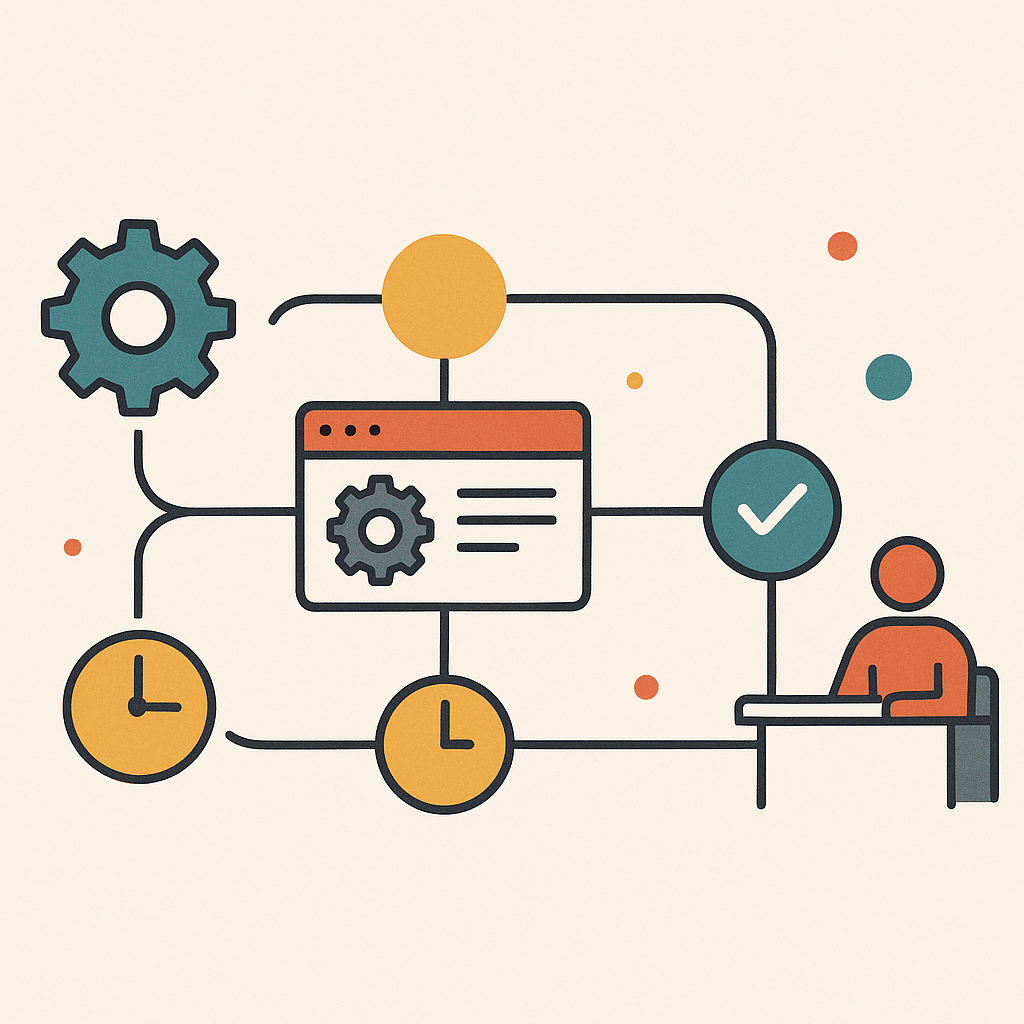
Custom ai development covers more ground than chatbots. Common builds include ai-powered automation for back-office workflows, internal tools that consolidate scattered data, and ai-driven analytics that turn raw operational data into decisions leaders act on. Service firms use generative ai to draft proposals and summarize client documents. Real estate and multi-location businesses use custom-built systems to standardize processes across sites. Ai in customer service routes and resolves routine requests without losing the human touch on complex ones. Each of these custom ai solutions targets a specific operational bottleneck, not a general “productivity” promise.
AI agents and automation for workflows
Ai agents are where workflow automation gets genuinely useful. Unlike a fixed script, intelligent agents can read context, make decisions within rules you set, and complete multi-step business workflows on their own. An agent might pull an invoice, validate it against a purchase order, flag the mismatch, and route it for approval, all without a person touching it. The agent handles judgment calls that used to require a human, while staying inside guardrails you define. That’s the difference between automation that breaks on edge cases and intelligent agents that handle the messy reality of business operations.
How a custom AI solution is built (development process)
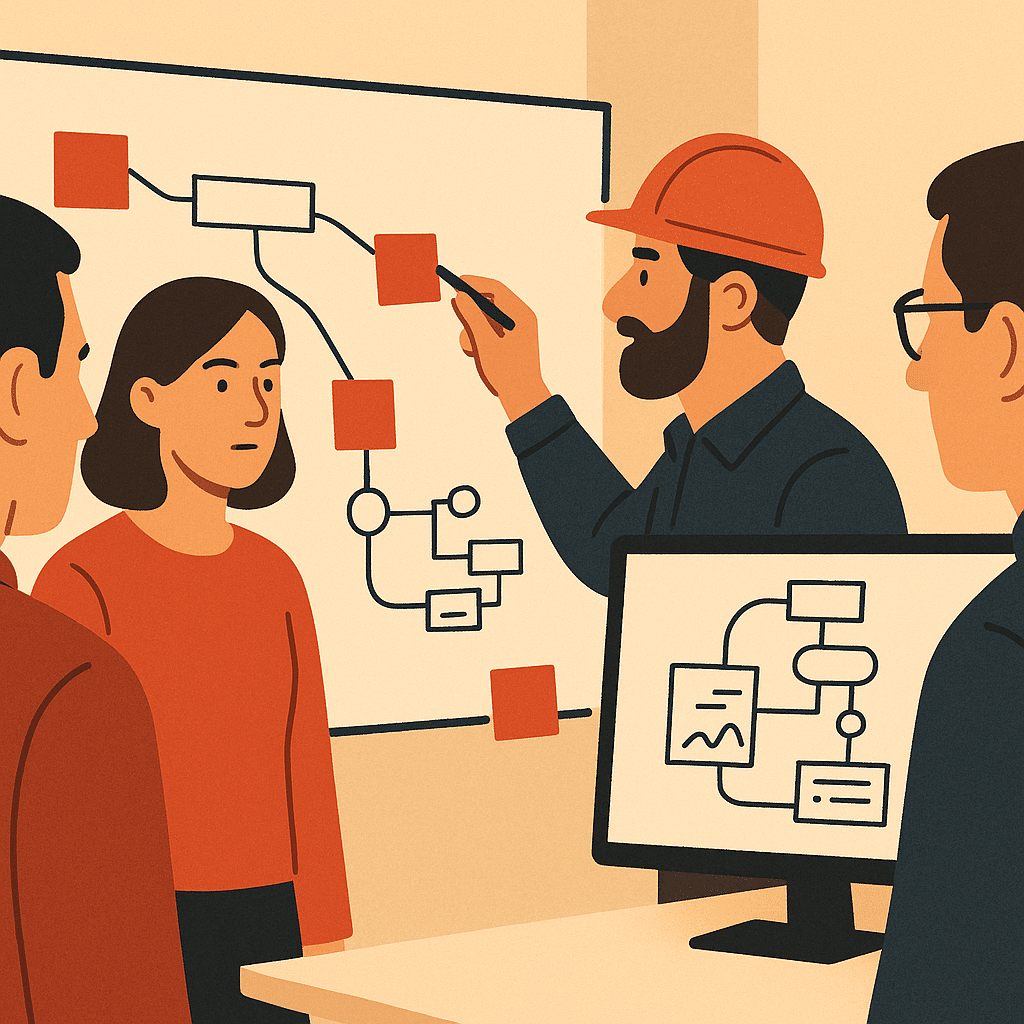
Good custom ai development starts with discovery, not code. We map your manual processes, find where time leaks, and identify which operational bottlenecks justify a build. Next comes data integration: pulling your documents, databases, and tools into one place the system can use. Then we build and test against real workflows, adjusting until outputs match how your team decides. Deployment is staged, not flipped overnight, so operations keep running. The goal throughout is technology that works the way your team works. Drawing on research on operational efficiency and workflow design, the most durable gains come from rethinking the process itself, not just layering software on top of it. We once watched a client skip the discovery step on a finance build and wire AI straight onto a broken approval chain; the system automated the wrong handoff and produced mismatched ledgers for a full quarter before anyone caught it. If you want a clearer picture of the steps involved, our overview of how the process unfolds breaks it down. Results vary based on existing processes, complexity, implementation, and team adoption.
When a business needs custom AI
You don’t need custom AI for everything. If a packaged tool already covers your need cleanly, use it. The case for a custom ai solution appears when your bottlenecks are specific, your data is proprietary, or your business workflows span several disconnected systems no single product handles. Founder-led companies hitting growth-related inefficiencies are a frequent trigger. The manual work one person held together stops scaling. If your operational data exists but isn’t accessible, or your team spends hours on repetitive tasks with clear rules, those business needs signal custom ai solutions are worth evaluating.
Choosing a custom AI development partner
Pick an ai development partner who starts with your operations, not their tech stack. The right partner runs a discovery-led process, asks about your bottlenecks before pitching ai implementation strategies, and commits to building and deploying, not just advising. Ask whether you’ll work directly with the people doing the build. Founder access usually means clearer decisions and less lost in translation. A good ai development partner also plans for maintenance from day one, because an unmonitored system degrades as your data and workflows shift underneath it. Be cautious of anyone promising guaranteed ROI or full automation of every process. Honest partners describe realistic outcomes.
Solving operational bottlenecks and manual work
Most manual work hides in the seams between systems. Someone exports a report, reformats it, and uploads it somewhere else. Multiply that by a dozen tasks and a growing team, and you’ve got operational bottlenecks nobody owns. Custom ai solutions target these directly through workflow automation that removes the handoffs entirely. The root cause is usually that no off-the-shelf software was built for your exact sequence of steps. A custom-built system can be, delivering process improvement that compounds. The goal isn’t more software. It’s less manual work, measured in hours your team gets back each week.
Connecting disconnected systems and improving visibility
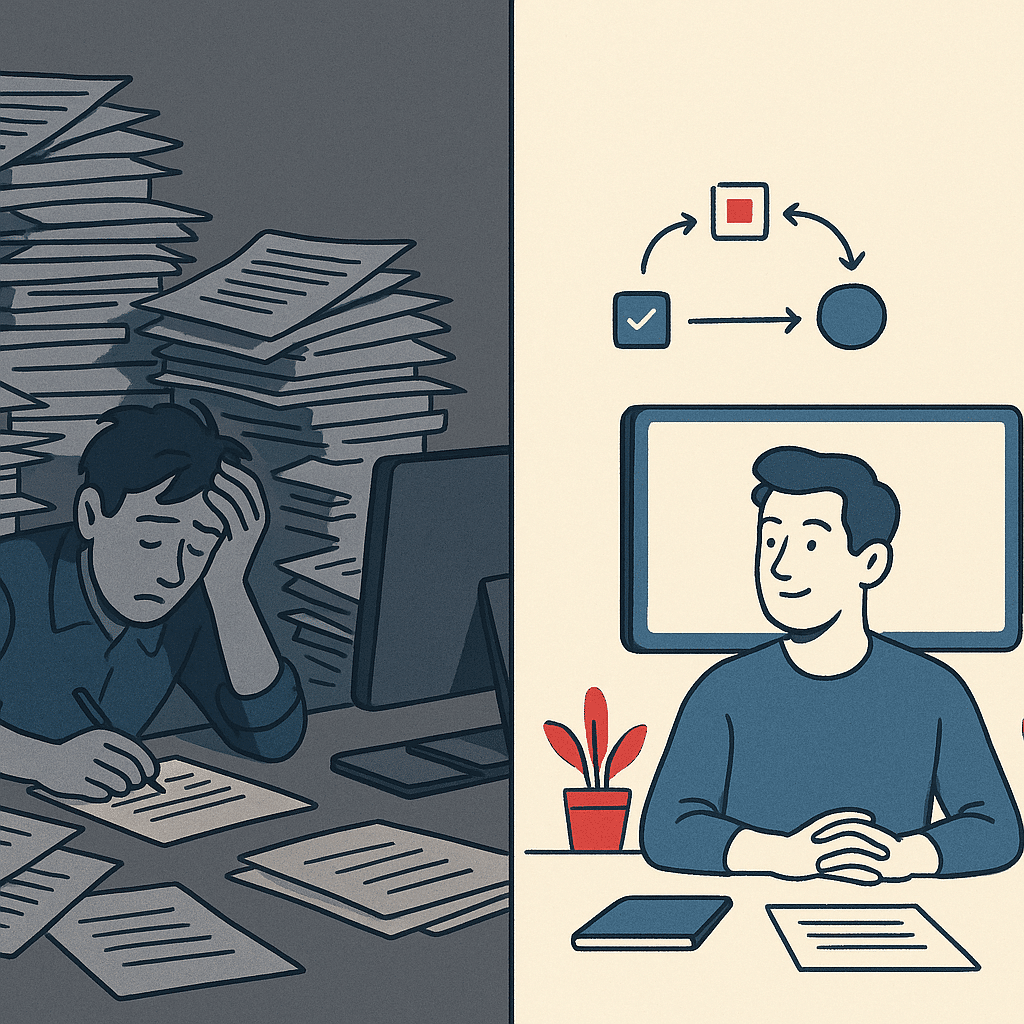
When critical information lives across multiple tools, leaders lose operational visibility. You can’t manage what you can’t see, and disconnected systems mean numbers never line up in one view. Custom ai solutions use data integration to pull those sources together, then surface them through internal tools built for how you decide. The payoff is operational visibility that’s current, not assembled by hand at month-end. With scalable systems connecting your data, ai-driven analytics flag problems while there’s still time to act, instead of explaining them after the quarter closes.
Reducing founder dependency through scalable systems
In a lot of founder-led businesses, too much knowledge and decision-making sits with one person. That’s a risk and a ceiling. When the founder is the bottleneck, the company can’t grow faster than one person’s hours. Custom-built systems and ai agents capture the rules and judgment that used to live in someone’s head, encoding them into scalable systems the team relies on. This is how ai adoption and ai-powered automation turn founder dependency into a process improvement that holds up under growth. It’s a real competitive advantage when your operations keep running without constant oversight.
If repetitive work is slowing your team down, a short discovery call with the BespokeMind team can help identify where custom ai business solutions might remove manual processes and improve operational efficiency across your business operations. There’s no pressure to commit. The goal is simply to map your bottlenecks and see whether a tailored system makes sense for how you actually operate.
Frequently Asked Questions
What exactly are custom AI business solutions and how do they work?
Custom AI business solutions are AI systems built around how your business actually operates, rather than generic tools applied to every company. They work by integrating your internal data from documents, databases, and operational systems, then training models on your proprietary processes so outputs reflect your specific workflows and decision logic.
How is a custom AI solution different from off-the-shelf AI software?
Off-the-shelf tools deploy quickly and cost less upfront, but offer predefined features and limited adaptability for specialized tasks. Custom solutions are built to fit your existing systems and unique workflows, trading higher initial time and cost for tighter integration and full control.
Why do businesses choose custom AI over pre-built tools?
Businesses choose custom AI to get tailored functionality, seamless integration with existing systems, and accuracy that comes from training on their own data. Pre-built tools are designed for broad use cases, so they often miss the specific bottlenecks a single company is trying to remove.
Are custom AI business solutions actually worth the cost and time?
It depends on the size of the problem you’re solving. Basic projects can start around $10,000, mid-market builds often run €80,000 to €150,000 over 3-5 months, and enterprise systems can exceed $1 million, so the investment makes sense when the manual work it removes is significant and recurring.
What ongoing costs should I expect after the system is built?
Maintenance typically adds 15-25% of the initial build cost per year, covering updates, monitoring, and integration upkeep. Budgeting for this from the start prevents a working system from degrading once the initial project ends.
What if my team isn't technical enough to manage a custom AI system?
A well-built custom system is designed to work the way your team already works, not to require new technical skills. The goal is less manual work and clearer visibility, with the complexity handled in the build and maintenance rather than passed to daily users.
Which AI options make sense for small and mid-sized companies?
SMBs can start with ready-made tools like Tidio for support automation (from $29/month) or HubSpot Breeze for CRM and marketing tasks, then move to custom builds as workflows get more specific. The right choice depends on whether your bottlenecks are common enough for a packaged tool or unique enough to need a tailored system.
Custom AI or a ready-made platform: which should I pick for my business?
Ready-made platforms suit fast deployment and standard needs on a limited budget, while custom AI fits unique workflows, data security requirements, and long-term scalability. Match the decision to your actual operational bottlenecks rather than to the technology itself.