

A regional accounting firm spends eleven hours a week copying invoice data from PDFs into its accounting software. The task is mind-numbing, error-prone, and invisible to clients, who only notice when a number comes back wrong. That's the kind of problem bespoke ai solutions for business are built to remove. Not by bolting on another subscription, but by designing a system around the exact way the work already flows. This article walks through what custom AI actually means, where it beats generic tools, how the build process works, and how to figure out whether your operation is ready for business automation.
What bespoke (custom) AI solutions for business actually are
Custom AI solutions are systems designed and built around how a specific business operates, instead of software you configure and hope fits. The difference sits in the starting point. A generic product starts with features it already has and asks you to adapt. A bespoke build starts with your workflow, your data, and the exceptions your team handles by instinct. It then builds those into working business automation. If you're curious about how this works in practice, it helps to look at how Bespoke Mind AI scopes and builds custom systems before deciding whether a custom approach fits your situation.
Most businesses don't need more software. They need systems that connect the tools they already run and remove unnecessary manual work through workflow automation. That's the core of what custom AI does. It might be an AI agent that reads incoming emails and routes them, a chatbot that qualifies leads against your actual sales criteria, or an internal tool that pulls numbers from three disconnected systems into one view.
Here's why that matters: generic platforms are built for the average of thousands of companies, so they handle the common 80% and ignore the 20% that makes your operation yours. That 20% is usually where the manual work piles up.
Adoption is no longer an edge case. The McKinsey Global Survey on the state of AI found that a majority of organizations now report using AI in at least one business function, with a growing share building capabilities beyond off-the-shelf pilots. Ai business solutions have moved from experiment to operational tool. The question for most teams is no longer whether to use AI, but which problems justify ai business solutions built around their own process, and which are fine left to a packaged tool.
The limitations of off-the-shelf, one-size-fits-all AI tools
Off-the-shelf ai tools are genuinely useful. For drafting an email, summarizing a document, or answering a general question, they're fast and cheap. The problem starts the moment your work stops looking like everyone else's.
One-size-fits-all ai assumes your process matches the vendor's assumptions. Your CRM has custom fields they didn't anticipate. Your pricing follows rules no dropdown menu captures. Your approval chain has three exceptions that live in a senior manager's head. A packaged tool can't see any of that, so your team ends up doing the real work manually and using the tool only for the easy 10%.
Many assume a subscription AI product will cut their manual work simply because it carries an "AI" label. In reality, the manual work often moves rather than disappears. Staff copy data in and out of the tool, correct its generic outputs, and patch the gaps between disconnected systems. That's not operational efficiency. That's a new bottleneck wearing a new logo.
There's also a ceiling on fit. You can't adjust a one-size-fits-all ai to your proprietary data or industry-specific use cases without the vendor's roadmap allowing it. Integration with your existing systems is whatever they decide to support, which is the opposite of custom ai solutions tailored to your business.
The U.S. Small Business Administration's guidance on technology adoption reminds owners that any new business software carries compliance and data-handling obligations, which generic tools rarely tailor to your situation. Packaged tools have their place. They just can't solve the underlying problem when the problem is the shape of your own workflow.
Why businesses move toward custom AI (the underlying problems it solves)
Companies rarely go looking for AI. They go looking for relief from a specific pain, and custom AI turns out to be the fix. The patterns repeat across industries.
Manual processes come first. Teams perform the same task hundreds of times a week: re-keying orders, chasing status updates, formatting reports. Disconnected systems come second. Information lives in a CRM, a spreadsheet, an inbox, and an accounting tool that never talk to each other, so someone becomes the human bridge.
Then there's founder dependency. Too much knowledge sits with one person, and the business can't scale because every decision routes through their head. Custom AI can capture some of those decision rules and make them repeatable, supporting better business decision-making across the team rather than just at the top.
The root cause underneath most of these problems is the same: business workflows grew organically, tool by tool, and no single system was ever designed to match how the work actually moves. Each tool solved one slice. The gaps between them became manual work.
Consider a retailer running three locations on spreadsheets. Each store manager tracks inventory differently, head office reconciles it by hand every Monday, and a stockout during a promotion costs a few thousand dollars in lost sales before anyone notices. The spreadsheets aren't the problem. The lack of a connected system is. Workflow automation built around their real process closes that gap and gives leadership visibility they never had.
Custom ai solutions address scaling issues, administrative overload, and reporting blind spots at once, because they're built to fit business operations as they truly run, not as a template imagines them.

Common use cases for bespoke AI (customer experience, operations, industry-specific)
The strongest custom AI projects cluster around customer experience use cases, internal operations, and industry-specific work.
On the customer experience side, an ai chatbot tuned to your actual products and sales criteria can qualify leads, answer common questions, and book calls without a rep touching it. This is different from a generic bot. It knows your inventory, your policies, and when to hand off to a human. Bespoke Mind Ai builds exactly this kind of lead-qualifying chatbot, scoped so it reflects how your sales team actually decides who's worth a call. That can improve customer engagement while cutting response time.
In operations, the wins come from automating repetitive tasks: invoice processing, document classification, data entry across systems, and status reporting. Ai agents can read, sort, and route work that used to sit in someone's queue. The result can be increased productivity without adding headcount.
Industry-specific use cases are where custom AI pulls furthest ahead. A manufacturer might use a configurator that generates instant quotes from customer specs. A logistics operation might run demand forecasting to size next month's orders, or predictive maintenance that flags equipment before it fails. A property firm might automate tenant communications and document handling.
None of these come out of a box. They depend on your data, your rules, and your systems. That's the common thread across every strong use case: the more specific and repetitive the task, the better a custom build tends to perform, because specificity is precisely what generic tools can't deliver.
Benefits of bespoke AI solutions (efficiency, time savings, better decisions)
The clearest benefit is less manual work. When a system handles the repetitive tasks that used to eat a team's day, people move to higher-value activities. That's the whole point. The goal isn't more software. It's less manual work.
Time savings can compound. Picture a distribution company where two staff spend a combined fifteen hours a week reconciling delivery records across three platforms. Automate that reconciliation and you don't just save fifteen hours. You can also reduce the errors, the delayed invoices, and the Friday scramble that came with it. Well-scoped projects have reported returns between 3 and 8x in the first year, with payback often inside two to four months, though results vary based on existing processes, business complexity, implementation, and team adoption.
Operational efficiency is the second gain, and it's a main reason business automation can pay for itself. Workflows that took days can compress into hours because the handoffs between systems happen automatically instead of waiting for a human to notice.
The third benefit, and the one most teams underrate, is better business decision-making. When your data flows into one place instead of sitting trapped in disconnected systems, leaders get more visibility. You can see which jobs are profitable, which customers are slow to pay, and where the operational bottlenecks sit, closer to real time rather than a month late.
Custom ai can also support scalable systems. Because the solution fits your workflow, growth doesn't automatically mean more hiring to handle more volume. That's a meaningful lever for business growth and a reason more companies pursue custom ai solutions, especially founder-led companies where the founder is the current bottleneck.
How AI customization works (data, training, integration into existing systems)
Ai customization isn't magic, and understanding the basics helps you judge what's realistic. There are three moving parts: data, logic, and integration.
Data comes first because AI learns from and acts on it. A custom build starts by looking at what you already have: records in your CRM, documents in shared drives, transaction history, email threads. The quality and structure of that data shapes everything downstream. Messy, inconsistent data produces messy results, which is why data quality work often takes up more of a project than people expect.
The second part is logic and training. Some custom AI uses large language models guided by your specific instructions and examples. Some uses rules you define. Many combine both. The system is shaped to make the decisions your team makes, following the criteria you actually use, not a vendor's defaults. This is what tailored to your business really means in practice.
The third part is integration and compatibility. A custom system has to connect to your existing systems, your CRM, accounting software, databases, so it reads and writes where the work already lives. Without that, you've just built another island. Bespoke Mind Ai focuses on connecting AI into the software a business already runs, so the automation fits inside current business workflows rather than forcing a migration.
Here's why the integration step matters so much: an AI that can't touch your real systems can only advise, not act. Automation that meaningfully removes manual work has to be wired into the pipes.
Key components and building blocks of a bespoke AI system
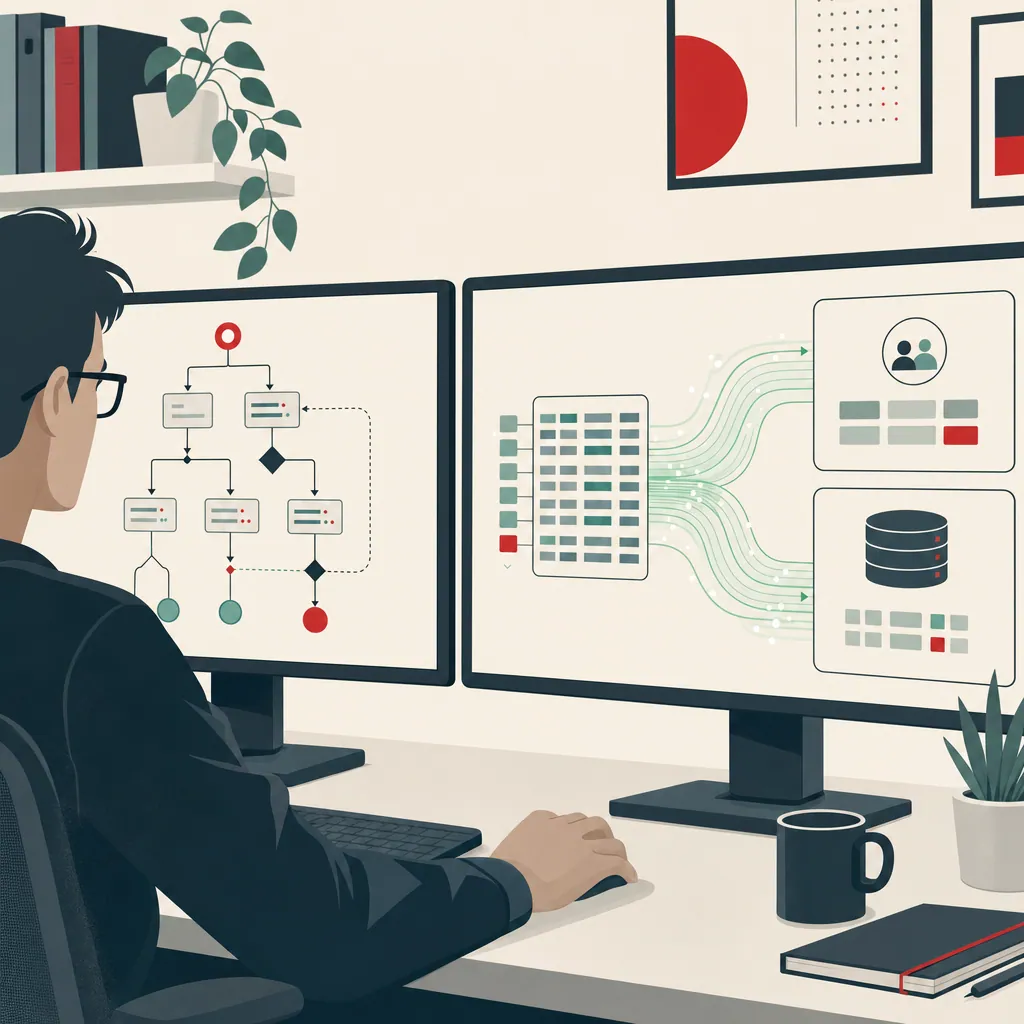
Most custom AI systems are assembled from a handful of recurring building blocks. Knowing them helps you picture what you're actually paying for.
The first is the data layer. This is where information gets collected, cleaned, and connected from your existing systems. Nothing useful happens without it.
The second is the logic or model layer. This is the decision engine, whether that's a language model, a set of rules, or both, configured to handle your specific tasks and exceptions.
The third is ai agents and automation workflows. These are the active pieces that do the work: reading an incoming request, classifying it, pulling related data, and taking an action or routing it to a person. A single system might run several agents, each handling one slice of a business process.
The fourth is interfaces, which includes internal tools and dashboards your team actually uses daily. A chatbot customers talk to, an internal tool that surfaces reports, or a configurator that generates quotes all count here. Bespoke Mind Ai's internal tool development covers this layer, building the dashboards and interfaces that turn automation into something a non-technical team can operate.
The fifth is the integration layer that ties everything to your CRM, ERP, and other systems so data moves without manual copying.
These blocks combine into scalable systems. The exact mix depends on the problem. A lead-qualification build leans on a chatbot and CRM integration, while a reporting build leans on the data layer and dashboards. The approach follows the workflow, which is the whole premise of custom-built work.
Important considerations before adopting (data quality, security, privacy, compatibility)
Before building anything, a few factors influence whether a custom AI project succeeds or stalls.
Data quality is the big one. If your records are incomplete, duplicated, or scattered, the AI inherits those flaws. You don't need perfect data to start, but you need to know its state, because cleanup is often the first real task. A common pattern: teams that skip the data audit discover halfway through that half their records are missing fields the automation depends on.
Security and privacy come next, and they're not optional. Any system touching customer records, financial data, or employee information has to handle that data responsibly. Ask where data is stored, who can access it, and how it's protected. If you operate in healthcare, finance, or any regulated field, these obligations vary by industry and jurisdiction, so confirm requirements with a qualified professional or the relevant regulatory authority before you build. For a structured way to think through these risks, NIST's AI Risk Management Framework offers a useful, vendor-neutral starting point for evaluating trustworthiness and risk before deployment. Security and privacy decisions made late are expensive to retrofit.
Integration and compatibility with existing systems is the third factor. A system that can't connect to the tools you already run forces manual bridging, which defeats the purpose. Confirm early that your current platforms expose the access a custom build needs.
Finally, consider ownership and team adoption. Will you own the finished system, or depend on the builder forever? And will your team actually use it? The best-built automation can fail if people route around it. Clear success metrics, defined and agreed before development starts, keep a project honest and measurable. These considerations don't kill projects. Ignoring them does.
How to get started with bespoke AI and take the next step
Getting started with ai doesn't mean committing to a large build on day one. It means identifying one problem worth solving and scoping it properly.
Start with the pain, not the technology. Where does your team lose the most hours to repetitive tasks? Where do disconnected systems force someone to act as a manual bridge? Where does a delay or error cost real money? Those answers point to your first project far better than any list of AI features. If you're unsure where your biggest opportunities sit, it's worth taking a moment to find out what your business can automate before committing to a direction.
The sensible first step is a discovery conversation that maps your actual workflow before anyone proposes a solution. A discovery-led process matters because the wrong starting point produces an impressive system that solves a problem you didn't have. Bespoke Mind Ai begins engagements this way, scoping the underlying business challenge first and pricing the work as a fixed outcome, so you know what you're getting before committing.
From there, a well-run project defines success metrics, confirms data and integration requirements, builds, and deploys. Fixed-price scoping can help protect you from runaway costs, and owning the finished system protects you from vendor lock-in.
Many business owners assume custom means enterprise-only and expensive. In reality, ai solutions for small businesses can work well precisely because small operations have focused, repetitive problems that scope cleanly. You don't need a technical team to begin. You need a clear problem and a partner who starts by understanding your business operations rather than selling you a platform. That's the difference between getting started with ai well and buying software you'll abandon.

How to run an AI readiness audit before you build anything
An ai readiness audit is a short, honest assessment of whether your business is set up to benefit from custom AI yet. Skipping it is how projects fail quietly. If you'd rather have this assessed professionally rather than guessing, requesting an AI readiness audit for your operations gives you a structured view of where you stand before any build decisions are made.
Start with your data. List where your important information lives and what shape it's in. Is customer data in one CRM or spread across tools? Are records consistent, or does every team member format things their own way? An ai readiness audit flags data quality gaps early, while they're cheap to fix.
Next, map your systems. Write down every platform your team touches daily and note which ones talk to each other and which don't. The disconnected systems you find are usually where the biggest automation opportunities hide, because the gaps between them are filled with manual work right now.
Then assess your processes. Which business workflows are stable and well-defined, and which change constantly? Stable, repetitive processes tend to automate more cleanly. Chaotic ones need tidying first, because automating a broken process just produces broken results faster.
Finally, gauge team readiness. Who owns the process today? Will they support a change or resist it? Adoption influences whether a system delivers time savings or gathers dust.
The output of a good audit is a ranked shortlist: a few processes where the data is decent, the workflow is stable, and the payoff is clear. That shortlist is your roadmap. An audit can save money for a simple reason: it moves the hard thinking to the cheapest phase, before any code gets written.
Mapping your operational bottlenecks to identify where AI fits first
Once you know you're ready, the next job is finding the single best place to start. That means mapping operational bottlenecks and ranking them.
Walk through one of your core business operations end to end, step by step. For each step, ask two questions: how long does this take, and how often does it happen? High-volume, high-time steps are your prime candidates. A task that takes two minutes but happens four hundred times a week outranks a task that takes an hour but happens once.
Mark where work waits. Operational bottlenecks often show up as queues: requests sitting in an inbox, approvals stuck pending, data waiting to be copied from one system to another. Those waiting points are usually where custom AI and workflow automation earn their keep, because removing a bottleneck speeds up everything downstream of it.
Also mark where errors creep in. Manual data entry, repeated copy-paste, and judgment calls made under time pressure are error-prone by nature. Automating them can cut rework as well as time.
Now rank your list by two factors: impact and feasibility. The best first project is high-impact and clean to build, usually a repetitive, rule-based task with decent data behind it. Resist starting with the most complex, most visible problem. Early wins build the trust and momentum that make bigger projects possible.
This mapping exercise also protects your budget. It stops you spending on a flashy custom ai feature that looks impressive but barely moves the needle, and points you at the unglamorous bottleneck that's quietly costing you the most. This is where bespoke ai solutions for business prove their value: not in the headline feature, but in the quiet bottleneck removed.
If repetitive work and disconnected systems are slowing your team down, a discovery call with Bespoke Mind Ai to scope your first automation can help identify where custom AI fits first and what a realistic build would involve. It's a low-pressure conversation focused on your actual business operations, not a sales pitch. If you'd rather take that step directly, you can book a free automation discovery call to walk through your workflow with someone who builds these systems for a living.
Frequently Asked Questions
What exactly makes an AI solution 'bespoke' instead of just customized software?
A bespoke AI solution is built around your specific workflows, data, and decision rules from the ground up, rather than configuring a shared platform that many other businesses also use. It encodes the exceptions and judgment calls your team currently handles in their heads, which generic tools typically can't account for.
Is a bespoke AI solution actually worth the cost compared to buying an off-the-shelf tool?
It depends on the problem: off-the-shelf tools deploy faster and cost less upfront, but they rarely fit niche workflows or proprietary data without workarounds. Bespoke builds take longer to deliver but remove the ongoing cost of forcing your operations to match someone else's software.
Can a small business realistically justify custom AI development, or is it only for large companies?
Small and mid-size businesses can see strong returns when the use case is well-scoped and repetitive, such as invoice processing or lead qualification. Reported outcomes in well-scoped projects have ranged from 3 to 8x return within the first year, with payback often inside 2-4 months.
What happens if the bespoke AI system doesn't work the way my business actually operates?
This is the core risk with any custom build, which is why scoping should start with mapping your current workflows and bottlenecks before any development begins. A fixed-price, outcome-focused engagement with clear success metrics defined upfront reduces the chance of delivering a system that doesn't match reality.
How long does it take to build a bespoke AI system for a business?
Custom builds typically take weeks to a few months, depending on integration complexity with existing CRMs, ERPs, or databases and whether fine-tuning is required. This is longer than deploying an off-the-shelf tool, which can often go live in days.
What should I check before hiring a provider to build a bespoke AI solution?
Confirm the provider defines your specific problem and success metrics before proposing a solution, rather than leading with a generic demo. Also check evidence of past work in your industry and whether you'll own the resulting system once it's built.
Do I need an in-house technical team to maintain a bespoke AI system after it's built?
Not necessarily, but you should clarify ownership and maintenance responsibility before the project starts. Many providers scope engagements so the business owns the system outright, reducing dependency on the original developer for day-to-day operation.
What kinds of business problems are actually worth solving with bespoke AI versus leaving alone?
High-volume, repetitive, or transactional tasks, like quoting, document classification, or customer response handling, tend to show the clearest returns. Low-frequency or highly variable tasks often don't generate enough volume to justify a custom build.