

A mid-sized operations team can burn 15 hours a week just copying data between tools that don't talk to each other. You don't fix that by buying more software. The real benefits of ai in business show up when process automation removes that repetitive work. It connects those systems and turns trapped data into something a leader can act on. This article breaks down where ai for business genuinely pays off, where the hype misleads, and how to tell the difference before you spend a dollar.
What AI is and how it works in a business context
In a business setting, artificial intelligence is software that learns patterns from data. It uses those patterns to make predictions, decisions, or generate outputs. In practice that means a few things. Machine learning spots trends, generative AI drafts content or summarizes documents, and AI agents carry out multi-step tasks across systems. None of it is magic. It reads the data you feed it and acts within the rules you set. Output quality tracks input directly. AI governance rules vary by jurisdiction, so check the framework where you operate. The U.S. National Institute of Standards and Technology's AI Risk Management Framework is a useful reference for how to govern these systems responsibly rather than treating them as something you can't see into. It also helps to understand where AI actually helps in business strategy before assuming it fits every situation.
Common misconceptions about AI and why hype gets in the way
The loudest myth is that AI will run your business on its own. It won't. It automates specific tasks and gets less reliable the fuzzier the job becomes. Another common assumption is that artificial intelligence replaces entire teams. In reality, it usually removes the repetitive slice of a role and leaves the judgment work with people. The hype hurts because it pushes leaders toward flashy ai tools instead of the boring, high-value fixes that save time. The Federal Trade Commission has warned businesses about exaggerated AI claims, and that skepticism is healthy. The Pew Research on public understanding of AI shows how uneven awareness still is, which fuels the confusion. Judge any AI system by the hours it removes, not the demo it dazzles with.
Increased operational efficiency and automation of repetitive work
This is where most businesses see the fastest return. Process automation handles the tasks your team does the same way every day: data entry, order routing, invoice matching, status updates. Increased efficiency shows up here first for a simple reason. Repetitive work is predictable, and predictable work is easy to automate reliably. Workflow automation connects the steps that now need someone to copy, paste, and forward. Picture a service firm where staff enter each client into four systems. Automating that handoff returns hours a week. Bespoke Mind Ai builds this around how business operations actually run, so the goal is less manual work rather than more tools. This is the essence of AI workflow automation that removes repetitive work rather than layering on complexity.

Improved decision-making through data and predictive analytics
Most businesses already collect enough data to make better calls. They just can't see it. AI-driven data analysis pulls information out of scattered systems and turns raw numbers into business intelligence a leader can read at a glance. Predictive analytics goes further. It uses patterns to flag what's likely next: which customers may churn, when inventory runs short, where cash flow tightens. Good data analysis removes the delay between data existing and data being usable, which is why decisions speed up once the numbers surface in one place. That improved decision-making is one of the clearest benefits of ai in business. To understand how it fits alongside the broader benefits of artificial intelligence in business, see decision support as one piece of a wider picture. The advantage isn't a crystal ball. It means fewer decisions made on gut feel when the numbers were there all along.
Cost reduction and measurable ROI
Cost reduction from AI comes in two forms: hours saved and errors avoided. Time savings are the easier one to measure. If a task takes 10 hours a week and automation cuts it to two, that recovered time has a dollar value you can calculate. If you want a structured method, this guide on how to calculate ROI on AI automation projects walks through the numbers. The harder savings come from fewer mistakes. A misrouted order or a duplicate payment carries real cost. Your return on investment depends entirely on picking the right target, because a low-frequency task doesn't generate enough repeated hours to pay back the build. A common pattern: teams that automate a rare task see thin return. Teams that hit a daily bottleneck get increased efficiency quickly. Deloitte's State of AI in the Enterprise survey points to targeted deployments outperforming broad, unfocused ones. Scoping the cost reduction before building separates a smart project from wasted spend. Results vary based on existing processes, complexity, and adoption.
Enhanced customer experience and personalization
Customers notice speed and relevance. AI improves customer experience by responding faster and tailoring what each person sees. Hyperpersonalization means the recommendations, messages, and support a customer receives reflect their actual behavior rather than a one-size-fits-all script. Generative AI can draft personalized responses at a scale a small team could never match by hand. The practical win is that these improvements don't require a bigger support department. They require the routine questions to be handled automatically so people focus on the complex ones. Done well, this raises satisfaction while freeing staff from repetitive inquiries that clog the queue.

Risk management, resilience, and scalability
- Manual processes may fail under increased order volume
- Key knowledge held by one person creates fragility
- AI can miss anomalies without proper setup
- Good risk management requires early problem detection
- Scalability is crucial for workforce management
Growth breaks manual processes. A workflow that works for 50 orders a day quietly falls apart at 500. This is where scalability becomes a real advantage. Automated systems handle rising volume without a matching rise in headcount, which also eases workforce management as you grow. AI supports risk management by flagging anomalies a human might miss, like an unusual transaction or a supplier pattern that signals trouble. Most fragility traces back to one person holding key knowledge in their head, so when that person is out, the process stalls. Systems that encode that process make a business more resilient when someone leaves. Good risk management isn't about eliminating problems. It's about seeing them earlier and keeping business operations steady as you grow.
Innovation, problem-solving, and competitive advantage
When your team stops spending afternoons on data entry, that time goes somewhere. Innovation and creativity are usually starved not by a lack of ideas but by a lack of hours. That freed capacity gives people room to solve harder problems and test new approaches. Competitive advantage in ai for business rarely comes from having the fanciest model. One of the clearest benefits of ai in business is operational efficiency that outpaces rivals still buried in manual work. A business that answers customers faster, spots trends sooner, and ships changes quicker can earn an edge that compounds. The approach that wins is boring on the surface and powerful underneath: remove friction, then use recovered capacity to move faster. That is where a real competitive advantage forms.
Practical ways SMBs can start using AI in operations
Start small and specific. Pick one repetitive task that eats measurable hours every week and automate it. Common early wins for small business ai tools include automated data entry between systems, email and document summarization, meeting notes, and routing inquiries. The mistake is trying to fix everything at once. AI works best when you prove value on a single narrow workflow, measure the time savings, then expand. Off-the-shelf business software covers many standard tasks well, so there's no need to build custom systems for problems generic tools already solve. The rule for a sound ai strategy: automate repetitive tasks you can name, not vague ambitions to become an AI company.

Why AI pilots fail and how to avoid wasted investment
- Lack of clear problem leads to pilot failure
- Skipping data readiness results in unreliable output
- Complex processes hinder measurement of AI success
- Tight scoping is essential for pilot survival
- Focus on measurable metrics to ensure success
AI pilots failing usually trace back to one cause: no clear problem to solve. A pilot launched to "explore AI" has no success metric, so it drifts and gets shelved. The fix is an ai strategy built on a named operational bottleneck with a measurable time or cost attached. The second common failure is skipping data readiness, then wondering why the output is unreliable. Running an AI readiness audit of your operations surfaces exactly these gaps before they sink a project. The third is picking a process so complex no one can tell whether the AI helped. Consider a mid-sized firm that spins up a pilot to automate its most tangled approval chain: with five exceptions for every rule, no one can tell if the AI saved time or added confusion, and the project quietly dies. Avoid all three by scoping tightly: one bottleneck, one metric, one clean data source. A pilot that answers "did this save the hours we predicted?" survives. One that answers "is AI cool?" does not.
Custom-built AI vs off-the-shelf software for real ROI
- Tailored to specific operational bottlenecks
- Integrates seamlessly with existing workflows
- Delivers real returns on unique challenges
- Avoids manual workarounds and inefficiencies
- Fast to deploy and cost-effective
- Suitable for standardized tasks
- May require workarounds for unique workflows
- Can lead to inefficiencies if misaligned
Off-the-shelf software is fast to deploy and cheap to start, and for standardized tasks it's often the right call. The trade-off shows up when your workflow doesn't match the tool's assumptions. Then your team builds workarounds, and those workarounds become the new manual work you were trying to remove. Custom AI solutions built around your operations make sense when your operational bottlenecks are specific to how your business runs. Take a common case: a distribution company juggling three incompatible order systems. AI agents can bridge a gap no generic tools fit, so a custom integration can deliver the real return. Bespoke Mind Ai builds custom AI solutions and internal tools fitted around a client's actual workflow rather than forcing the team to adapt.
How to assess AI readiness before adopting
AI readiness comes down to three questions. Do you have a clearly defined problem with a measurable cost? Is your data accessible and reasonably clean, or trapped in silos? Does your team have the appetite to change how it works across daily business operations? Skip any of these and value stalls, because AI can only act on data it can reach and processes people will actually use. A readiness assessment maps your data, identifies the highest-value bottlenecks, and estimates the likely return before you commit budget. Bespoke Mind Ai offers AI readiness audits and project scoping that surface these gaps early, so ai for business builds on solid ground. The point is to spend on the right problem, not to spend more.
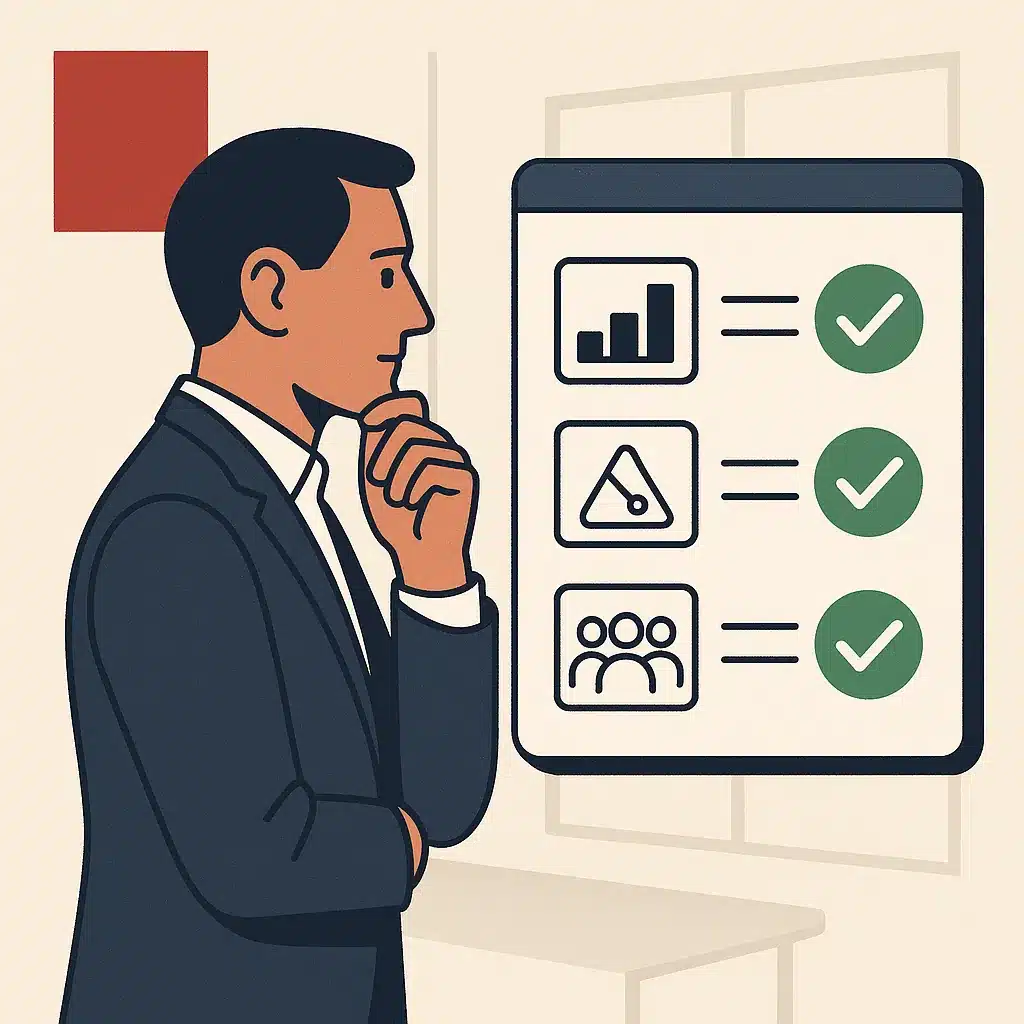
The benefits of ai in business are real, but they follow the fit between the tools and your actual workflows, not a generic checklist. Successful ai adoption depends on that fit, and so does the operational efficiency you gain. Bespoke Mind Ai starts every engagement with a discovery call to identify where workflow automation and custom AI can remove manual effort, and where they can't. You can book a discovery call to map your operational bottlenecks and get a practical view of what's worth building.
Frequently Asked Questions
What are the main advantages of AI in business?
The most consistent gains come from automating repetitive manual work, connecting disconnected systems, surfacing data as usable insight, reducing errors, and freeing staff for higher-value tasks. In practice, the biggest advantage is fewer hours lost to admin and handoffs rather than any single 'smart' feature.
What is the 30% rule in AI?
The 30% rule is a rough guideline that AI tends to reliably automate or accelerate around 30% of the tasks in a given role or workflow, rather than replacing the whole job. It's a useful expectation-setter: target the repetitive 30% first, and keep human judgment on the rest.
Which jobs are most likely to survive AI?
Roles built on human judgment, relationships, and physical or complex problem-solving tend to hold up best, think skilled trades, healthcare providers, senior operations and strategy leaders, client-facing sales, and creative direction. AI usually reshapes these jobs by removing admin, not eliminating the role.
What are the disadvantages of AI in business?
Common downsides include upfront setup cost, poor results when data is messy or siloed, over-automating processes that still need human review, and tool sprawl from adding software instead of fixing the underlying workflow. Most of these are avoidable with a readiness audit before you build.
Is AI actually worth it for a small or mid-sized business?
It's worth it when you can point to specific repetitive tasks eating measurable hours each week, that's where ROI shows up fastest. If you can't name the bottleneck or the time it costs, that's a signal to scope the problem before spending on AI.
What if our data and systems are a mess, can we still benefit from AI?
You can, but data readiness usually needs to come first, because AI amplifies whatever quality your data already has. Starting with a small automation on one clean workflow often delivers value faster than a large project on disconnected systems.
Do we need custom AI, or is off-the-shelf software enough?
Off-the-shelf tools work well for standard, common tasks, but they force your team to adapt to the software. Custom AI makes sense when your workflows are specific enough that generic tools create workarounds instead of removing them.
How quickly do the advantages of AI in business show up?
Narrow, well-scoped automations often show time savings within the first few weeks of use, while broader intelligence and reporting benefits build over months as data accumulates. Starting small gives you a measurable result before committing to larger builds.