
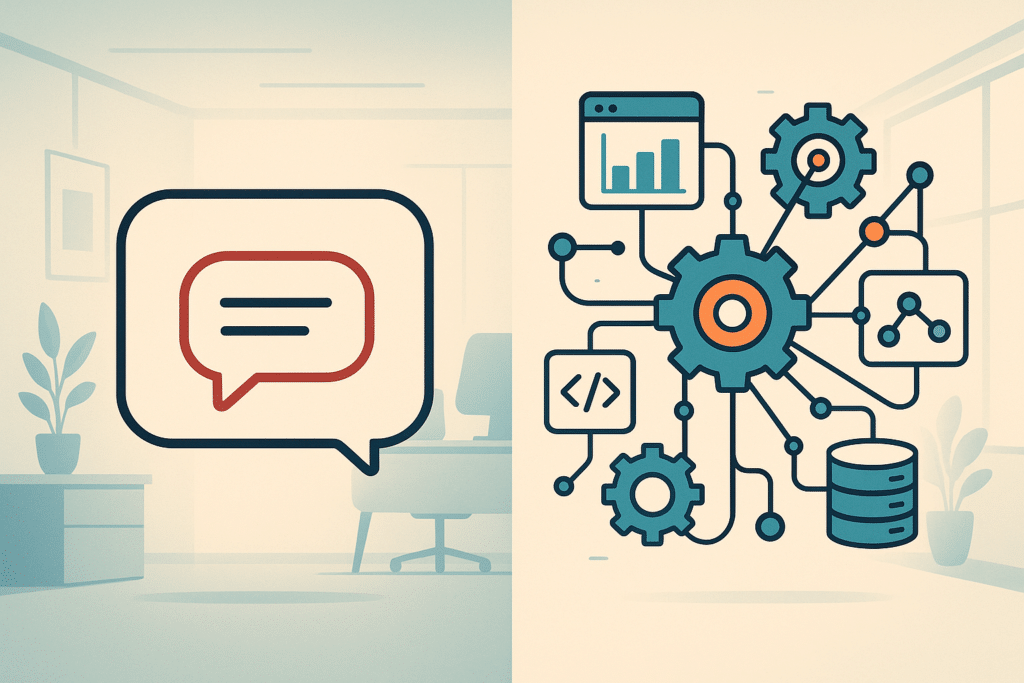
Plenty of logistics companies have a “chatbot” that answers order-status questions all day. What they really need is something to pull the order, update the warehouse system, and email the customer without a person touching three tabs. That gap is the whole story behind ai agent vs chatbot. Most teams get sold the wrong side of it, they buy a talker when the problem needs a doer. This article breaks down what each technology does, where each one fits, and how to tell a real agent from marketing.
Definition of an AI chatbot
So what is a chatbot, in plain terms? A chatbot is software built to hold a conversation and answer questions. Most run on set responses, matching what you type to a prepared reply. Newer versions use conversational AI to sound more natural, but the job stays the same: understand a message and respond to it.
An ai chatbot handles things like "Where's my order?" or "What are your hours?" It talks. It doesn't act. According to IBM's overview of chatbots, a chatbot simulates human conversation to answer questions and provide information. That is exactly where its usefulness starts and stops.
For customer service, that's often enough. The value shows up as resolution rate on common questions, freeing your team from repetitive replies and lifting productivity. The limit is structural: a chatbot can't finish a task that spans multiple systems, because it has no way to act inside them. It reads and replies; it does not read, decide, and write. That single constraint is why so many support "solutions" leave the manual work untouched behind the scenes.
Definition of an AI agent
Now, what is an ai agent? An AI agent is software that can plan and complete tasks to reach a goal, not just answer a question. It works through a request step by step, connects to the tools or systems that do the work, and checks whether the outcome was reached. Think of it less as a talker and more as a doer.
Where a chatbot replies, an ai agent acts. It might read an email, pull data from a CRM, update a record, and send a confirmation, all in one run. According to McKinsey's explanation of AI agents, agents can run complex, multi-step workflows with limited human oversight. That's the practical difference that matters for business operations.
That capability is what makes agents useful for task automation across disconnected systems. It's also why the term gets misused, which we'll get to. When a founder-led business pays people to shuttle data between tools, the underlying problem is rarely a lack of answers. It's a lack of action, and that's the gap business automation is built to close.
Side-by-side comparison of AI agents vs chatbots
- Primary job: Answer questions
- Behavior: Reply
- Scope: Single conversation
- Autonomy: Low
- Best fit: FAQs, support triage
- Primary job: Complete tasks
- Behavior: Plan and act
- Scope: Multi-step, multi-system
- Autonomy: Higher, with oversight
- Best fit: Workflow automation
Here's a clean ai agents vs chatbots comparison you can hold in your head. A chatbot receives a message and returns a message. An ai agent receives a goal and returns a completed outcome. One converses, the other coordinates.
| AI Chatbot | AI Agent | |
|---|---|---|
| Primary job | Answer questions | Complete tasks |
| Behavior | Reply | Plan and act |
| Scope | Single conversation | Multi-step, multi-system |
| Autonomy | Low | Higher, with oversight |
| Best fit | FAQs, support triage | Workflow automation |
This comparison isn't about which is "better." A chatbot that answers 500 common questions a day is doing real work. An ai assistant that closes tickets end to end is doing different work. The mistake is buying one when your problem needs the other, and the cost is measured in the manual work you thought you were removing but didn't.
Core functional differences (reasoning, memory, action, autonomy)
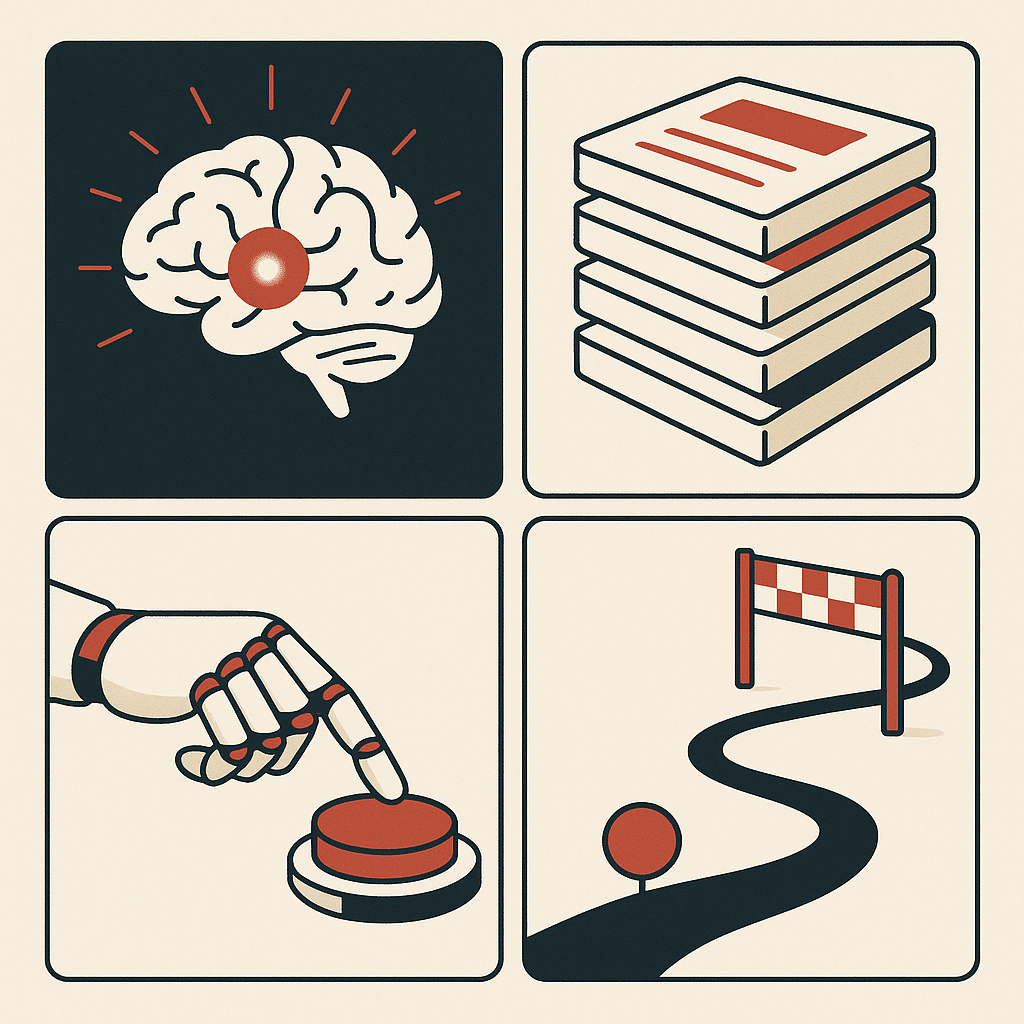
The core functional differences come down to four things: reasoning, memory, action, and autonomy. A chatbot using set responses does little planning. It matches inputs to outputs. An ai agent works out what steps are needed, in what order, based on context.
Memory is the next split. Chatbots often forget once the chat ends. Agents can carry context across steps, so a decision made early informs a later action. This works because the agent remembers information between actions, that continuity is what lets it handle a full workflow instead of a single disconnected exchange.
Then there's action and autonomy, the biggest of the core functional differences. The real dividing line is that an agent decides and does, while a scripted bot only responds. Autonomy without controls becomes risk, so reliable agents keep humans in the loop on high-stakes steps. Frameworks like the NIST AI Risk Management Framework offer authoritative guidance on deploying autonomous systems responsibly and managing the operational risk that comes with them.
Use cases for chatbots vs AI agents
- Answering FAQs on a website
- First-line customer service triage
- Collecting basic info before a handoff
- Guiding users to the right page or document
- Processing an order across systems
- Compiling a weekly report from systems
- Reconciling data entry between tools
- Routing and updating support tickets end to end
The clearest use cases split by how many steps the work takes. Chatbots win when the job is answer-and-done. Agents win when the job is do-a-sequence-and-finish.
Good chatbot use cases:
- Answering FAQs on a website
- First-line customer service triage
- Collecting basic info before a handoff
- Guiding users to the right page or document
Good AI agent use cases:
- Processing an order across a CRM, inventory, and email
- Compiling a weekly report from disconnected systems
- Reconciling data entry between two internal tools
- Routing and updating support tickets end to end
The pattern is simple. If the value is a good answer, you likely want an ai chatbot. If the value is a completed process, you want an agent. Many teams force a chatbot into agent-shaped work, then wonder why the manual work never went away. The reason is straightforward: a tool that only talks cannot complete a task that requires acting inside three or four systems, no matter how well it talks.
When to use which technology (decision guidance)
Start with the task, not the tool. Ask one question: does this end in an answer, or in an action? If it ends in an answer, a chatbot is usually the cheaper, faster fit. If it ends in an action across systems, you're looking at an agent.
Next, count the steps and the systems. A single-step, single-system task rarely needs an agent. A multi-step task spanning disconnected systems is where business automation earns its keep by removing manual work and cutting operational bottlenecks.
Many assume a smarter chatbot will eventually handle their whole workflow. In reality, if the work requires acting inside your systems, no amount of conversation quality replaces the ability to act. Match the technology to the shape of the problem. You avoid paying for capability you don't use, and you avoid buying a talker when you needed a doer. This is the heart of the ai agent vs chatbot decision: it isn't about which is more advanced, it's about which matches the work in front of you.
Business impact and workflow automation
The business impact of getting this right shows up in time savings and fewer handoffs. A chatbot improves operational efficiency at the front door by handling routine questions. An agent improves operational efficiency deeper in your business operations by finishing tasks people used to do by hand.
Here's why this matters: most operational bottlenecks aren't caused by slow answers. They're caused by manual work moving data between tools. That's where workflow automation and ai-driven workflows drive real process improvement. The agent does the copying, checking, and updating that quietly eats hours, and each step of process improvement can add up to higher productivity over time.
At one growing services firm, staff spent roughly ten hours a week re-keying client data between a booking tool and their invoicing system. Every mismatch meant a delayed invoice and a follow-up email, so the manual work created more manual work downstream. An agent that handled that transfer removed the re-keying and freed the team for higher-value tasks. Business automation like this rarely looks flashy. It just gives you back the hours, and better visibility into your operations. This is the kind of custom-built work Bespoke Mind focuses on: systems built around how your business actually operates, not off-the-shelf software you bend to fit.
The agent-washing problem (fake AI agents)
Here's the uncomfortable part. A lot of products labeled "agents" are chatbots with a new sticker. This is agent-washing: marketing a scripted bot as an autonomous system because "agent" sells better right now.
How do you spot agent-washing? Ask what the thing actually does when no human is watching. If the honest answer is "it replies with information," it's a chatbot, however it's branded. A real agent takes action across your systems and reports back on the outcome.
The root cause is incentive. "AI agent" commands attention and budget, so simple scripted bots get rebranded overnight. This matters for buyers, because you can pay agent prices for chatbot capability and never remove the manual work you set out to eliminate. Judge these ai systems by the tasks they complete, not the label on the box. Whether it decides and acts or only follows a script is the test that cuts through the noise.
Real-world examples of chatbots and agents
Concrete examples make the line obvious. A website support widget that answers shipping questions is a chatbot. It's helpful, it lifts resolution rate on common queries, and it never touches your backend.
Now the agent side. A support agent that reads an incoming ticket, checks the customer record, issues a refund within set limits, and closes the ticket is doing task automation across multiple systems. Same customer service department, very different tool.
Another example: a reporting ai assistant that logs into your analytics tool, your CRM, and your finance sheet every Monday, then produces a single summary. A chatbot can describe last week's numbers if you ask nicely. An agent goes and assembles them. These custom-built systems handle the connective work between disconnected systems that used to need a person, spreadsheets, and an hour of copy-paste every week.
A quick word on where this goes wrong in practice. One operations manager rolled out a "reporting agent" that pulled numbers correctly for a month, then silently skipped a data source after a tool changed its login screen. Nobody noticed until a leadership meeting used a report missing a full revenue line. The lesson isn't that agents fail, it's that they need logging and a human checkpoint on the outputs that decisions depend on.
Evolution from conversational AI to autonomous systems
The shift from conversational AI to autonomous systems didn't happen overnight. Early chatbots followed strict scripts. Then language models made conversation far more natural, and the ai chatbot got genuinely useful for support and information.
The next step was giving these models access to tools. Once a system could not just talk about an action but perform it, the ai agent emerged. That's the real evolution: from responding to working through a task, from scripting to acting.
What hasn't changed is that autonomy needs guardrails. As systems moved toward making decisions on their own, the sensible pattern became keeping humans on the important calls. The reason is simple: an autonomous system acting on a wrong assumption can repeat that mistake across every run, so a checkpoint on high-stakes steps limits how far a single error travels. The direction of travel favors more capable ai tools for business, but the goal stays practical: build scalable systems that reduce manual work and improve productivity while your team keeps control of what matters.
Cost, implementation effort and total cost of ownership
Cost is where the ai agent vs chatbot decision gets real. A chatbot is usually cheaper to stand up. It answers questions, and off-the-shelf options exist that work reasonably well out of the box.
An agent costs more, mostly in setup, not licensing. The expense sits in connecting the agent to your CRM, your inventory tool, your email, and whatever else the workflow touches, then testing that it behaves correctly across each step. That integration work is real, and it's worth being honest about it upfront rather than discovering it mid-project.
But total cost of ownership tells a fuller story. A chatbot that only deflects questions has a low ceiling on what it can save. An agent that removes ten hours of manual work a week can keep returning that time and lifting operational efficiency long after setup. The right way to weigh it is not sticker price, it's the manual work removed against the effort to build and maintain the system. For a founder-led business, the deciding factor is usually the size of the operational bottleneck the agent removes, not the tool's monthly fee.
To keep total cost of ownership honest, plan for maintenance. Systems that touch other systems need occasional attention when those tools change, so budget a little ongoing time for that upkeep rather than treating the build as a one-time cost.
Custom-built systems vs off-the-shelf AI tools for operations
Off-the-shelf AI tools are built for the average business, which means they rarely fit yours exactly. You end up adjusting your workflows to match the software instead of the software matching how you actually operate. Custom-built systems flip that logic. They connect your existing tools, follow your real processes, and remove the manual steps that generic products ignore. The trade-off is straightforward: off-the-shelf gets you moving fast but hits a ceiling, while custom takes more upfront work and keeps paying back as you scale. The right choice depends on how specific your operational problems really are.
Choosing the right AI approach to reduce manual operational work
Start with the work, not the technology. Map where your team spends hours on repetitive tasks, then ask what outcome you actually want to change. Some problems need nothing more than a simple automation connecting two systems. Others need AI to read, classify, or decide at a scale humans cannot match. The mistake is reaching for the most advanced option when a basic workflow would do the job cheaper and more reliably. Match the approach to the size and shape of the problem. A well-placed automation that quietly removes ten hours a week beats an impressive tool nobody trusts to run unsupervised.
Frequently Asked Questions
Is ChatGPT an AI agent or a chatbot?
By default, ChatGPT is a chatbot: it responds to prompts but doesn't take independent action. It becomes closer to an AI agent when connected to tools that let it complete multi-step tasks, like retrieving data or triggering workflows, without constant human input.
What's the actual difference between an AI agent and a chatbot?
A chatbot answers questions and holds conversations, while an AI agent can plan and execute tasks across your systems to reach an outcome. In practice, a chatbot tells a customer their order status; an agent looks it up, updates the record, and sends the confirmation.
What are the main types of AI agents?
AI agents are commonly grouped into five types: simple reflex, model-based reflex, goal-based, utility-based, and learning agents. Most business automation uses goal-based or learning agents, since they can handle changing conditions in workflows like order processing or reporting.
Are AI agents just bots with a new name?
No. Bots follow fixed rules and scripts, while AI agents make decisions, use multiple tools, and adapt to context to complete a task end to end. The difference matters when work involves several steps across disconnected systems rather than a single scripted reply.
Is an AI agent actually worth it for a small business?
It's worth it when you have repetitive, multi-step tasks eating team hours, like manual data entry between tools or routine reporting. If your problem is only answering common questions, a chatbot is cheaper and sufficient, so the value depends on the underlying process, not the technology.
What if an AI agent makes a mistake in a live workflow?
Well-built agents include approval steps, logging, and limits so a human reviews high-risk actions before they run. The goal is to remove manual work on predictable tasks while keeping visibility and control, not to hand over decisions blindly.
Who are the big AI agent providers?
The frequently cited players include OpenAI, Google, Microsoft, and Anthropic, which supply the underlying models. For business use, the real work is connecting those models to your specific tools and processes, which is where custom-built systems come in.
Do I need to be technical to use AI agents in my operations?
No. The point is that the system works the way your team already works, so staff interact with normal tools while the agent handles the steps behind the scenes. A custom setup should hide the technical complexity and focus on the operational outcome.