
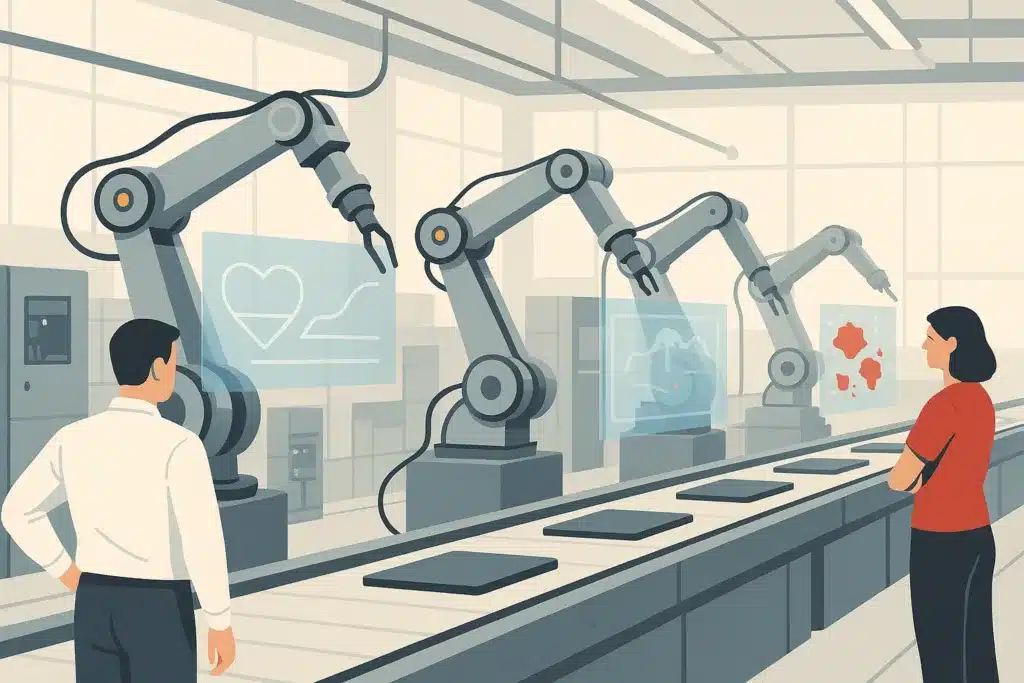
A single unplanned line stoppage can cost a mid-size plant thousands of dollars an hour. Most of those stoppages were predictable. That gap between "we could have seen it coming" and "we didn't" is exactly where ai for manufacturing earns its keep. This article breaks down what the technology actually does on the shop floor. It covers which applications remove real manual work, and which ones are still marketing noise you can safely ignore.
What AI in manufacturing actually means (plain-English definition)
Strip away the buzzwords and ai in manufacturing means software that learns from data instead of following pre-written rules. A traditional controller repeats an identical task forever. An AI system watches sensor readings, images, and production logs, then makes predictions: this bearing will fail next week, this weld looks off, demand will spike in March. That shift to data-driven decisions separates artificial intelligence in manufacturing from ordinary automation. It sharpens production processes along the way. The U.S. Department of Energy's advanced manufacturing resources track how these approaches are applied across the manufacturing industry to cut energy use and improve throughput.
Why AI matters for manufacturing operations and manual work
Manufacturing runs on repetitive tasks: logging readings, inspecting parts, chasing spreadsheets, rescheduling when a machine goes down. Every hour spent on that manual work is an hour not spent solving harder problems. The reason ai for manufacturing matters is simple. It takes the predictable, high-volume decisions off people's plates and frees them for judgment calls. That can lift operational efficiency without adding headcount. According to the McKinsey Global Institute's work on automation, a large share of manufacturing activities are technically automatable using current technology. The broader U.S. Bureau of Labor Statistics data on the manufacturing sector shows just how many workers are tied up in these repetitive roles, which is why so many operations leaders are reviewing where their teams still do manual work by hand. If you want a clearer picture of the specific tasks worth targeting, you can find out what your manufacturing operations can automate before committing to any tooling.
The core technologies behind manufacturing AI (machine learning, computer vision, NLP)
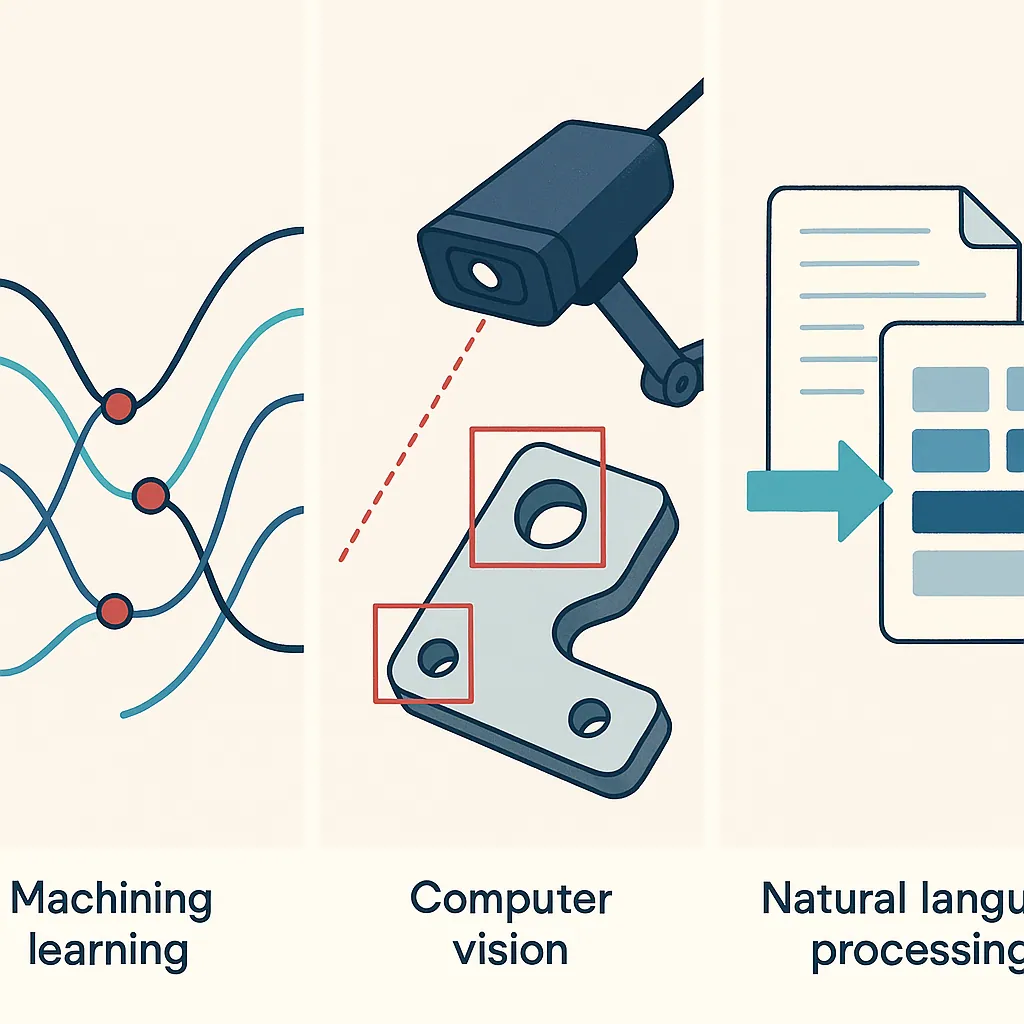
Three technologies do most of the heavy lifting. Machine learning finds patterns in numeric data: vibration, temperature, and cycle times. It uses them to forecast what happens next. Computer vision reads images and video, spotting scratches, misalignments, or missing components faster and more consistently than a tired human eye. Natural language processing handles the messy text: maintenance logs, operator notes, and supplier emails, turning them into searchable data. This kind of data analysis feeds systems that handle complex, unstructured inputs. Most real deployments combine these rather than relying on one, because a single technique rarely covers both the numeric signals and the unstructured text a live line produces. That combination is what makes ai systems flexible on a live shop floor.
Predictive maintenance and reducing unplanned downtime
Predictive maintenance is the application most factories start with, and for good reason. Instead of fixing machines on a calendar or after they break, a machine learning model watches sensor data and flags a machine failure before it happens. It works because failing components change their behavior first: vibration, heat, or current drift away from a healthy baseline well before the part actually gives out. The model learns the normal signature of a healthy machine, then alerts you when readings drift toward known failure patterns. That lets teams schedule repairs during planned windows and reduce downtime that would otherwise stop a line. Picture a stamping shop that loses $8,000 every time a press seizes mid-shift. Catching two of those events a year could pay for the system many times over. It also cuts waste from scrapped in-progress parts.
Quality control and defect detection with computer vision
Manual visual inspection is slow, inconsistent, and expensive. People miss defects late in a shift, and standards drift between inspectors. Computer vision fixes this by inspecting every part in real time against a learned reference. The camera catches surface flaws, dimensional errors, and assembly mistakes that a human eye passes over at line speed. Many assume this quality control setup only works for high-volume, identical parts. In reality, modern models handle custom runs and varied products once trained on enough examples. Strong quality control also feeds data back into production processes. Recurring defects get traced to their root cause instead of just being caught and tossed. Looking at how businesses actually use AI to remove manual work makes it clear that inspection is one of the fastest wins, since the inputs and outputs are both easy to measure.
Supply chain, inventory, and demand forecasting
Supply chain management is where bad guesses get expensive. Order too much and cash sits in a warehouse. Order too little and a line stalls waiting on parts. AI improves demand forecasting by learning from sales history, seasonality, lead times, and even external signals. It then produces forecasts that can beat gut feel. Better forecasts feed smarter inventory management, keeping stock lean without stockouts. Consider a fabrication shop that reorders steel on a fixed monthly schedule: a demand model that reads seasonal order patterns would flag a March surge in January, so the buyer isn't scrambling for stock when the line is already running short. Predictive analytics across supply chain management also flags supplier delays early, giving buyers time to react. The payoff is real-time insights into what to make, buy, and hold, plus tighter inventory management that reduces both carrying costs and firefighting.
Production planning, simulation, and digital twins
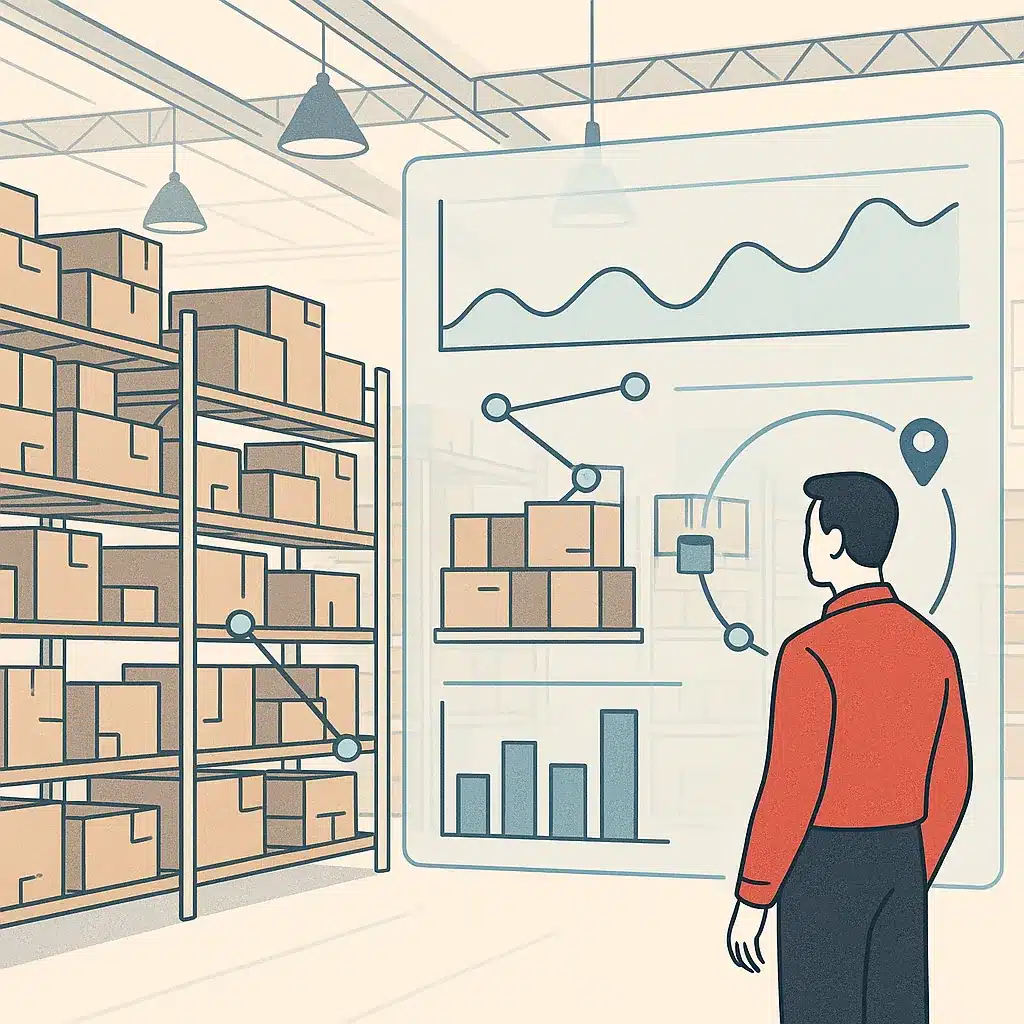
Production planning gets harder as product mix and order volume grow. Digital twin technology helps by creating a live virtual copy of a line or process, fed by real sensor data. Planners run "what if" scenarios on the model: change the schedule, add a shift, or reroute a bottleneck, and see the outcome before touching the real floor. That means fewer costly mistakes in the physical world. Digital twin technology also supports better production planning by simulating how a change to one station ripples through the whole flow. Efforts like NIST's smart manufacturing operations program show how connecting systems and standardizing data make these simulations trustworthy. Combined with data analysis of past runs, it turns planning from educated guessing into tested decisions. That tightens manufacturing processes over time.
Cobots, generative design, and shop-floor automation
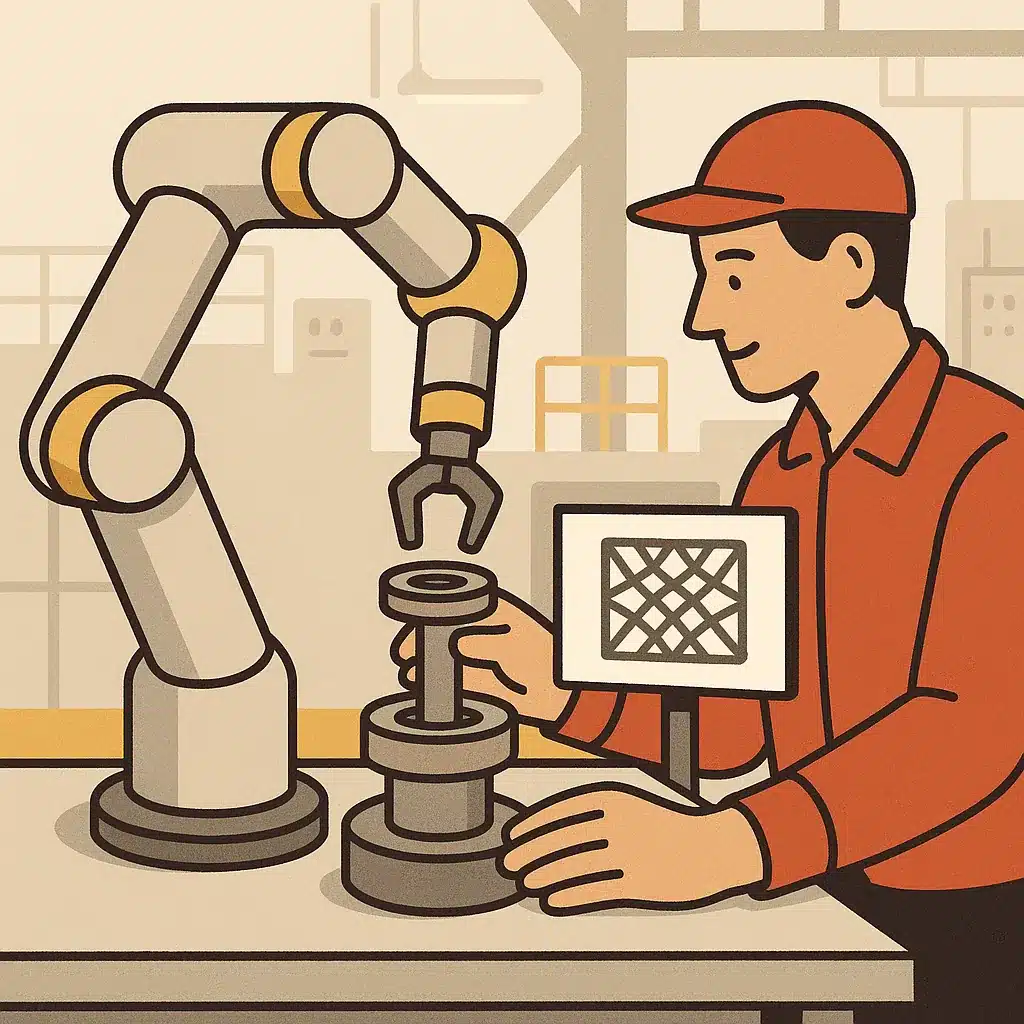
Cobots, or collaborative robots, work alongside people rather than behind safety cages. They handle repetitive lifting, loading, and assembly tasks while operators manage exceptions and quality. On the design side, generative design uses AI to propose part geometries that hit weight, strength, and cost targets a human might never sketch. This matters most for custom manufacturing, where every part is different. Together with broader process automation, these tools reduce the manual work that wears teams down. The point of shop floor automation is not replacing people. It is removing the dull, physically taxing parts so skilled workers spend time where their judgment counts.
What removes manual, repetitive work vs. what is just hype
- Predictive maintenance improves equipment reliability.
- Computer vision inspection enhances quality control.
- Automated scheduling optimizes production flow.
- Demand forecasting increases inventory efficiency.
- Promises of fully autonomous factories are unrealistic.
- AI can’t fix disconnected systems without integration.
- Starting with technology over bottlenecks leads to failure.
- Vague vendor pitches should be treated with suspicion.
Here is the blunt version. What genuinely removes repetitive tasks: predictive maintenance, computer vision inspection, automated scheduling, and demand forecasting. These have clear inputs, measurable outputs, and proven ai use cases that can lift operational efficiency on real production lines. What is mostly hype: promises of a fully autonomous "lights-out" factory that runs with zero people, or AI that magically fixes disconnected systems without integration work. The root cause of failed projects is usually starting with the technology instead of a specific bottleneck, because a model trained on messy, disconnected data just automates the existing confusion. Real workflow automation solves one painful, well-defined problem first. If a vendor can't tell you which manual task disappears and how you'll measure it, treat the pitch with suspicion.
How SMB and mid-size manufacturers can start (readiness and where custom systems fit)
You do not need a massive Industry 4.0 program to begin. Start with one high-cost, repetitive problem, then check what data you already have. Many smaller plants are surprised that their existing machines produce enough signal to feed a model and reduce downtime, with no full retrofit into smart factories required. A short readiness assessment sorts real opportunities from noise, and running an AI readiness audit for your operations is the cleanest way to see which siloed data sources can actually feed a model. Adoption timelines, costs, and even safety and labor rules vary by state and region. Confirm requirements with the relevant authorities before committing. This is where custom ai for manufacturing, built as custom AI systems built around how your plant actually operates, fits better than generic tools. Off-the-shelf software rarely matches how your line actually runs, especially once industrial sensors and workflow automation enter the picture.
If manual work is slowing your team and you want to know which tasks are genuinely automatable, Bespoke Mind Ai scopes custom ai solutions and process automation around how your operation actually works. A no-pressure discovery call to map your automation opportunities is a practical first step to find a high-value bottleneck to tackle. Results vary based on existing processes, business complexity, implementation, and team adoption.
Frequently Asked Questions
What exactly is AI in manufacturing and how does it work?
AI in manufacturing uses technologies like machine learning, computer vision, and generative AI to monitor and optimize production across factories and supply chains. It works by collecting data from sensors, cameras, and machines, then detecting patterns to predict failures, catch defects, and improve output.
Which AI is best for manufacturing?
There is no single best AI:the right choice depends on your use case, since predictive maintenance relies on machine learning, quality inspection uses computer vision, and scheduling or reporting often use generative AI or AI agents. Most factories combine several, which is why custom-built systems scoped around your actual operations tend to outperform off-the-shelf tools.
How does AI actually improve efficiency and quality on the factory floor?
AI analyzes sensor data to anticipate machine breakdowns before they happen, cutting unplanned downtime:Rockwell Automation used this approach to raise uptime on legacy machines. Computer vision systems also inspect parts in real time, catching defects human inspectors miss and lowering scrap rates.
What's the difference between traditional automation and AI-driven manufacturing?
Traditional automation uses fixed, deterministic rules in PLCs, robotic arms, and conveyors to repeat the same programmed tasks. AI-driven manufacturing uses data-driven algorithms that adapt to variability, predict failures, and handle changing or unstructured conditions rather than following rigid instructions.
Is AI for manufacturing actually worth it for a small or mid-sized factory?
It can be, but the payback depends on your readiness and picking the right use case:one small machine shop reported 380% ROI, saving roughly $164,000 a year by automating scheduling and inventory. The businesses that succeed start with a specific bottleneck and a clear ROI target rather than adopting AI broadly.
What if my factory runs on old legacy machines without modern sensors?
Legacy equipment is a common starting point, not a blocker:Rockwell Automation connected data from older machines to enable predictive maintenance and measurable productivity gains. The practical first step is an AI readiness assessment to identify which existing data sources can feed a model before investing in new hardware.
Which manufacturing jobs are most affected by AI?
AI most directly changes repetitive, rules-based roles like manual visual inspection, routine scheduling, and data entry, since these are the easiest to automate. Roles requiring judgment, exception handling, and oversight of AI systems typically shift rather than disappear:operators move toward supervising and interpreting the technology.
Where should a manufacturer start with AI to see ROI fastest?
Predictive maintenance and computer-vision quality control are the most mature, widely deployed use cases with proven returns, per IBM and Snowflake. Start with one high-cost, repetitive problem:like unplanned downtime or defect leakage:rather than trying to automate the whole operation at once.